At a Glance
- Understanding what the best AI governance tools are and why they matter in 2026.
- Key capabilities enterprise organizations expect from governance platforms.
- Comparative overview of leading platforms including Adeptiv AI, OneTrust, Microsoft, IBM, HolisticAI.
- How to select, implement, and scale an AI governance tool aligned with risk and compliance frameworks.
- Real-world case studies and adoption statistics illustrating ROI and impact.
- FAQs addressing common questions about the best AI governance tools and their strategic role.
Introduction
As enterprises increase their reliance on artificial intelligence, the need for robust oversight mechanisms becomes more than a regulatory tick-box—it is a strategic imperative. The best AI governance tools have emerged as the backbone of responsible enterprise AI infrastructure, empowering organizations with the visibility, controls, and auditability required to deploy and manage AI at scale. According to recent industry research, more than 75% of large enterprises plan to adopt dedicated AI governance platforms by 2026, driven by regulatory activity, operational complexity, and stakeholder expectations. In this evolving landscape, selecting the right and the best AI governance tools is no longer optional—it is foundational to innovation, trust, and competitive advantage. In this article, we will explore what these tools do, compare major platforms (including Adeptiv AI), and outline what to look for in your governance-tool strategy.
What Are AI Governance Tools?
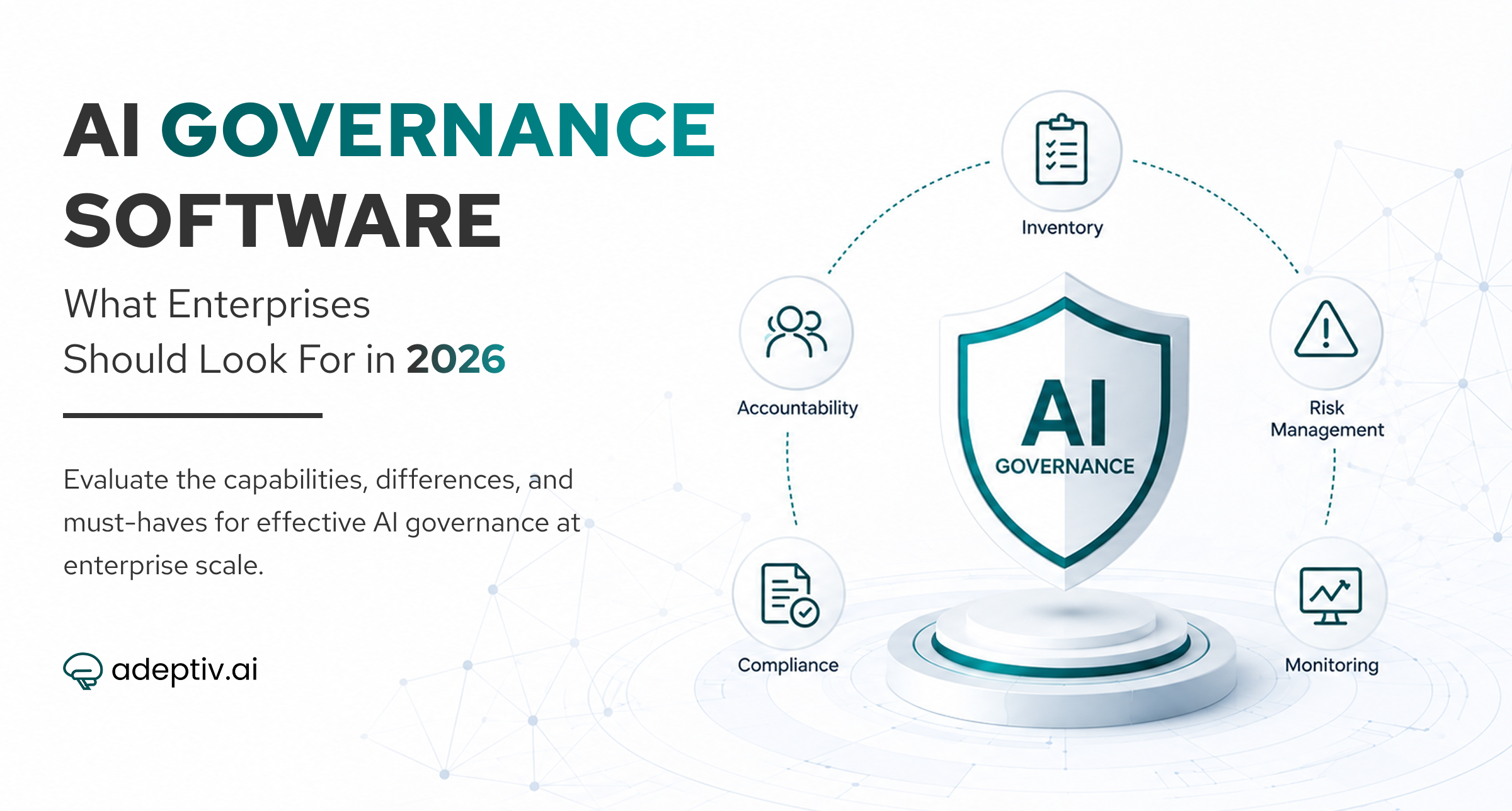
AI governance tools are specialized software platforms designed to oversee the lifecycle of artificial intelligence—from model development and deployment through monitoring, compliance, and audit. They extend beyond typical data science or MLOps tools by embedding policy, ethics, transparency, and risk-management workflows directly into AI operations.
Key capabilities typically include:
- Model registry and tracking (who built it, when, how).
- Risk assessment and classification (high-risk vs limited-risk systems).
- Policy mapping and controls enforcement (data governance, access, drift detection).
- Transparency artifacts (model cards, dataset documentation, decision logs).
- Monitoring and alerting (fairness metrics, performance drift, security anomalies).
- Audit-ready reporting and external compliance support (for frameworks like the EU AI Act, NIST AI RMF).
While a data platform might simply monitor model performance, the best AI governance tools take a unified AI governance approach, ensuring performance, risk, and compliance are managed together with business strategy. For example, platforms like OneTrust and IBM emphasise policies and controls, whereas others, such as HolisticAI, focus on model lifecycle automation. At Adeptiv AI, we combine these elements into a unified governance framework—helping enterprises build AI systems that are not only powerful, but accountable and resilient.
Why Enterprises Need Governance Tools Now
The rapid escalation of enterprise AI deployments is matched by regulatory momentum and stakeholder scrutiny. Consider the following trends:
- Emerging laws like the EU AI Act make high-risk AI systems subject to mandatory controls and documentation.
- Surveys show that 67% of risk officers believe unknown AI use in their organizations poses a major concern.
- Complex AI ecosystems, with third-party models, cloud services, and hybrid infrastructures, increase operational risk.
Such factors mean that firms relying solely on ad-hoc or manual governance practices will struggle to keep pace. AI governance tools automate risk classification, embed policy enforcement, and provide audit logs—reducing manual burden and increasing assurance.
Comparative Overview of Leading Platforms
To clarify capabilities, here is a comparison of selected best AI governance tools:
| Platform | Differentiator | Use-Case Fit |
| Adeptiv AI | Integrated governance + audit readiness + compliance automation | Enterprises needing end-to-end governance tied to regulation |
| OneTrust | Strong policy management and consent/privacy integration | Organizations focused on privacy/Risk-GRC overlap |
| Microsoft | Broad AI tool ecosystem with governance layer in Azure | Enterprises already using Microsoft AI stack |
| IBM | Enterprise AI governance with explainability and operational sensors | Large regulated firms with complex operational models |
| HolisticAI | Focus on model-lifecycle automation, low-code tools | AI teams needing rapid model turn-around with governance embedded |
While each platform has merit, enterprises should evaluate based on risk posture, existing stack, regulatory footprint, and scale. At Adeptiv AI, our AI governance platform applies a single “governance-first” layer that complements MLOps, avoids duplication, and ensures audit readiness from day one.
What Isn’t an AI Governance Tool
It’s worth drawing a boundary here because the category gets muddied often. A few adjacent tool types get called “AI governance” in vendor marketing without actually functioning as one:
- MLOps platforms manage model deployment pipelines and infrastructure — valuable, but focused on getting models into production, not on policy enforcement or compliance documentation.
- Data catalogues track metadata and lineage, which support governance but typically lack AI-specific risk classification or regulatory mapping on their own.
- General GRC platforms handle enterprise risk broadly, but often don’t understand model-specific concerns — drift, explainability, fairness metrics — with the granularity regulators now expect.
- Shadow AI discovery tools are excellent at finding unauthorized AI usage but frequently stop at detection, without a workflow to remediate or govern what they find.
A genuine AI governance tool sits at the intersection of all four: discovering AI assets, assessing risk, enforcing policy, monitoring behaviour, and generating audit evidence — as a single connected workflow rather than four disconnected ones.
How to Select and Implement the Best AI Governance Tool
Selecting the right governance tool is more process than product. Here is a step-by-step framework:
- Inventory your AI footprint — catalogue all models, business areas, geographies, and third-party dependencies into a live AI inventory and risk register.
- Classify risk early — perform an AI risk assessment to determine which models qualify as “high-risk” under frameworks like the EU AI Act or US sectoral guidance.
- Map controls to regulation — identify which policy controls you must apply and choose a tool that allows you to enforce them.
- Integrate with development and deployment pipelines — governance must sit in CI/CD, model registry, data pipelines—not bolt-on later.
- Monitor continuously and adjust — ensure the tool provides real-time AI monitoring dashboards for drift, fairness, explainability, and alerting.
- Prepare for audit and reporting — test your governance system with a mock audit; ensure the tool generates artifacts easily.
Throughout this journey, the governance tool should function as a control plane rather than just a “feature set”—enabling fast innovation under safe guardrails.
What These Tools Typically Cost
Vendor pricing in this category is almost always bespoke, which makes early-stage comparison harder than it should be. As a directional guide: focused, mid-market deployments — typically single-framework compliance scope with a moderate AI inventory — tend to run in the low tens of thousands of dollars annually. Enterprise-wide programs spanning multiple regulatory frameworks, larger model inventories, and deeper integration requirements commonly run into the hundreds of thousands annually.
The variable that moves cost the most isn’t seat count — it’s compliance scope. A program built for one regulation is a fundamentally smaller engagement than one built to satisfy the EU AI Act, ISO/IEC 42001, and NIST AI RMF simultaneously, with audit-ready compliance evidence management across all three. Ask any vendor to price against your actual regulatory footprint, not a generic tier.
Real-World Examples and ROI
Consider these real-life impacts:
- A global bank using a governance tool (similar to Adeptiv AI’s platform) cut model-validation time by 40% and reduced compliance audit prep time by 60%.
- A multinational FMCG company generated 30% faster marketing campaigns using generative AI models—because governance tools enabled faster approval cycles.
Such case studies emphasise that governance tools are not overhead—they are enablers of speed, trust, and efficiency.
Challenges and Best Practices
Even with the right tool, organisations face obstacles:
- Legacy culture resistant to governance.
- Fragmented toolchains producing data silos rather than unified oversight.
- Third-party model risk especially with open-source or vendor-provided models.
Best practices to mitigate these include senior sponsorship anchored in a clear responsible AI policy, centralised model discovery, vendor governance policies, and linking governance metrics to business KPIs.
Six Questions to Ask Any Vendor
Feature lists are easy to make look complete in a demo. These six questions tend to surface the real answer faster:
- Can you show me a complete AI inventory generated automatically, not manually entered?
- Is risk scoring mapped to a named regulatory clause, or is it a generic scale?
- Does this cover autonomous agents, or only static models?
- Can you produce a full audit evidence package for one system, live, right now?
- What breaks if a new regulation changes a risk tier tomorrow?
- What’s excluded at the pricing tier that we’d need for full production coverage? In vendor conversations, this is usually the question set that separates a real answer from a sales deck.
What to Look for as AI Governance Tools Evolve Beyond Static Audits
Most AI governance tools focus on documentation, policy workflows, and periodic compliance reviews. However,
enterprise AI systems now operate continuously across production environments, third-party APIs, and copilots,
autonomous agents, and embedded decision systems.
This operational shift is changing what enterprises should actually expect from any tool in this category — including the ones in the comparison table above. In practice, teams evaluating best AI governance tools in 2026 are increasingly screening for:
Modern enterprises increasingly need:
- Real-time monitoring across production systems, not just pre-deployment checks.
- Continuous risk assessment workflows that update as models change, not one-time classification.
- Organisation-wide AI inventory visibility, including tools business teams adopted without IT’s knowledge.
- Runtime observability and model drift detection.
- Audit-ready compliance traceability generated automatically, not assembled under deadline.
- Coverage for shadow AI and third-party or vendor-embedded AI systems.
That’s a meaningful shift from how this category looked even two years ago. Static, point-in-time governance — a policy document reviewed annually — is being replaced by tools that behave more like infrastructure: always on, always current. Any AI governance tool still built primarily around periodic audits and manual review cycles is going to struggle to keep pace with how AI is actually deployed inside modern enterprises, where new models, agents, and vendor integrations show up continuously rather than in scheduled batches. If you’re comparing tools against this checklist, it’s worth reading how a governance platform approaches this operationally — we go deeper on that distinction here — but the checklist itself applies regardless of which vendor you’re evaluating.
Conclusion
In a world where AI innovation is advancing faster than regulation, the tools that manage governance and compliance are the foundation of sustainable adoption. Best AI governance tools transform risk into reliability—and allow enterprises to innovate confidently. Platforms like Adeptiv AI provide the integrated governance layer that scales alongside your AI ambitions, enabling you to deploy smart, safe, and trusted systems. As you expand your AI footprint, remember: innovation without governance is a liability; governance without innovation is a missed opportunity. The right tool brings both together.
FAQs
1. What defines the best “AI governance tools”?
The best AI governance tools are a software platform that manages model lifecycle, compliance, transparency, and risk in an integrated fashion—beyond mere monitoring or metrics.
2. Can I use multiple tools instead of one platform?
Yes—but using disparate governance tools often leads to fragmentation. A unified platform (like Adeptiv AI) offers consistent controls and audit-ready reporting across all models.
3. Are open-source AI models supported?
Yes. The modern best AI governance tools must handle vendor or open-source models by providing metadata, audit logs, and risk classification workflows.
4. How long does implementation take?
For a mid-sized enterprise, baseline governance can be operational within 3-6 months when integrated into model pipelines and compliance workflows.
5. Will the best AI governance tools replace our legal or compliance team?
No. Governance tools automate oversight and reporting, but legal, compliance, and business experts still define policy, interpret regulations, and manage exceptions.
6. What’s the difference between AI governance tools and AI monitoring tools?
Monitoring tools report on what already happened inside a model — drift, latency, errors. Governance tools go further: they classify risk, enforce policy, and produce audit evidence, turning monitoring signals into compliance actions rather than just alerts.
7. Do AI governance tools cover AI agents, not just models?
Coverage varies widely. Older, documentation-first tools were built around static models and often miss autonomous agents entirely. When evaluating options, confirm agent and third-party/vendor-AI coverage explicitly — don’t assume it’s included.
8. How much do AI governance tools typically cost?
Pricing is usually bespoke, but indicative ranges run from roughly $20–50K/year for focused mid-market deployments to several hundred thousand dollars annually for enterprise-wide programs spanning multiple regulatory frameworks.
Try Our AI Governance Product Today! Seamlessly integrate governance frameworks, automate policy enforcement, and gain real-time insights—all within a unified system built for
security, efficiency, and adaptability.