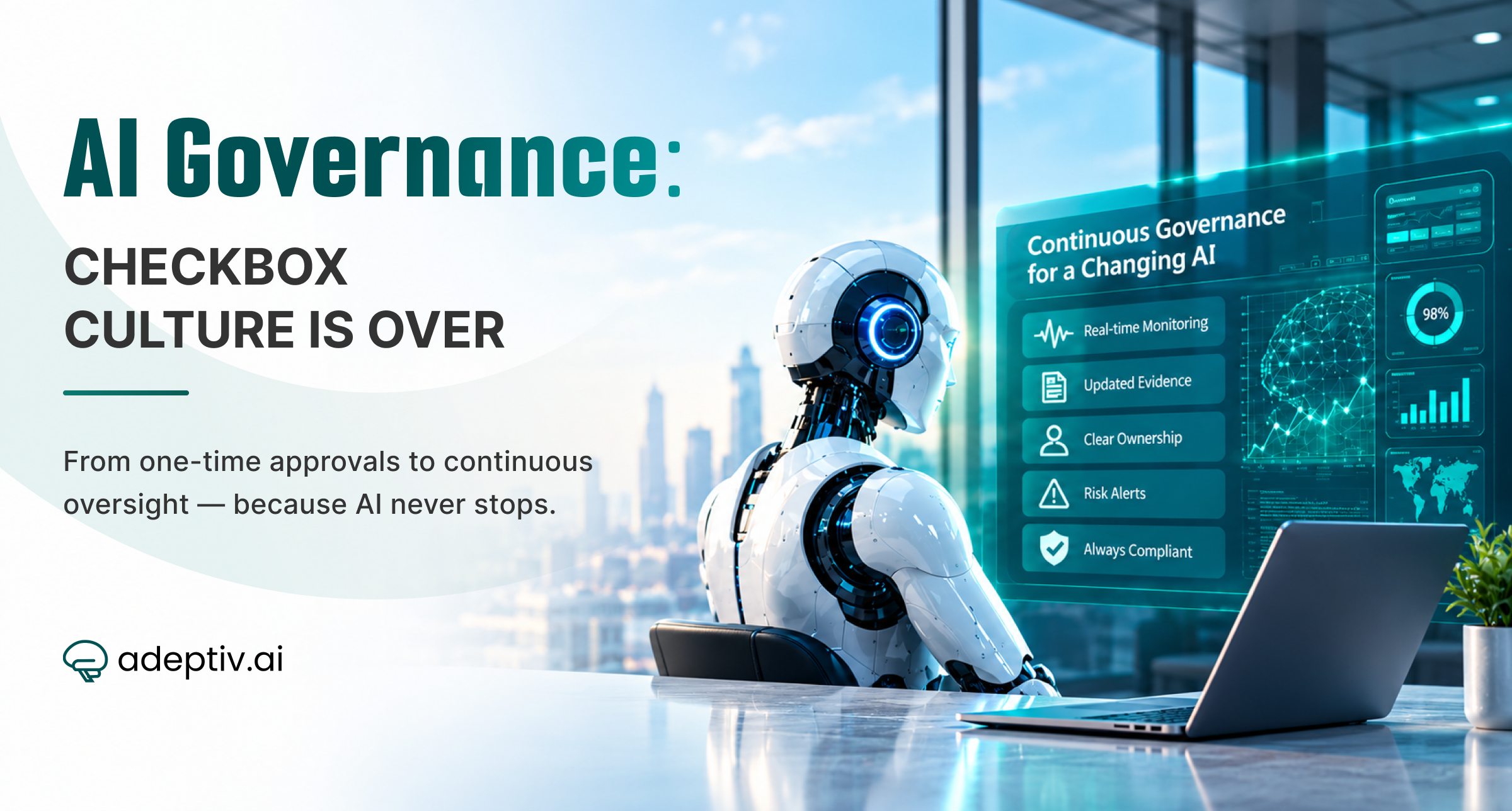
For years, AI governance has often followed a familiar process: assess a use case, complete a review, obtain approval, document the decision, and move on. The organization has a record showing that the system was reviewed, the relevant stakeholders signed off, and the required controls were considered. On paper, governance is complete.
But AI systems do not remain static after approval.
They interact with new data, connect to additional tools, receive updated permissions, and operate within changing business environments. Models can produce different outputs as inputs and usage patterns evolve. AI agents can take actions across multiple systems, creating operational consequences that were never fully visible during the initial review.
Meanwhile, the governance process may remain unchanged. The original assessment sits in a document, the next review is scheduled months later, and responsibility for monitoring ongoing behavior is distributed across teams.
This creates a fundamental gap between approving an AI system and governing it throughout its operational life.
Governance was built to approve AI once. AI behaves continuously.
For enterprises moving from experimental AI projects to production deployments and autonomous agents, Continuous AI Governance is becoming a critical operational requirement. Responsible AI governance cannot end at sign-off. It must remain connected to the systems, risks, controls, and decisions that change after deployment.
Where Continuous AI Governance Matters Most
The limitations of checkbox-based governance become particularly apparent when organizations deploy AI across business-critical workflows.
A traditional AI application may generate recommendations or assist employees with routine tasks. An agentic AI system can go further: retrieve information, invoke tools, update records, trigger workflows, and execute actions with limited human intervention.
That difference changes the governance challenge.
An agent initially approved to summarize customer requests might later receive permission to update customer records. A finance agent may begin with read-only access before gaining authority to initiate transactions. A procurement agent may move from comparing supplier offers to communicating with vendors or initiating purchasing workflows.
Each change introduces a new set of questions.
- Does the system still operate within its approved scope?
- Are its permissions appropriate for the actions it can take?
- Has the risk assessment been updated to reflect new capabilities?
- Can the organization reconstruct what happened when an unexpected action occurs?
- Who is responsible for investigating and resolving a control failure?
An approval document cannot answer these questions indefinitely.
The challenge is not simply whether an organization can deploy an AI agent. It is whether the organization can maintain visibility and control as that agent becomes more capable and interconnected.
This is where Continuous AI Governance becomes essential.
Why the Checkbox Model Keeps Failing
The problem is not that approval workflows are unnecessary. Enterprises still need documented decisions, risk assessments, accountable owners, and formal authorization before deploying AI.
The problem is treating these activities as the complete governance process rather than its starting point.
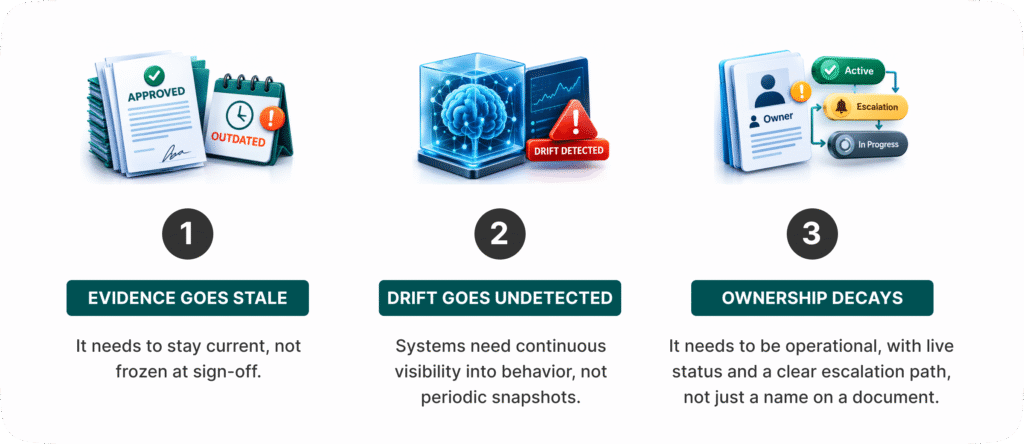
Three recurring weaknesses explain why the checkbox model falls short.
1. Governance Evidence Becomes Outdated
An AI use case may pass an assessment using a particular model version, dataset, vendor configuration, and set of permissions. Over time, one or more of those conditions may change.
If the supporting evidence remains unchanged, the organization can no longer be certain that the original approval reflects the current system.
A completed assessment is not proof of continuing compliance. Evidence must remain relevant to the system’s present configuration, controls, and operating conditions.
What needs to change: Evidence should be linked to the controls it supports, with clear ownership, review dates, and mechanisms for identifying outdated or incomplete documentation.
2. Operational Changes Go Undetected
AI risks do not always emerge as obvious incidents. They may develop gradually through changing inputs, increased usage, model updates, new integrations, or unexpected patterns of behavior.
For example, a customer-facing AI assistant may initially produce reliable responses. After a knowledge source changes or a new integration is introduced, it may begin providing inaccurate information or exposing data outside its intended context.
A periodic review may eventually identify the problem, but that leaves a gap between the change and its detection.
What needs to change: Continuous AI Governance should connect operational monitoring with risk thresholds, control requirements, and escalation procedures. Where relevant telemetry is available, teams should be able to identify meaningful changes and investigate them before they become larger incidents.
3. Accountability Exists on Paper but Not in Practice
Many organizations assign an owner to an AI system during approval. However, responsibility can become unclear when the system moves between development, security, legal, compliance, and business operations.
A control may fail without a defined process for assigning corrective action. An incident may be detected without clarity about who can suspend the system or approve its return to service.
What needs to change: Ownership must extend beyond a name in a register. Governance needs defined responsibilities, actionable workflows, escalation paths, and evidence that issues have been addressed.
Together, these weaknesses reveal why Continuous AI Governance must be an ongoing operating capability, not an administrative milestone.
What Continuous AI Governance Looks Like in Practice
Continuous AI Governance does not mean reviewing every AI decision manually or slowing every deployment with additional approvals. It means applying the appropriate level of oversight throughout the AI lifecycle, based on the system’s risk, capabilities, and business context.
A practical enterprise model connects five activities.
Discover: Maintain visibility into AI systems, use cases, models, vendors, owners, and integrations. Unknown or undocumented AI usage creates blind spots before risk assessments even begin.
Assess: Evaluate intended use, data sensitivity, potential harm, security exposure, regulatory obligations, and the level of human oversight required.
Control: Define approval requirements, access boundaries, operating conditions, testing expectations, and escalation rules. Higher-risk use cases may require additional reviews or explicit human authorization.
Monitor: Track relevant operational signals, control status, incidents, and changes that could affect the original risk assessment.
Improve: Update assessments, investigate incidents, refresh evidence, and revise controls as systems, regulations, and business requirements evolve.
These activities should reinforce one another. A change in an AI system’s permissions, for example, may trigger a reassessment, require new approval, and introduce additional monitoring requirements.
The objective is not to create more paperwork. It is to ensure that governance decisions remain connected to how AI is actually being used.
How Adeptiv AI Supports Continuous AI Governance
Adeptiv AI approaches enterprise governance as an ongoing process that connects AI inventory, risk assessment, control management, monitoring, and accountability.
Rather than treating approval as the end of governance, the platform helps organizations maintain visibility into AI systems and the evidence, controls, and responsibilities associated with them.
Keep Governance Evidence Current
Governance teams often manage evidence across spreadsheets, internal documents, cloud repositories, and disconnected compliance workflows. This makes it difficult to establish whether a control is adequately supported by current information.
Adeptiv helps connect governance evidence to the controls it supports. Evidence from supported systems, uploaded files, and connected repositories can be associated with relevant requirements and used to inform control status.
When evidence becomes outdated or a control requires attention, governance teams can identify the issue and take corrective action rather than relying entirely on the next scheduled audit.
This creates a more traceable relationship between documented requirements, supporting evidence, and the status of governance controls.
Monitor AI Systems After Deployment
An AI system passing its initial assessment does not guarantee that it will remain within its approved operating conditions.
Adeptiv’s monitoring and observability capabilities are designed to help enterprises maintain visibility into deployed AI systems through operational logs, telemetry, and relevant metrics.
Its monitoring module tracks more than 20 metrics, according to the platform’s stated capabilities. These signals can help teams investigate changes in system behavior and understand how operational conditions relate to governance requirements.
When configured thresholds are crossed, alerts can help teams identify potential issues and initiate investigation.
The value is the connection between operational visibility and governance action. Instead of treating monitoring and compliance as separate activities, organizations can use relevant operational signals to inform risk reviews, control status, and escalation decisions.
Monitoring should complement—not replace—appropriate testing, human oversight, and incident response procedures.
Make Accountability Actionable
Responsible AI governance requires clear ownership at every important decision point.
Adeptiv supports structured workflows for governance activities such as use-case approval, control review, and corrective action. Assigning owners and defining approval responsibilities helps organizations establish who must act when a requirement is unmet.
If a control requires remediation, a defined workflow can route the issue to the responsible person for review and resolution.
This helps reduce the risk of findings remaining unresolved because responsibilities are unclear or follow-up depends on manual coordination.
For enterprise leaders, the goal is straightforward: make governance responsibilities visible, trackable, and actionable.
Apply Consistent Readiness Reviews
Different teams often adopt AI through different processes. One business unit may complete a detailed risk assessment, while another introduces a third-party AI service with limited visibility or documentation.
Without consistent requirements, governance coverage becomes uneven.
Adeptiv supports structured governance workflows that help organizations apply consistent production-readiness expectations across AI use cases. Reviews can incorporate the relevant risk assessments, control requirements, ownership, evidence, and approvals before deployment.
The level of scrutiny should remain proportionate to risk. A low-impact internal assistant and an AI system influencing consequential business decisions should not necessarily follow identical review requirements.
Consistency means applying a defined, risk-based process—not treating every AI system as equally risky.
Maintain a Current AI Inventory
An enterprise cannot effectively govern systems it cannot identify.
AI tools may be introduced by technology teams, embedded in third-party software, or adopted independently by business functions. Over time, the resulting environment can become difficult to map.
Adeptiv helps organizations maintain a centralized inventory of AI systems and use cases, supporting a clearer view of ownership, risk assessments, controls, and related evidence.
This inventory provides a foundation for governance decisions. Teams can identify which systems require review, where documentation is incomplete, and which use cases need closer oversight.
As the environment changes, inventory information should be reviewed and updated so governance remains aligned with the systems the organization actually operates.
From Approval Records to Continuous Accountability
The difference between checkbox governance and Continuous AI Governance is not the number of documents an organization maintains. It is whether those records reflect reality and lead to action.
Consider a hypothetical enterprise finance agent approved to reconcile transactions. During its initial review, the agent has restricted permissions and a clearly defined operating scope.
Several months later, the business team requests access to another financial system.
Under a checkbox model, the change might be treated as a routine technical update. The original approval remains on file, even though the agent’s capabilities and potential impact have changed.
Under a Continuous AI Governance model, the new integration prompts a review of permissions, data access, risk exposure, and approval requirements. The responsible owner evaluates whether additional controls are necessary. Monitoring requirements are updated where appropriate, and the decision is documented.
If unexpected behavior subsequently occurs, the organization has a clearer path to investigate the event, identify responsibility, and take corrective action.
This is the operational difference that matters: governance responds to changes instead of assuming the original approval remains sufficient.
Building a Continuous AI Governance Framework
Moving beyond checkbox culture requires coordination across technology, security, legal, compliance, risk, and business teams.
Organizations can begin with four priorities.
Establish visibility before scaling. Identify AI systems, use cases, vendors, owners, data access, and the business processes they influence. Make undocumented or unapproved usage visible.
Define risk-based governance requirements. Determine which use cases require formal assessment, additional testing, human approval, restricted permissions, or enhanced monitoring. Align requirements with applicable laws, industry obligations, and internal risk tolerance.
Connect policy to operational controls. A policy should specify what must happen, who is responsible, what evidence demonstrates compliance, and what happens when a requirement is not met. A rule that cannot be implemented or verified is difficult to enforce consistently.
Review governance throughout the lifecycle. Reassess systems when material changes occur, investigate incidents, refresh evidence, and periodically validate that controls remain effective.
Relevant frameworks can help structure this work. The NIST AI Risk Management Framework provides guidance for managing AI risks; ISO/IEC 42001 establishes requirements for an AI management system; and the EU AI Act introduces legal obligations for covered AI systems and relevant actors. Applicability and implementation requirements depend on the organization’s role, use cases, and jurisdiction.
No single framework eliminates operational risk. Organizations must translate applicable requirements into controls, responsibilities, evidence, and ongoing oversight that fit their actual AI environment.
A governance platform can support this process, but effective governance also depends on sound policies, trained personnel, executive accountability, and appropriate technical safeguards.
The Business Benefits of Continuous AI Governance
Continuous AI Governance is not only a compliance consideration. It can also support more confident enterprise AI adoption.
When teams have better visibility into AI systems, they can identify ownership gaps and prioritize reviews. When controls and evidence are connected, compliance teams can spend less time assembling disconnected records. When monitoring and escalation processes are defined, operational teams have a clearer path to investigating problems.
These capabilities can help organizations scale AI while maintaining appropriate oversight.
They also support better executive decisions. Leaders need to understand which AI systems are deployed, where significant risks exist, whether required controls are operating, and which issues need attention.
A current governance view makes those questions easier to address than a collection of approval documents that may no longer reflect the environment.
The objective is not to eliminate every possible AI failure. It is to build an operating model that can identify risks, detect meaningful changes, assign responsibility, and respond effectively.
Continuous AI Governance Cannot Stop at Sign-Off
Checkbox culture treated governance as something an organization could complete: review the system, approve the use case, file the evidence, and move on.
That approach becomes increasingly inadequate as AI systems evolve, integrate with business processes, and begin taking autonomous actions.
Approval remains important. Documentation remains important. Compliance assessments remain important. But none of them can substitute for visibility into what happens after deployment.
Effective Continuous AI Governance connects policy with implementation, evidence with controls, monitoring with risk, and responsibility with corrective action.
Adeptiv AI helps organizations bring these activities together through AI inventory visibility, governance workflows, risk assessment, evidence management, and ongoing monitoring and observability.
Checkbox culture treated governance as something you finish. AI never stops. Governance can’t either.
Ready to move beyond one-time AI approvals?
Explore how Adeptiv AI can help your organization establish a more connected, accountable, and continuously informed approach to enterprise AI governance.
FAQs
Continuous AI Governance is an ongoing approach to managing AI systems throughout their lifecycle. It includes risk assessment, monitoring, accountability, evidence management, and regular reviews as systems and their operating conditions change.
It helps organizations identify emerging risks, detect meaningful system changes, maintain relevant compliance evidence, and preserve oversight after AI deployment.
Key elements include AI inventory management, risk assessment, transparency, accountability, data privacy, human oversight, compliance, operational monitoring, and continuous improvement.
An AI governance platform can centralize AI inventory, support risk assessments, track controls and evidence, structure approval workflows, and improve visibility into potential issues.
Adeptiv AI supports AI inventory management, risk assessments, governance workflows, evidence tracking, and monitoring and observability to help enterprises maintain a more connected approach to AI oversight.
Where Continuous AI Governance Leads
The key question is not whether your organization has AI governance documented. It is whether you can identify every AI system in use, assign accountable owners, keep risk classifications current, and produce reliable evidence when needed. If not, you have a specific gap to address before the next audit.
N E X T S T E P
Discuss your Continuous AI Governance gaps with the Adeptiv AI team to explore how the platform can support your existing GRC and compliance structure.