Understanding the NIST AI Risk Management Framework (AI RMF)
NIST AI governance framework is a guide for the sectors, industries and use cases to successfully identify and manage AI associated risks across the AI life cycle.
The NIST AI RMF applies to organizations that design, develop, deploy, procure, or use AI systems, including private companies, government agencies, startups, and AI vendors. It is sector-agnostic and technology-neutral, making it relevant for both traditional ML systems and advanced generative AI models.
The primary objective of the NIST AI RMF is to help organizations identify, assess, manage, and reduce AI-related risks throughout the AI lifecycle while enabling innovation and trustworthy AI adoption.
Why This Framework Matters
The NIST AI RMF matters because AI risks are no longer ideas. AI risks are real AI risks affect the reputation AI risks affect the standing AI risks affect the finances. Organizations see exposure, from the outcomes. Organizations see exposure from the decision making.
Organizations see exposure from the security vulnerabilities. Organizations see exposure from the scrutiny. Organizations see exposure, from the loss of trust.
When we look at it from a business point of view the framework helps organizations:
Reduce deployment failures and model misuse
Make sure we do not have the non‑ Make sure we do not have the non‑compliance.
Strengthen enterprise risk management
I work to improve the trust of customers and
Prepare for alignment with binding laws such as the EU AI Act and S. state AI laws
Moreover, The NIST AI Risk Management Framework complements regulatory regimes such as the EU Artificial Intelligence Act by translating compliance into actionable risk management processes.
NIST AI RMF · Self-Assessment
Your result appears on this page. We handle your email under our
privacy policy.
Key Areas Covered by the Framework (Regulatory highlights)
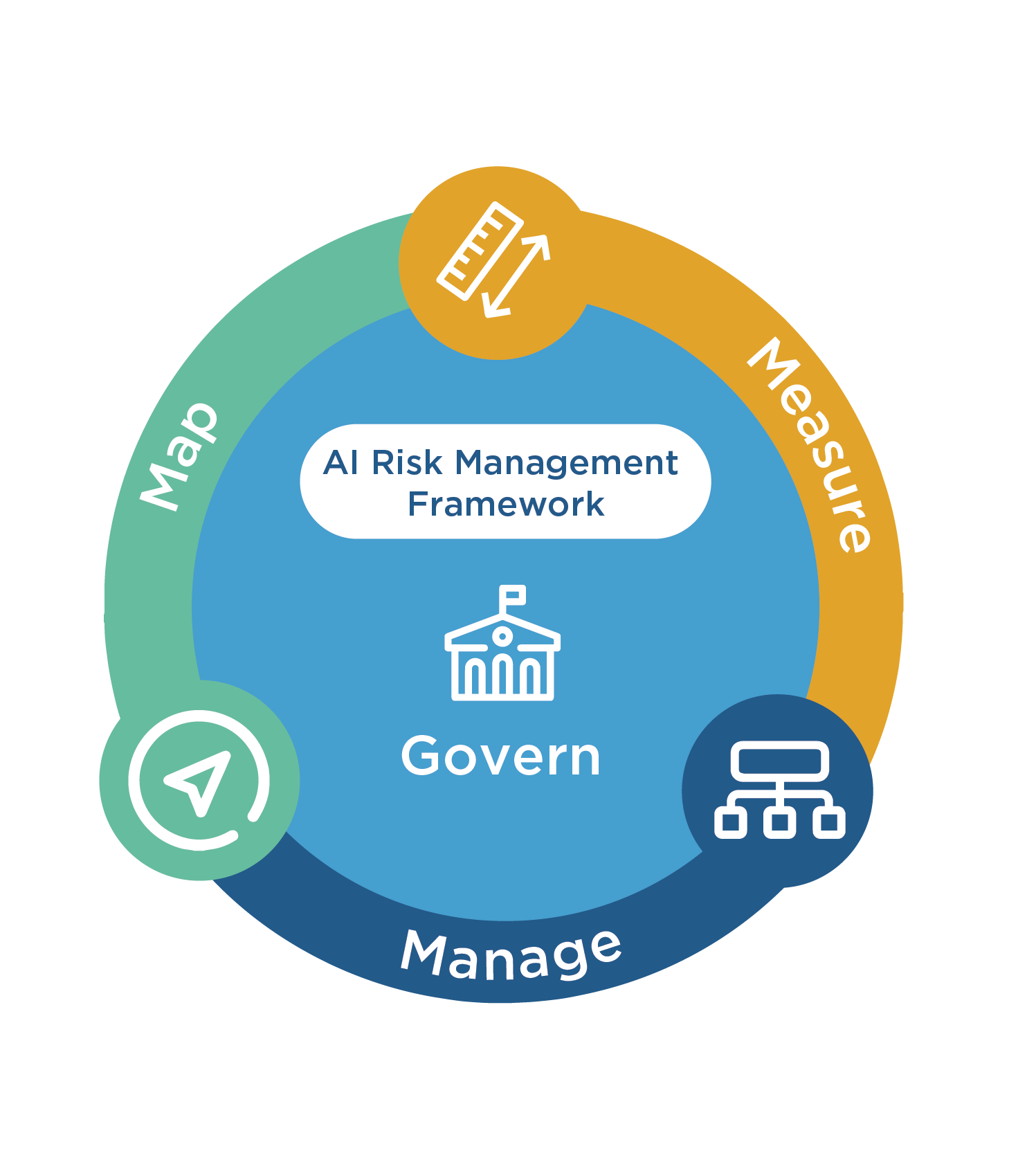
The NIST AI RMF consists of four fundamental functions (which are accompanied by traceable outcomes and risk management profiles)
Govern
Set of organization policies, to ensure your organization has it’s accountability structures, roles and oversight in place for managing AI risks. It is about leadership accountability, moral congruence and cross-functional co-operation.
Map
Centers on AI systems in context – including purpose, stakeholders, data sources, system deployment environment, and possible impacts. This is key to determine when, and in what way, risks will materialize.
Measure
Organizations must measure and manage risk for AI risks including bias, robustness, explainability, security and performance drift using acceptable metrics testing and validation.
Manage
Includes focusing on risks, addressing controls, assessing systems after deployment and enhancing the processes for reducing risk over time
These functions apply across the full AI lifecycle, from design and development to deployment, monitoring, and retirement.
Governance, Documentation & Controls
NIST AI RMF puts a lot of focus on written rules and tracking which helps the organisations in:-
Model documentation, data provenance records, and system logs
Incident response and escalation procedures for AI-related harms
Continuous monitoring and review mechanisms
The framework encourages the alignment with the existing controls such, as enterprise risk management (ERM) cybersecurity frameworks and compliance programs. The framework reduces duplication and reduces the burden.
How Our Platform Enables Compliance
Our AI governance platform operationalizes the NIST AI RMF by translating its principles into actionable workflows and controls. The platform enables organizations to:
Map AI use cases to RMF requirements in accordance with their lifecycle stage
Conduct structured AI risk assessments aligned with Govern, Map, Measure, and Manage
Maintain centralized documentation for models, datasets, and decisions
Track risk mitigation actions and ownership across teams
Monitor ongoing performance, bias indicators, and compliance gaps
Generate audit-ready evidence aligned with NIST outcomes
By embedding RMF controls directly into AI development and deployment processes, the platform ensures compliance is continuous, scalable, and measurable, rather than a one- time exercise.
Penalties & Liability Exposure
The NIST AI RMF itself is voluntary and non-binding; however, failure to adopt its principles can significantly increase liability exposure.
Organizations that ignore AI risk management may face:
Regulatory enforcement under sectoral laws (consumer protection, discrimination, data protection)
Contractual liability for AI system failures
Product liability and negligence claims
Reputational damage and loss of market trust
Increasingly, regulators and courts view frameworks like NIST AI RMF as a benchmark for reasonable organizational conduct, meaning non-alignment may weaken legal defenses.
Who Should Pay Attention
The NIST AI RMF pertains most strongly to:
AI products businesses and software as a service (SaaS) suppliers
Companies using AI for hiring, finance, healthcare or customer analytics
Agencies and Other Public Bodies of the State
Compliance, Legal, Risk and Internal Audit departments
Boards of Directors and Senior Leadership in Charge of AI oversight
Firms already in, or gearing up for, regulated AI markets
The RMF is gradually becoming a default governance expectation for organizations engaging in AI at scale.
Update & Enforcement Status
NIST AI RMF was released officially on January 2023 and it still keeps evolving through guidance updates, profiles and implementation playbooks. Although it is not a law or regulation, it is being cited more often by regulators, legislators and industry groups around the world. This framework is also becoming a model to newer AI laws and standards, making early adopters definitely the winner in their wish for future-proof AI governance.