| AI Governance | As organizations adopt artificial intelligence, one question becomes increasingly important: how can they manage AI risks without slowing down innovation? Many organizations respond by creating a single governance process for every AI initiative. Each project must complete the same forms, pass the same reviews, and receive approval from the same departments, regardless of what the system does or how much risk it presents.
But consider the difference between an AI assistant that summarizes meeting notes for an internal team and an autonomous agent that can access customer records, modify databases, or initiate financial transactions. Both require appropriate oversight, but they do not present the same level of risk.
Treating them identically may seem like a straight forward way to maintain control. In practice, however, it can create unnecessary delays for simple projects while leaving more complex systems without the focused attention they need. The challenge is not simply to govern every AI system. It is to make sure that the level of oversight matches the system’s capabilities, the data it handles, and the consequences of its actions.
Understanding the One-Size-Fits-All Approach
When AI adoption begins to grow, security, legal, privacy, and compliance teams must find ways to manage technologies that introduce new risks. Standardized processes can help establish consistency, particularly when an organization is still learning how AI fits into its operations.
The problem arises when standardization becomes inflexible.
Under a uniform ai governance model, every AI use case may be expected to follow the same process:
- Complete a detailed risk assessment, regardless of the system’s complexity.
- Document every model, dataset, and vendor configuration using the same requirements.
- Obtain approval from multiple departments before deployment.
- Follow the same review timeline, even when the potential impact differs significantly.
This approach assumes that applying the same process to every system will produce consistent and effective governance. However, consistency in procedure does not necessarily mean that the actual risks are being managed appropriately.
An internal assistant with limited permissions has a different risk profile from an AI agent that can invoke external tools, process sensitive information, and execute actions without waiting for human approval. Both need governance, but the depth of assessment, the controls required, and the level of ongoing monitoring should reflect those differences.
Why Treating Every AI Use Case the Same Creates Problems
A uniform governance process can create three major challenges as organizations expand their use of AI.
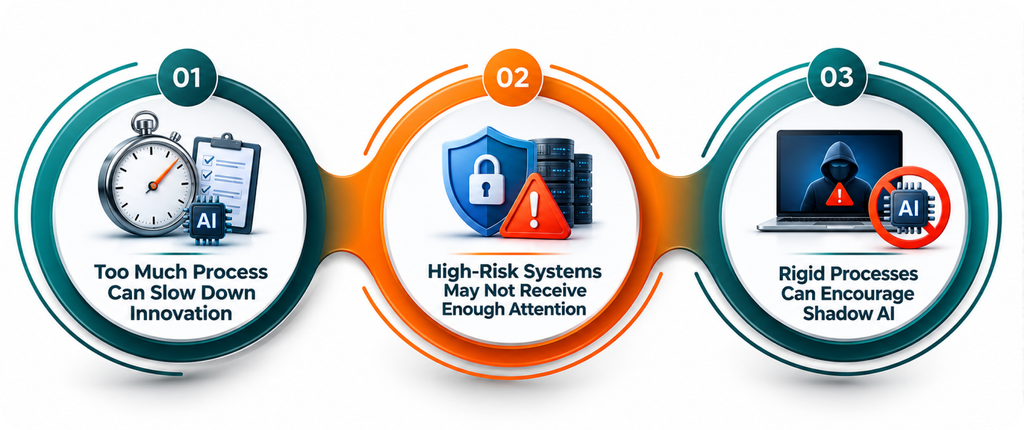
1. Too Much Process Can Slow Down Innovation
When even a small internal experiment requires lengthy documentation and multiple approval stages, teams can spend more time navigating the approval process than testing their ideas. For instance, a data scientist experimenting with an embedding model for internal document search may face the same review requirements as a team deploying an autonomous agent with access to sensitive business systems.
Over time, this creates frustration. Teams may begin to view ai governance as an obstacle rather than a way to develop and deploy AI responsibly. The answer is not to remove necessary checks. It is to avoid imposing requirements that do not reflect the actual risk of a project.
2. High-Risk Systems May Not Receive Enough Attention
Security and compliance teams have limited time and resources. If they spend too much of their capacity reviewing low-impact applications, they may have less time to examine systems that could create significant operational, financial, or regulatory consequences.
Consider an AI agent that can update customer records, access external APIs, or initiate financial transactions. Its assessment should consider the permissions it holds, the actions it can perform, the data it can access, and what could happen if it behaves unexpectedly.
A standard approval checklist alone may not provide the depth of assessment these systems require. The real issue is not that low-risk systems receive oversight. It is that high-risk systems need additional scrutiny, rather than being treated as just another item in the approval queue.
3. Rigid Processes Can Encourage Shadow AI
Employees often turn to AI tools because they want to work faster and solve practical problems. When the official approval process is too slow or difficult to navigate, some may start using unapproved applications, enter company information into consumer AI services, or develop internal tools without informing IT and security teams.
This creates what is commonly known as shadow AI.
The organization may no longer have a clear picture of which tools are being used, what information they process, or what actions they can perform. Ironically, a process designed to maintain control can make AI usage harder to track if it encourages employees to work outside established governance arrangements.
A more practical approach makes it easier for teams to adopt suitable AI tools while ensuring that higher-risk applications receive the necessary review and safeguards.
Moving Towards Risk-Proportional AI Governance
Effective governance does not mean applying the strictest possible controls to every AI system. It means understanding where the risks lie and responding accordingly. This is the principle behind risk-proportional governance: the level of assessment, control, and monitoring should reflect the characteristics and potential consequences of each AI use case.
Several factors can help determine the appropriate level of oversight.
- Autonomy and execution capability: Does the system only provide recommendations, or can it independently call tools, modify records, and trigger business workflows?
- Data sensitivity: Does it process public information, internal business documents, confidential data, or sensitive personal information?
- Potential impact: What could happen if the system produces an incorrect output, makes an inappropriate decision, or is compromised?
- User exposure: Is the system used by a small internal team, employees across the organization, or external customers?
- Tool access and permissions: Can the system only retrieve information, or can it also change data, access external services, and perform consequential actions?
These factors help organizations distinguish between AI systems that need relatively lightweight oversight and those that require more rigorous controls.
Risk assessment should not end at deployment, either. An AI assistant that initially has read-only access may present a different risk if it later receives permission to modify records or connect to additional data sources. Changes in permissions, integrations, autonomy, or observed behaviour may therefore warrant a fresh assessment.
Putting Risk Tiering into Practice
One way to implement risk-proportional governance is to group AI use cases into risk tiers, with different requirements for assessment, approval, and monitoring.
The following model is illustrative. Organizations should define their own criteria according to their operations, risk appetite, and applicable requirements.
Tier 1: Low-Impact Internal Assistants
Examples: Basic text summarizers, internal knowledge search tools, and productivity assistants operating with limited permissions and low-sensitivity information.
Governance approach:
- Streamlined intake and initial risk assessment.
- Clear ownership and basic documentation.
- Standard security and data-handling safeguards.
- Periodic reviews appropriate to the system’s use.
The objective is to maintain visibility and essential safeguards without creating unnecessary delays for low-impact projects.
Tier 2: Moderate-Impact Business Workflows
Examples: Customer support drafting tools, sentiment analysis systems, and internal analytics applications that process confidential business information or generate outputs for human review.
Governance approach:
- Documented risk and privacy assessments.
- Appropriate checks on model and data provenance.
- Defined business and technical ownership.
- Regular monitoring and compliance reviews.
- Human review before consequential decisions or external communications, where appropriate.
These systems need more structured oversight because they interact more closely with business operations and may process more sensitive information.
Tier 3: High-Impact Autonomous Systems
Examples: AI agents that modify database records, invoke powerful tools, initiate financial transactions, or handle sensitive information with limited human intervention.
Governance approach:
- Detailed, cross-functional risk and readiness reviews.
- Least-privilege permissions and defined tool-access boundaries.
- Runtime controls suited to the actions the system can perform.
- Continuous monitoring of relevant risk signals and behaviour.
- Human approval for critical actions where required.
- Reassessment when capabilities, permissions, or operating conditions change.
These systems require particular attention because their autonomy and access can increase the consequences of unexpected behaviour.
A tiered model helps organizations apply governance more proportionately: simpler use cases can move through appropriate streamlined processes, while systems with greater potential impact receive stronger safeguards and closer scrutiny.
How Adeptiv AI Supports Proportional, Risk-Based Governance
Putting risk-proportional governance into practice across an enterprise requires more than maintaining spreadsheets or documenting approvals. Organizations need visibility into their AI systems, a way to assess their risks, and mechanisms to monitor behaviour and control actions where necessary.
Adeptiv AI supports this approach through its AI governance control plane.
- Centralized AI Discovery and Inventory: Adeptiv helps organizations improve visibility into AI agents, use cases, models, and third-party AI systems. This gives teams a clearer view of their AI landscape and helps establish ownership.
- Risk Assessment and Tiering: Assessing AI systems against relevant risk factors helps organizations determine where additional scrutiny may be needed, particularly when systems handle sensitive data, have extensive tool access, or perform autonomous actions.
- Runtime Control Enforcement: Through its Gateway, Adeptiv can allow, redact, escalate, or deny model and tool calls according to configured runtime rules. This helps organizations establish boundaries around what an AI agent can do, rather than relying only on reviews completed before deployment.
- Continuous Observability and Monitoring: Monitoring can help identify risk signals such as unusual tool usage, sensitive-data exposure, and deviations from expected agent behaviour. These signals can inform decisions about whether further investigation or reassessment is needed.
- Containment and Intervention: Supported containment capabilities can help interrupt problematic execution, including stuck agent loops or activity that exceeds defined operational boundaries.
Together, these capabilities support a governance approach that connects AI discovery, risk assessment, runtime controls, and ongoing monitoring.
The goal is not to apply the same controls to every AI system. It is to help organizations make better-informed governance decisions and establish appropriate safeguards based on how their AI systems operate and what they are capable of doing.
Organizations may begin with a standardized process because it is easier to establish and manage. However, as AI adoption expands, the same requirements can become inefficient because systems differ in autonomy, data access, purpose, and potential impact.
Organizations should consider data sensitivity, autonomy, tool permissions, user exposure, and the potential consequences of failure. These criteria should be documented, and assessments should be revisited when a system’s capabilities or operating conditions change.
Not when implemented properly. It maintains baseline safeguards while applying stronger assessment and controls where risks are greater. It can also help security and compliance teams focus their expertise on systems with more significant potential consequences.
Depending on its capabilities, a governance platform can help organizations discover AI systems, assess risk, monitor behaviour, and enforce configured controls. These technical capabilities work alongside clear policies, accountable ownership, and human decision-making where needed.
Building a More Practical Approach to AI Governance
The effectiveness of AI governance should not be measured only by the number of forms completed or approvals recorded. It should also be measured by whether organizations can identify meaningful risks, apply suitable controls, and maintain visibility as their AI systems evolve.
Treating every use case identically may appear consistent, but it can create unnecessary friction while failing to account for important differences between AI systems.
A more effective approach combines consistent governance principles with proportionate oversight. Lower-risk applications can follow streamlined processes, while high-impact and autonomous systems receive more rigorous assessment, stronger execution boundaries, and closer monitoring.
When governance reflects risk, organizations can support innovation while maintaining meaningful oversight of how their AI systems operate.
Next Step
Discuss your AI governance strategy with the Adeptiv AI team to explore how AI discovery, risk assessment, runtime controls, and ongoing observability can support a more scalable approach to enterprise AI governance .