| Connected AI Governance | As enterprises accelerate AI adoption, their AI environments are becoming increasingly interconnected. AI agents, models, APIs, MCP servers, enterprise applications, and third-party services now operate as part of broader technology ecosystems. These connections extend AI capabilities beyond standalone model interactions, enabling systems to retrieve information, access enterprise resources, and execute actions across multiple environments.
However, every connection introduces additional governance considerations. Integrations can expand access permissions, create new data flows, introduce external dependencies, and increase the complexity of monitoring AI activity. An AI system’s risk profile is therefore not determined solely by its model or intended purpose. It is also influenced by the tools it can access, the services it depends on, and the actions it can perform through those connections.
This creates a critical challenge for enterprise AI governance: organizations must establish visibility and control across the entire connected AI ecosystem, rather than governing models and agents in isolation.
Understanding the Governance Risk of Connected AI Ecosystems
Traditional IT governance has established processes for managing applications, infrastructure, APIs, vendors, and data access. However, Agentic AI introduces a different operational dimension. AI agents can dynamically select tools, process information, coordinate workflows, and invoke connected services as part of autonomous execution.
Consequently, an integration is no longer simply a technical connection between two applications. It can become an execution pathway through which an AI agent accesses data, interacts with business systems, and initiates actions.
This changes the scope of AI Governance. Organizations must understand:
- Which AI agents, models, and third-party services are operating across the enterprise.
- Which APIs, MCP servers, and external tools are connected to each agent.
- What permissions and data access capabilities these integrations provide.
- How information moves between models, agents, tools, and external services.
- Whether actual agent behaviour remains within approved execution boundaries.
- How changes to integrations, vendors, and permissions affect existing risk assessments.
Without this visibility, governance teams may have an incomplete understanding of their enterprise AI environment, making it difficult to maintain consistent oversight and accountability.
Why Connected AI Tools and Vendors Create Governance Challenges
The growing dependency on interconnected AI services introduces several areas of risk that require dedicated governance attention.
1. Expanded Access and Permission Exposure
An AI agent’s operational authority is closely connected to the permissions granted to its tools and integrations. Access to APIs, databases, enterprise applications, and external services can expand what an agent is technically capable of doing.
The governance concern extends beyond whether a connection is authorized. Organizations must also determine whether the permissions associated with that connection are appropriate for the agent’s intended function and autonomy level.
Excessive permissions can increase the potential impact of unauthorized actions, unintended tool invocation, and compromised execution paths. An effective Agentic AI Security framework should therefore establish clear access boundaries, least-privilege principles, and controls over the operations an agent can perform through connected services.
2. Third-Party Vendor and Dependency Risks
Enterprise AI environments increasingly incorporate vendor-provided models, embedded AI capabilities, external platforms, and managed services. These dependencies introduce additional considerations involving data processing, service configurations, security practices, and operational accountability.
Vendor approval alone does not establish control over every AI capability provided through that relationship. Organizations also need to understand which AI services are being used, what enterprise resources they can access, and how their integrations influence the overall risk posture.
Changes in vendor capabilities, service configurations, or connected components may also affect previously established governance decisions.An effective AI vendor governance approach should therefore combine third-party visibility with ongoing assessment of associated AI assets, dependencies, and access requirements.
3. Data Exposure Across Connected Systems
Connected AI environments create multiple pathways through which enterprise information can be accessed, processed, and transferred.Data may move between internal applications, model providers, databases, MCP servers, and external APIs during agent execution. Each interaction introduces considerations relating to data sensitivity, processing purpose, access authorization, and information exposure.
Without sufficient observability, organizations may struggle to establish where sensitive information originated, how it was transformed, which connected services received it, and whether relevant data-handling requirements were maintained.
This makes data lineage an important component of Connected AI Governance . Organizations need visibility into information movement across execution steps, supported by appropriate monitoring for PII exposure, sensitive-data leakage, and policy violations.
4. MCP Server and Tool-Level Governance Gaps
The Model Context Protocol (MCP) enables AI applications and agents to connect with external tools and data sources through a standardized integration layer. While this improves interoperability, it also introduces additional governance requirements.
MCP servers can expose multiple tools with different permissions, capabilities, and operational effects. Consequently, governance cannot stop at identifying an MCP connection. It must also consider the tools exposed through that connection and the authority available to the agents using them.
Uncontrolled tool access can expand an agent’s execution scope and introduce risks involving unauthorized operations, inappropriate data access, and unexpected workflow behaviour.An Agentic AI Governance Framework should therefore incorporate MCP discovery, tool-level risk assessment, permission boundaries, and runtime monitoring of relevant interactions.
5. Integration Changes and Autonomy Drift
Enterprise AI environments evolve continuously. New tools may be connected, permissions may be modified, vendor services may change, and model or agent configurations may be updated. These changes can alter an AI system’s risk profile without changing its original business purpose.
A governance assessment performed before deployment may therefore become insufficient when the system’s connected resources or execution capabilities change. Organizations need mechanisms to compare declared configurations with observed behaviour and identify deviations involving autonomy levels, tool usage, and execution patterns.
Continuous monitoring helps governance teams maintain visibility into these changes and determine when reassessment or intervention is required.
Establishing a Connected AI Governance Framework
Managing connected AI risks requires an approach that combines asset visibility, access governance, risk assessment, runtime enforcement, and continuous observability.
A practical Connected AI Governance Framework should address the following areas:
- AI Asset and Integration Discovery: Maintain visibility into agents, models, vendors, APIs, MCP servers, and connected enterprise services.
- Identity and Permission Governance: Establish clear ownership, access boundaries, and appropriate permissions for agents and their connected tools.
- Third-Party Risk Visibility: Maintain oversight of external AI providers, embedded AI capabilities, and associated dependencies.
- Data Flow and Lineage: Trace information across model calls, tool interactions, and connected systems to understand how data is accessed and processed.
- Runtime Policy Enforcement: Apply configured governance rules to model and tool calls before actions are executed.
- Continuous Observability: Monitor agent behaviour, tool usage, autonomy drift, sensitive-data exposure, and other relevant runtime risk signals.
- Containment and Intervention: Establish mechanisms to pause problematic execution, detect repeated activity, and enforce operational limits.
These governance capabilities should operate throughout the AI lifecycle rather than being limited to initial deployment approval.
Risk assessments should also be revisited when changes in integrations, permissions, vendors, or observed behaviour affect an AI system’s operating boundaries. This allows organizations to maintain governance decisions that reflect the current state of their AI environments.
How Adeptiv AI Supports Governance Across Connected AI Ecosystems
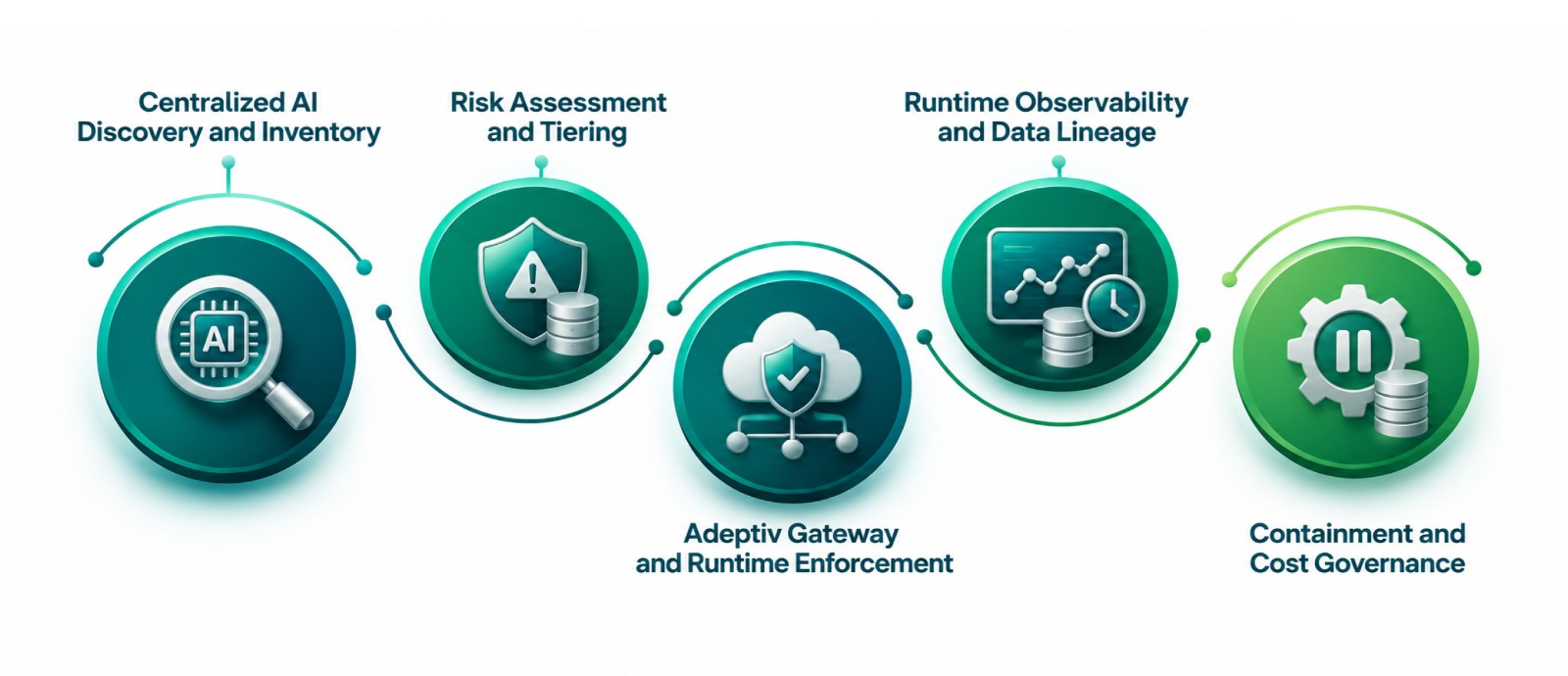
Managing connected AI environments requires more than maintaining separate records of models, vendors, and integrations. Enterprises need a centralized approach that connects AI discovery, risk assessment, runtime controls, and continuous monitoring.
Adeptiv AI supports this through its Connected AI Governance control plane.
- Centralized AI Discovery and Inventory: Discover AI agents, use cases, models, vendors, and embedded AI systems across the enterprise to establish asset visibility and ownership.
- Risk Assessment and Tiering: Assess source code, prompts, MCP servers, and connected tools to identify potential risk exposure and classify AI systems before production deployment.
- Adeptiv Gateway and Runtime Enforcement: Intercept model and tool calls through a centralized enforcement point. Configured runtime rules support allow, redact, escalate, or deny decisions before actions are executed.
- Runtime Observability and Data Lineage: Monitor autonomy drift, tool-sequence anomalies, sub-agent activity, prompt injection, PII exposure, hallucinations, and bias while tracing data across execution steps.
- Containment and Cost Governance: Support intervention through agent pause capabilities, loop detection, execution limits, and cost ceilings to help contain unexpected activity and manage resource consumption.
By connecting these capabilities, Adeptiv helps organizations move beyond fragmented AI oversight towards a more integrated governance approach. Its Gateway provides an enforcement layer for model and tool interactions, while observability and risk assessment support visibility into how AI systems operate and evolve.
The objective is to extend governance beyond the model itself and establish appropriate oversight across the tools, integrations, vendors, and execution pathways that influence enterprise AI operations. | Connected AI Governance |
Frequently Asked Questions
Connected AI tools expand an AI system’s permissions, data access and ability to take actions. Without governance, this can lead to security exposure, unauthorized actions and poor visibility into how data moves across systems.
Third-party vendor governance gives organizations visibility into external AI services, their dependencies and data-handling practices. It supports better risk assessments and ongoing oversight of vendor-provided AI.
MCP lets AI agents connect to external tools and data. MCP governance helps organizations identify connected servers, review the tools and permissions they expose, and monitor how agents use them.
Runtime enforcement applies governance policies to model and tool calls while an agent is running. It sets real-time boundaries on agent actions instead of relying only on documentation and pre-deployment reviews.
It should monitor agent behavior, tool usage, autonomy drift, sensitive-data exposure and configuration changes. Data lineage adds traceability across connected services.
Governing the Connections Behind Enterprise AI
Enterprise Connected AI Governance cannot stop at models and individual agents. Connected tools, third-party vendors, APIs, and MCP servers form part of the wider execution environment and directly influence how AI systems operate.
As Enterprise Agentic AI adoption expands, organizations need a governance approach that combines centralized discovery, risk management, runtime enforcement, and continuous observability. The focus must shift from simply identifying AI assets to understanding and controlling their connections and execution capabilities.
Next Step
Explore how Adeptiv helps enterprises govern Connected AI Governance ecosystems through centralized discovery, runtime enforcement, and continuous observability. | Connected AI Governance |