AI agents no longer just answer questions — they take actions inside enterprise systems. Governing that shift
requires more than a policy update. It requires operational infrastructure.
At a Glance:
Agentic AI Governance is the operational approach enterprises use to govern autonomous AI agents that can make decisions, access systems, use tools, and take actions without a human reviewing every step.
- Agentic AI changes the governance model: Organizations must govern not only AI outputs but also the decisions, permissions, tools, actions, and outcomes generated by autonomous agents.
- Continuous oversight is essential: Agent behavior can change dynamically, making periodic risk reviews insufficient for detecting drift, anomalies, or policy violations.
- Enterprise governance needs operational controls: Effective governance includes agent inventory, ownership, risk assessment, permissions, data and tool access, compliance mapping, monitoring, evidence, and human oversight.
- Compliance must connect to specific AI agents: Enterprises need to map applicable regulations and standards, such as the EU AI Act, ISO/IEC 42001, and NIST AI RMF, to individual agents and use cases.
- Audit-ready evidence matters: Immutable logs and continuously maintained evidence help organizations demonstrate what an AI agent did, why it acted, and who was accountable.
- A governance platform should operate continuously: Enterprises should evaluate platforms based on agent discovery, regulatory mapping, human-review controls, production monitoring, evidence generation, and integration with the systems agents use.
Every enterprise conversation about AI is starting to sound the same: the AI systems that were built to summarize, draft, and recommend are being asked to do more. Approve a refund. Query a production database. Update a CRM record. Trigger a downstream workflow. Call another agent to finish the job. That step — from producing an output a human reviews to taking an action a system executes — is the defining shift of agentic AI, and it is the reason governance teams are re-examining how they oversee AI in the enterprise.
This article is not another explainer on what agentic AI is. It is a working model for how enterprises govern it — the inventory, ownership, risk, permission, monitoring, and evidence practices that turn “we deployed some AI agents” into “we can prove, at any moment, what our AI agents are authorized to do, what they have done, and who is accountable for it.”
What Changes When AI Moves From Generating Outputs to Taking Actions
Traditional AI governance was built around a single checkpoint: the output. A model produced a prediction, a score, a piece of text, or an image, and a human — or a downstream process — decided what to do with it. Risk was largely contained at that one point of review.
Agentic AI removes that single checkpoint and replaces it with a chain of decisions. An agent interprets an instruction, decides which tool to use, accesses a system or data source, executes an action, and often hands off to another agent or process. Each link in that chain is a place where something can go right or wrong, and none of them necessarily passes through a human before it happens.
The practical consequence for governance teams is that the unit of oversight changes. It is no longer “was this output accurate and appropriate?” It is “was this agent authorized to take this action, on this system, with this data, under these conditions — and can we show that after the fact?” That is a fundamentally different governance question, and it is why so many enterprises are finding that policies written for generative AI outputs do not translate cleanly to autonomous AI behaviour.
Why Traditional Governance Models Struggle With Agentic Systems
Most enterprise AI governance programs were designed around a model inventory that updates periodically, risk assessments performed before deployment, and compliance reviews that happen on a fixed cadence. That model assumes AI behaviour is relatively static once it is approved.
Agentic systems break that assumption in three ways:
- Behaviour is dynamic, not fixed. An agent’s actions depend on context, the tools it has been given, and the instructions it receives in the moment — not just the model that powers it.
- Access is often broader than intended. Agents are frequently connected to multiple systems, APIs, and data sources to be useful, which means the practical blast radius of a misconfigured or manipulated agent can be much larger than a single model’s output.
- Review cycles are too slow. A quarterly or even monthly risk review cannot catch an agent that takes hundreds of actions per day. By the time a periodic review surfaces an issue, the exposure has already occurred repeatedly.
The result is a widening gap between how fast agentic systems act and how fast traditional governance processes can review them. Closing that gap is the central problem this article addresses.
The Agentic AI Governance Risk Model
A useful way to reason about agentic risk is to follow the same path an agent’s action follows: intent, permission, tool, action, outcome, and evidence. Risk can enter at any stage, and each stage maps to a different governance control.
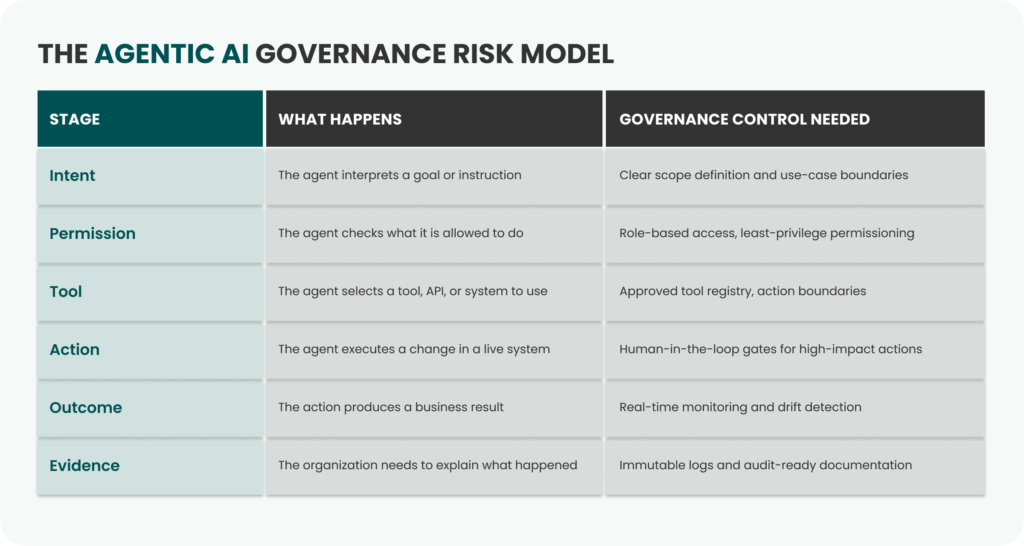
This is the same logic that industry frameworks from organizations such as the OWASP GenAI Security Project, IBM, and Palo Alto Networks converge on from different angles: agentic risk is not one event, it is a sequence, and governing only the beginning or only the end of that sequence leaves gaps in the middle.
What Enterprises Actually Need to Govern
Strip away the framework language, and enterprise agentic AI governance comes down to nine operational disciplines. Most organizations already do some version of these for traditional AI models — the difference is that agentic systems require them to run continuously, not periodically.
- Agent inventory. You cannot govern an agent you do not know exists. A live, centralized register of every agent — including ones spun up by individual teams outside formal IT channels — is the foundation everything else depends on.
- Ownership and accountability. Every agent needs a named business owner, not just a technical maintainer. When an agent takes an action, someone in the organization needs to be answerable for why.
- Risk assessment. Before an agent goes live — and again as its scope changes — its risk profile needs to be scored against factors like the systems it can touch, the data it can access, and the reversibility of its actions.
- Permissions and action boundaries. What an agent is technically capable of doing and what it is authorized to do are not the same thing. Explicit boundaries — and enforcement of those boundaries — prevent capability from becoming unchecked authority.
- Data and tool access. Every connection an agent has to a database, API, or third-party tool is a governance surface. Least-privilege access, scoped credentials, and regular access reviews limit exposure if an agent is compromised or misconfigured.
- Compliance mapping. As agentic systems fall under evolving obligations — from the EU AI Act to ISO/IEC 42001 to sector-specific rules — governance teams need those obligations mapped to the specific agents and use cases they apply to, not managed as a generic checklist.
- Continuous monitoring. Point-in-time review does not work when an agent can act thousands of times between reviews. Monitoring needs to run at the speed the agents operate, watching for behavioral drift, anomalous actions, and policy violations as they happen.
- Governance evidence. When a regulator, auditor, or internal risk committee asks what an agent did and why, “we believe it followed policy” is not an answer. Immutable logs and exportable evidence packs are what turn governance from a claim into a demonstrable fact.
- Human oversight. Autonomy does not mean the absence of humans — it means humans are positioned at the right checkpoints. High-impact or irreversible actions should route through human sign-off, even when lower-risk actions run independently.
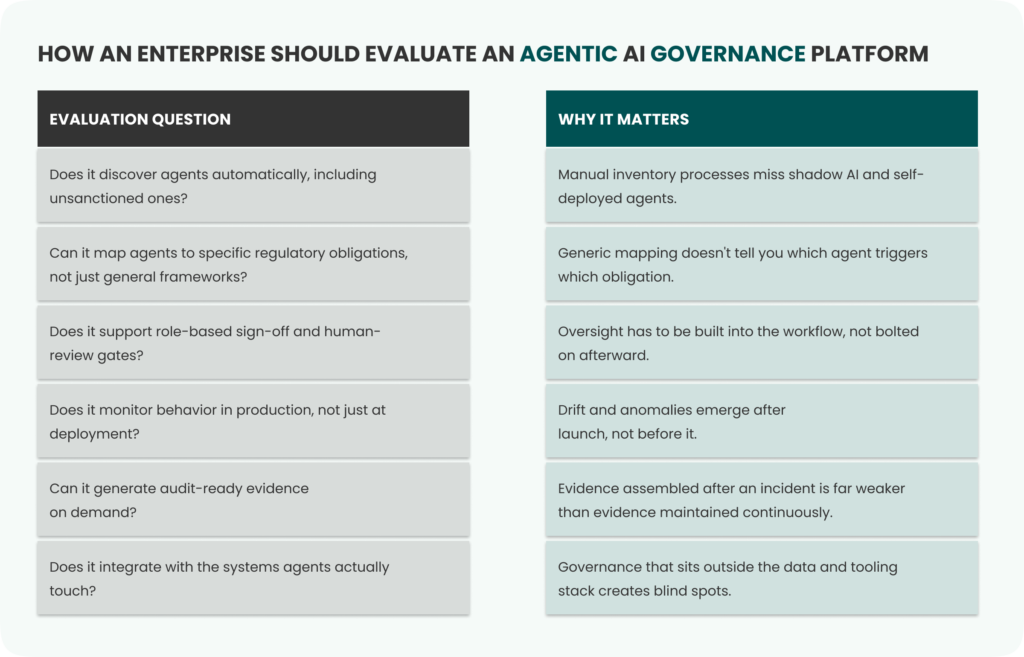
How an Enterprise Should Evaluate an Agentic AI Governance Platform
Most AI governance vendors today were built for model-level governance: documenting a model, running a fairness check, tracking a risk score. Agentic AI governance asks more of a platform, because the thing being governed is behavior, not just a static system. When evaluating a platform for agentic use cases, enterprise buyers should look for specific, verifiable capabilities rather than general claims of “AI governance.”
Where Adeptiv Fits
Adeptiv AI is built as governance infrastructure, not a governance checklist. The platform automatically discovers AI systems across an enterprise — including agents deployed outside formal channels — and maintains a continuously updated inventory rather than a static, periodically refreshed one. From there, it maps use cases to more than 30 global regulatory frameworks, including the EU AI Act, ISO/IEC 42001, and the NIST AI RMF, and keeps that mapping current as regulations change.
For the operational disciplines that agentic AI governance depends on, Adeptiv provides role-based workflows and human-review gates for sign-off, drift and behavioural-anomaly detection for continuous monitoring, and exportable evidence packs with immutable logs for audit readiness. The platform connects directly into the systems where agentic activity actually happens — including Snowflake, Databricks, MLflow, GitHub, S3, Okta, and enterprise SIEM tools — so governance runs alongside the infrastructure agents use, rather than as a separate reporting exercise layered on top of it.
The starting point does not have to be a full agentic governance program. For most enterprises, it begins with visibility: a current, accurate answer to “what AI — including which agents — is actually running in our organization today, and who owns it?” That question, more than any framework, is where Adeptiv’s enterprise AI governance platform is designed to start.
FAQs
1. What is Agentic AI governance?
Agentic AI governance is the set of practices, controls, and infrastructure enterprises use to oversee AI agents that take autonomous actions — covering agent inventory, ownership, permissions, risk assessment, compliance mapping, continuous monitoring, and audit evidence, rather than just reviewing static model outputs.
2. How is Agentic AI governance different from traditional AI governance?
Traditional AI governance reviews a model’s output at a single checkpoint. Agentic AI governance oversees a chain of autonomous decisions and actions — permissions, tool use, execution, and outcomes — which means it has to run continuously rather than at fixed review intervals.
3. What risks do AI agents create for enterprises?
AI agents can access data and systems beyond their intended scope, take irreversible actions without human review, operate outside approved boundaries if permissions are misconfigured, and act faster than periodic governance reviews can catch — creating compliance, security, and operational risk.
4. What should an Agentic AI governance platform provide?
It should provide automated agent discovery, mapping to relevant regulatory obligations, role-based permissioning with human-review gates, continuous production monitoring for behavioral drift, and audit-ready evidence generation — integrated with the systems agents actually use.
5. Why does continuous AI agent monitoring matter?
Because agents can take large numbers of actions between formal review cycles, periodic checks alone can miss drift, policy violations, or anomalous behaviour until after repeated exposure has already occurred. Continuous monitoring closes that gap by observing behaviour as it happens.
6. How does Agentic AI governance relate to AI compliance?
Compliance defines the external obligations — such as the EU AI Act, ISO/IEC 42001, or sector rules — that apply to autonomous AI systems. Governance is the operational discipline that ensures agents actually meet those obligations in practice and can prove it with evidence.
Bring Visibility to Your Agentic AI Footprint
See what AI agents are already running across your enterprise, who owns them, and where the governance gaps are — before a regulator or an incident finds them first.