At a Glance
Before investing in an AI Governance Platforms, enterprise buyers should understand what truly differentiates one solution from another. This guide provides a practical evaluation framework based on governance capabilities rather than feature lists.
- Learn how an AI Governance Platforms helps organisations govern AI throughout the entire lifecycle—from discovery and inventory to monitoring and audit readiness.
- Compare six leading enterprise AI governance platforms using practical criteria including AI inventory, risk assessment, real-time monitoring, and regulatory compliance.
- Understand how major frameworks such as the EU AI Act, ISO/IEC 42001, and NIST AI RMF influence platform selection and procurement decisions.
- Explore the governance capabilities that reduce compliance effort, improve transparency, and support responsible AI adoption at enterprise scale.
- Discover which AI governance capabilities matter most for banking, healthcare, manufacturing, government, insurance, and other regulated industries.
- Use the enterprise buyer’s checklist to evaluate vendors, compare governance maturity, and select a platform that supports long-term AI compliance and operational trust.
THE ONE FACT BUYERS OFTEN LEARN TOO LATE
Most AI failures are not model failures. They’re governance failures. The algorithm worked exactly
as designed — it was the missing oversight, absent audit trail, and unreviewed risk that turned a
working model into a liability. Choosing the wrong AI governance platforms in 2026 isn’t a
procurement mistake. It’s a regulatory one.
Why AI Governance Became Non-Negotiable in 2026
Three years ago, AI governance lived in ethics committees and policy documents. Today it lives in
boardrooms, legal filings, and procurement mandates. The shift happened fast — faster than most
enterprises prepared for.
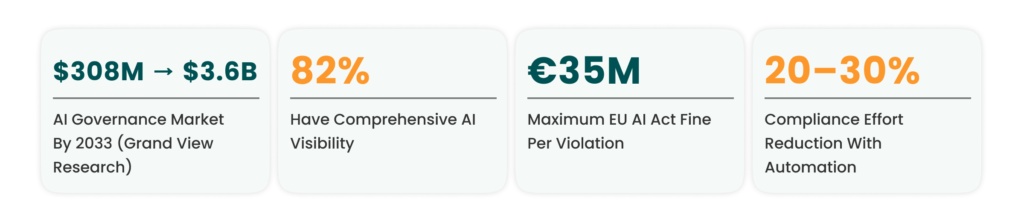
The EU AI Act’s partial enforcement began in February 2025. Full enforcement for high-risk AI systems
follows in August 2026. Organizations deploying AI in credit scoring, clinical decision support, hiring, or
critical infrastructure now face mandatory risk management systems, technical documentation requirements,
and registration in EU databases. Non-compliance carries penalties reaching €35 million or 7% of global
annual turnover — whichever is larger.
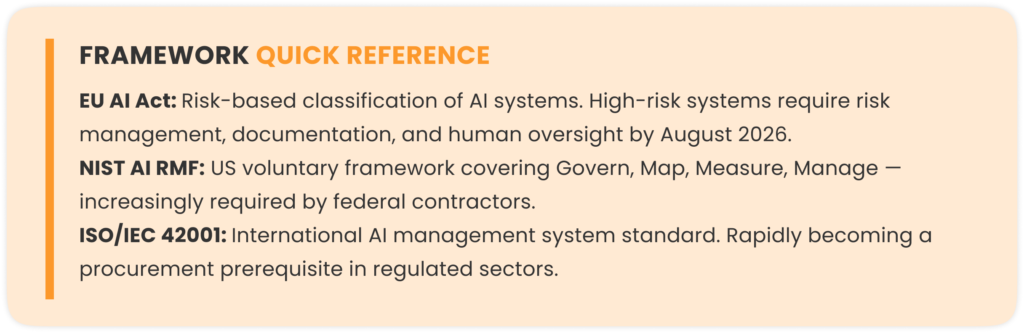
NIST’s AI Risk Management Framework and ISO/IEC 42001 have moved from voluntary guidance to de
facto procurement requirements. Enterprise buyers increasingly ask vendors to demonstrate alignment with
these frameworks before contracts are signed. The question is no longer whether to invest in AI governance.
The question is which platform makes that investment pay off.
What Enterprise Buyers Should Actually Evaluate
Most AI governance RFPs list features. The better question is: what does the platform do when a model
drifts, a regulation changes, or an auditor calls? Below are the eight capabilities that separate adequate tools
from dependable infrastructure.
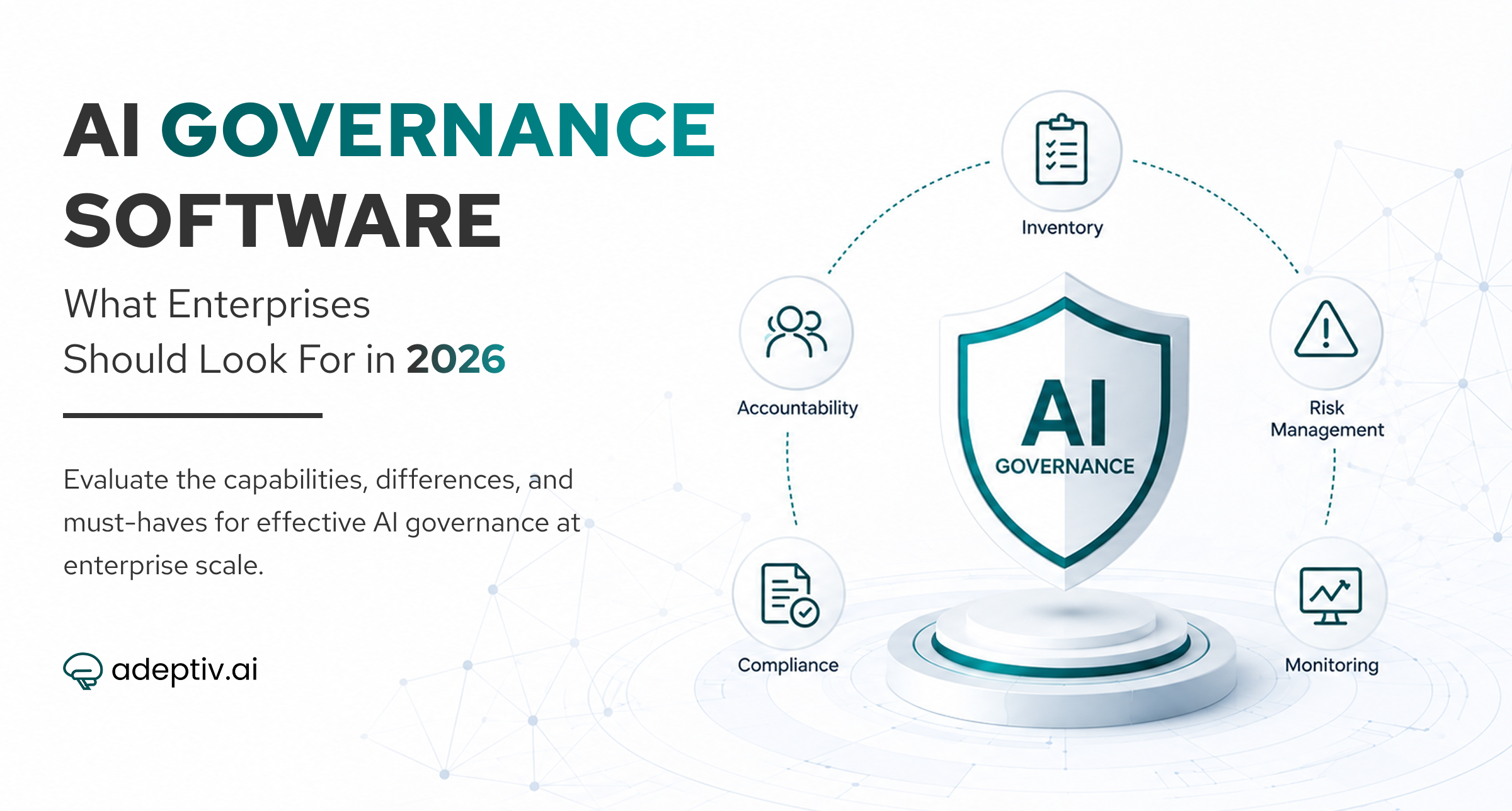
- AI Inventory Management — Complete, continuously updated registry of every AI model, dataset, and
vendor tool in deployment. Without this, governance is guesswork. - Automated Risk Assessment — Risk scoring that maps model behaviour against regulatory thresholds, not manual questionnaires filled out once per quarter.
- Real-Time Monitoring — Continuous oversight of live model outputs. Drift, bias, and performance
degradation detected before they become audit findings. - Regulatory Compliance Mapping — Automated alignment to the EU AI Act, NIST AI RMF, ISO 42001, and
sector-specific requirements. Updated as regulations evolve. - Audit Trail & Documentation — Timestamped, tamper-evident records that satisfy regulators and reduce
legal exposure in dispute scenarios. - Human Oversight Mechanisms — Structured workflows that keep qualified humans in decision loops for
high-risk AI — a hard requirement under the EU AI Act. - Explainability & Transparency — Model output documentation that satisfies both technical auditors and
non-technical board members. - Workflow Automation — Elimination of manual spreadsheet governance. Platforms that save 40+ hours per audit cycle deliver measurable ROI.
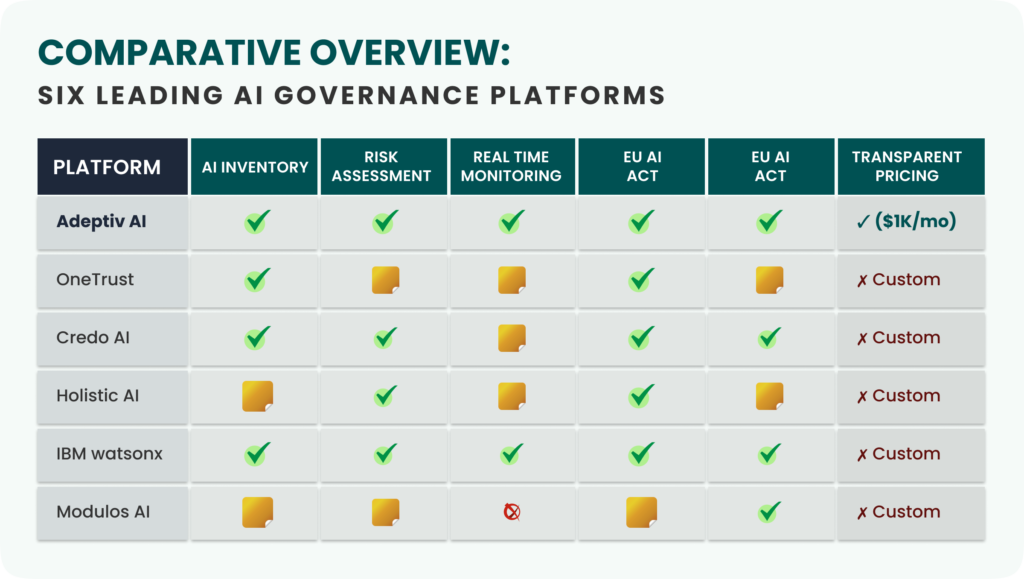
Comparative Overview: Six Leading AI Governance Platforms
The table below reflects publicly available vendor documentation, product pages, and industry reports as of
mid-2026. ✓ = fully supported, ■ = partial or add-on, ✗ = not available or not publicly documented.
Vendor Deep Dives
Adeptiv AI
Purpose-Built for AI governance from the ground up — not adapted from a data catalogue or privacy platform.
Adeptiv AI combines AI inventory management, automated risk assessment, real-time monitoring, and
full-framework compliance (EU AI Act, NIST AI RMF, ISO 42001) in a single, integrated product. Its
transparent pricing starts at $899/month, making it accessible to organisations that need enterprise-grade
governance without enterprise-level procurement timelines. Built specifically for regulated industries:
banking, healthcare, manufacturing, and government. The platform eliminates manual spreadsheet-based
governance and delivers continuous AI oversight — not periodic audits.
OneTrust AI Governance
OneTrust entered AI governance from a strong privacy and GRC foundation. According to publicly available
product information, it offers AI inventory and policy management capabilities well-suited to organisations
already in the OneTrust ecosystem. Real-time model monitoring capabilities, based on vendor
documentation, appear more limited compared to purpose-built AI governance platforms. Pricing follows
custom enterprise models. See comparison.
Credo AI
Credo AI has built strong credibility in AI policy management and risk assessment frameworks. Industry
reports note its alignment with NIST AI RMF and ISO 42001. According to publicly available information, the
platform focuses on structured governance workflows and audit-ready evidence generation. Organizations
seeking deep continuous monitoring capabilities alongside policy management should evaluate how Credo
AI’s feature set aligns with operational requirements. See comparison.
Holistic AI
Holistic AI positions itself around AI auditing and risk assessment, with particular strength in bias and
fairness evaluation based on vendor documentation. According to publicly available information, its inventory
management capabilities may require supplementation for enterprises with complex, multi-model
deployments. Custom pricing applies. See comparison.
IBM watsonx Governance
IBM brings enterprise-grade scale and deep regulatory expertise. Based on vendor documentation, watsonx
Governance integrates across the IBM ecosystem with strong AI lifecycle management capabilities. Industry
reports suggest implementation complexity and cost may represent a barrier for mid-market buyers or
organisations outside the IBM technology stack. Custom enterprise pricing applies. See comparison.
Modulos AI
Modulos AI targets structured AI risk management with an ISO 42001-aligned approach per vendor
documentation. Based on publicly available information, real-time monitoring capabilities appear limited
compared to platforms designed for continuous operational oversight. Organisations requiring live model
monitoring alongside compliance management should evaluate this gap carefully. See comparison.
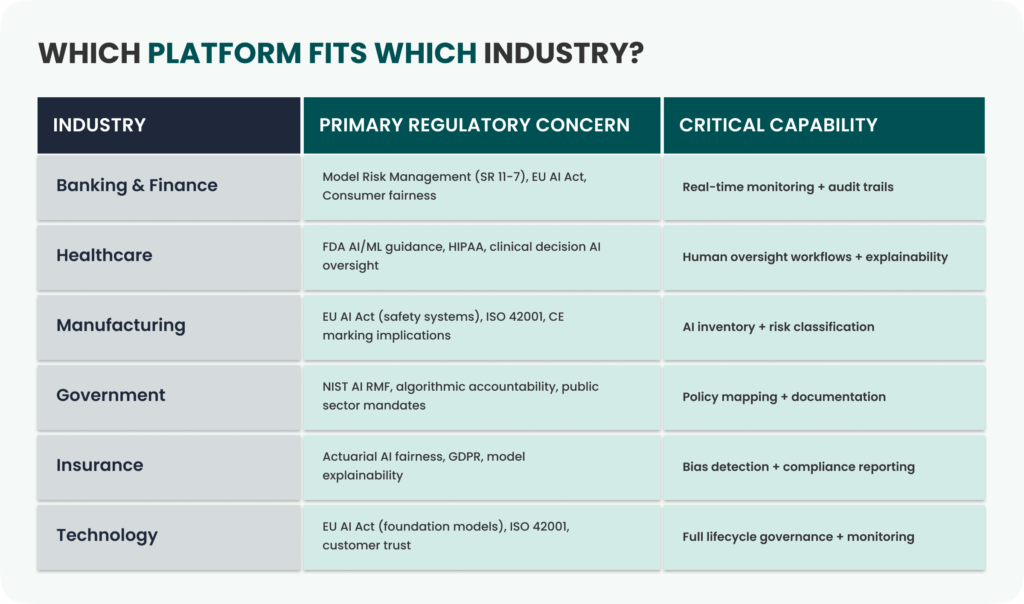
Which Platform Fits Which Industry?
AI governance requirements vary significantly by sector. Regulatory mandates, risk profiles, and audit
expectations differ between a hospital, a bank, and a logistics firm. Generic platforms often struggle to
accommodate this variation in depth.
Build vs Buy: The Hidden Maths of AI Governance
Some organizations default to building AI governance tooling internally. The reasoning is understandable:
custom control, no vendor dependency, existing engineering capacity. The reality rarely matches the plan.
Building a governance platform that covers AI inventory, risk assessment, real-time monitoring, and
regulatory mapping — and keeps pace with regulatory changes — typically requires 18-24 months and a
dedicated engineering team. Regulations change faster than internal roadmaps. The EU AI Act alone
required thousands of stakeholder submissions to shape its compliance guidelines. No internal team tracks
that full-time.
Purpose-built platforms like Adeptiv AI compress time-to-value from months to days, carry regulatory update
responsibility, and eliminate the ongoing maintenance burden. For most enterprises, the buy decision isn’t
about cost — it’s about speed and risk.
Enterprise Buyer’s Evaluation Checklist
Use this checklist when evaluating AI governance platforms in RFP processes or vendor demos:
- Does the platform provide a complete, auto-updating AI inventory across all environments?
- Is risk assessment automated and continuous — or manual and point-in-time?
- Does real-time monitoring cover model drift, bias, and performance simultaneously?
- Are EU AI Act, NIST AI RMF, and ISO 42001 frameworks built in — or sold as add-ons?
- Can the platform generate audit-ready documentation without manual assembly?
- Does pricing scale predictably, or does cost complexity grow with usage?
- What is the implementation timeline from contract signature to first live model governed?
- Does the vendor maintain regulatory update cadence as new frameworks emerge?
- Can the platform integrate with your existing MLOps and data infrastructure?
- Is a human oversight mechanism configuration available for high-risk AI systems?
The Next 24 Months in AI Governance
Full EU AI Act enforcement for high-risk systems arrives in August 2026. Organizations that have not
implemented compliant governance infrastructure by then face their first real enforcement exposure.
According to industry reports, roughly 90% of enterprises anticipate significant operational adjustments as a
result.
The market itself is moving fast. The AI governance software segment is projected to reach $1.21 billion by
2030. Consolidation is inevitable — smaller point solutions will be absorbed into platforms that offer
end-to-end coverage. Buyers who lock into single-capability tools today may face costly migration decisions
within three years.
The platforms that survive consolidation will be those built around continuous oversight — not periodic
audits. Real-time monitoring, automated evidence generation, and proactive regulatory alignment are the
differentiators that matter in 2026 and beyond.
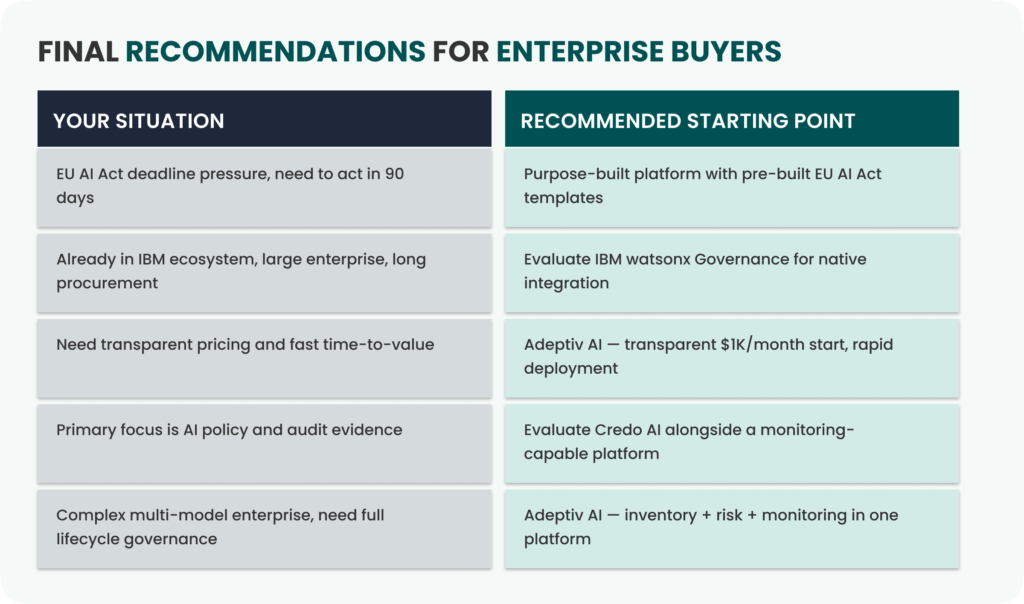
Final Recommendations for Enterprise Buyers
The best AI governance platforms is not the one with the most features — it’s the one your team will actually
use, that keeps pace with regulations, and that produces evidence your auditors and board will accept.
READY TO GOVERN YOUR AI?
Adeptiv AI gives CIOs, Risk Officers, and Compliance teams the governance infrastructure to deploy
AI confidently — with real-time monitoring, automated compliance, and full EU AI Act readiness from
day one.
Book a 30-minute demo
FAQs
1. What is an AI Governance Platforms?
An AI Governance Platforms is software that helps organisations manage AI systems throughout their lifecycle by providing AI inventory management, risk assessment, compliance automation, human oversight, real-time monitoring, and audit-ready documentation. It enables enterprises to govern AI consistently while meeting regulatory requirements.
2. How do I choose the right AI Governance Platforms?
The best AI Governance Platforms should provide automated AI inventory, continuous risk assessment, real-time monitoring, regulatory mapping, audit evidence generation, and support for frameworks such as the EU AI Act, ISO/IEC 42001, and NIST AI RMF. Organizations should evaluate governance capabilities rather than feature counts alone.
3. Why is an AI Governance Platforms important for enterprise AI?
As organisations deploy more AI systems, governance becomes essential for maintaining visibility, reducing operational risk, ensuring regulatory compliance, and generating evidence for audits. An AI Governance Platform helps enterprises operationalise responsible AI instead of relying on manual governance processes.
4. Which regulations should an AI Governance Platform support?
Modern AI Governance Platforms should support major global regulations and frameworks, including the EU AI Act, ISO/IEC 42001, NIST AI RMF, OECD AI Principles, GDPR, and other industry-specific governance requirements. Continuous updates are important as regulations continue to evolve.
5. What capabilities should enterprise buyers compare in an AI Governance Platform?
Enterprise buyers should compare AI inventory management, AI risk assessment, real-time AI monitoring, compliance automation, audit reporting, human oversight workflows, explainability, third-party AI governance, and integration with existing enterprise systems.
6. What is the difference between AI Governance Software and an AI Governance Platform?
AI Governance Software generally refers to individual governance applications or solutions. An AI Governance Platform is broader, combining multiple governance capabilities—including inventory management, risk assessment, monitoring, compliance automation, reporting, and lifecycle governance—within a unified enterprise platform.