At a Glance
- AI Inventory Management is now the foundation of effective AI governance, helping organizations discover, classify, and monitor every AI system operating across the enterprise—including shadow AI, vendor AI, and autonomous agents.
- Why untracked AI systems are becoming one of the biggest regulatory and compliance liabilities for modern enterprises.
- How shadow AI spreads across organizations through employees, SaaS platforms, browser extensions, and third-party vendors without governance oversight.
- The growing impact of regulations such as the EU AI Act, NIST AI RMF, ISO/IEC 42001, and emerging state-level AI laws on AI inventory and accountability.
- Why traditional AI governance approaches based on spreadsheets, annual reviews, and static inventories are no longer sufficient.
- The operational capabilities organisations need to achieve continuous AI discovery, risk assessment, compliance monitoring, audit readiness, and real-time governance at scale.
It is not the AI your CIO approved that keeps legal up at night. It is the one your procurement manager
installed in March, the one your marketing team quietly embedded in customer workflows, and the one
your vendor activated without asking.
Picture this: it is a Tuesday morning, and your Chief Compliance Officer receives an email from the EU AI Act
Supervisory Authority requesting a complete inventory of AI systems deployed across your organization. The
deadline is 14 days. You have two weeks to account for every AI model, every automated decision system, every
embedded copilot, every vendor-integrated AI workflow touching your operations.
Your CIO pulls together the approved AI register. It lists 23 systems. Your internal audit team, conducting a
parallel sweep, finds 74.
The gap between those two numbers is not a technology problem. It is a governance crisis — and it is playing out silently inside most large enterprises right now.
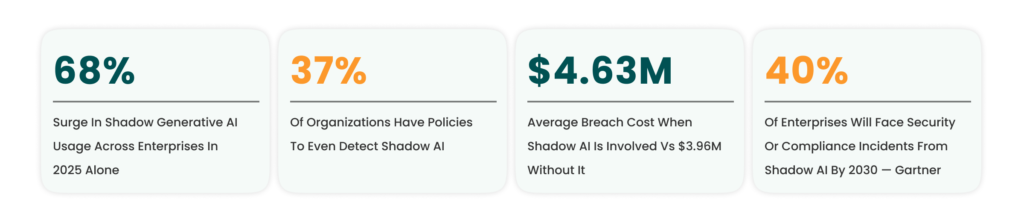
Shadow AI Is Not a Fringe Problem. It Is Organizational Physics
Three forces make shadow AI nearly inevitable inside modern enterprises. First, generative AI has an entry
barrier so low that any employee with a browser can deploy a capable model in minutes. Second, business units
are under visible organizational pressure to use AI — but rarely face any corresponding mandate around
governance. Third, enterprise culture prizes initiative and speed. The employee who automates a workflow
without asking is often celebrated, not questioned.
The result is a quiet proliferation of ungoverned AI that accumulates beneath the surface of enterprise
operations. It is not sabotage. It is rational behavior in an environment where governance structures have not
caught up with AI accessibility.
BOARDROOM SCENARIO
A senior HR director at a 12,000-person financial services firm installs an AI-powered candidate screening tool
through a SaaS platform’s premium tier. It is not formally procured. It processes CVs for six months. When an
external audit surfaces the tool, legal realizes it has been making algorithmic decisions about job candidates —
decisions that, under the EU AI Act and U.S. employment law, require specific human oversight controls,
documented bias assessments, and regulatory registration. The financial exposure? Potentially €15 million or 3%
of global annual turnover — and that is before the reputational cost of a discriminatory hiring algorithm making
headlines.
This is not hypothetical. In 2025, the Massachusetts Attorney General investigated a financial services firm whose AI underwriting models produced documented disparate harm against Black, Hispanic, and non-citizen applicants. No AI-specific law was needed for enforcement — existing consumer protection statutes were sufficient. The settlement required $2.5 million, mandatory annual fair lending testing, and ongoing reporting to the regulator’s office.
The central lesson for every executive: regulators do not need new laws. They need evidence that your AI
caused harm. And ungoverned AI provides that evidence efficiently.
The Invisible Architecture of Enterprise AI Risk
Ask any CIO to list their active AI systems. They will give you a confident answer. Then ask their security team to
conduct a network-level sweep for AI API calls. The results, in most organizations, are jarring.
Shadow AI does not arrive in a single dramatic deployment. It accumulates in layers. A browser extension with high-permission AI capabilities is installed by 20% of your workforce. A SaaS tool that quietly activated a generative AI feature in its latest update. A vendor’s API that reroutes data through an LLM before returning results. An internal team that built a Python script using an OpenAI API key on a personal account.
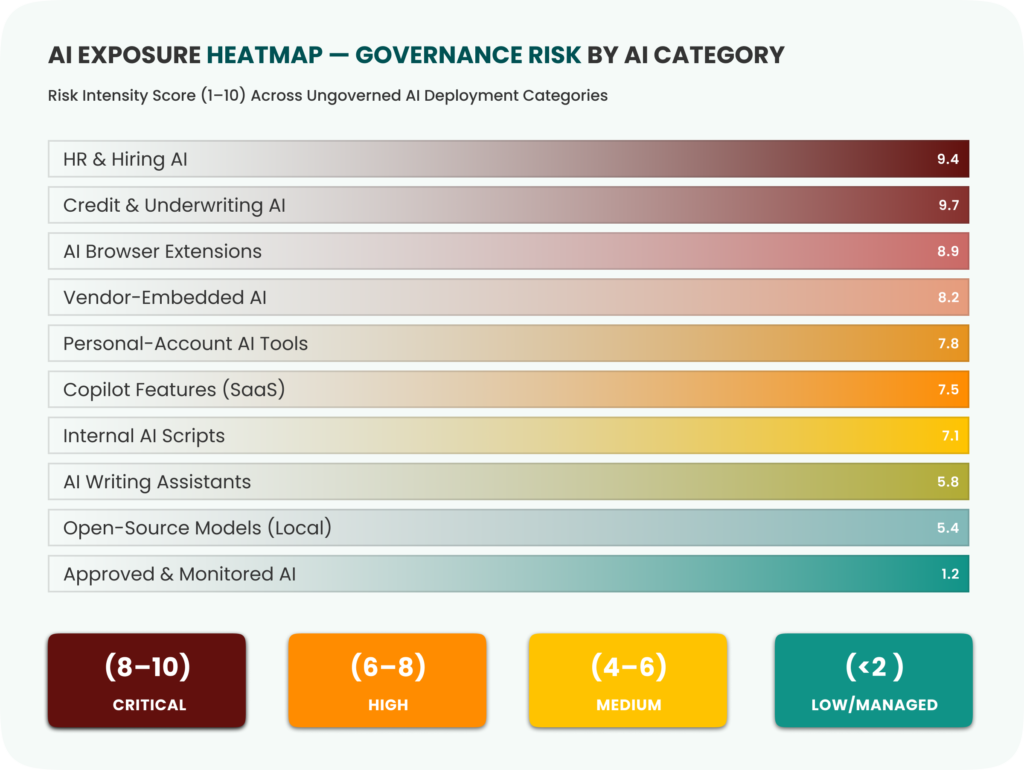
Harmonic Security found that 16.9% of sensitive data exposures — nearly 98,000 instances — occurred on
personal free-tier AI accounts completely invisible to IT. LayerX’s 2025 enterprise analysis found that 20% of
enterprise users had installed AI-enabled browser extensions, with 58% of those carrying high or critical
permission levels. Five percent were classified as outright malicious.
These are not rogue actors. These are your analysts, your managers, your developers — using tools that make
them faster. The governance failure is structural, not behavioral.

— Enterprise AI Governance Risk Framework, Adeptiv AI
Why Your Current Governance Program Is Already Behind
The uncomfortable truth: most enterprise AI governance programs were designed for a world that no longer
exists. They were built to govern a handful of internally-developed models, reviewed quarterly, with clearly
defined ownership. That world ended sometime around 2023.
Today, the average enterprise AI ecosystem includes internally-built models, vendor-provided AI, embedded AI
features inside approved SaaS tools, AI agents that trigger actions autonomously, and an expanding layer of
shadow AI that sits entirely outside formal governance structures. A quarterly policy review does not govern an
environment that changes daily.
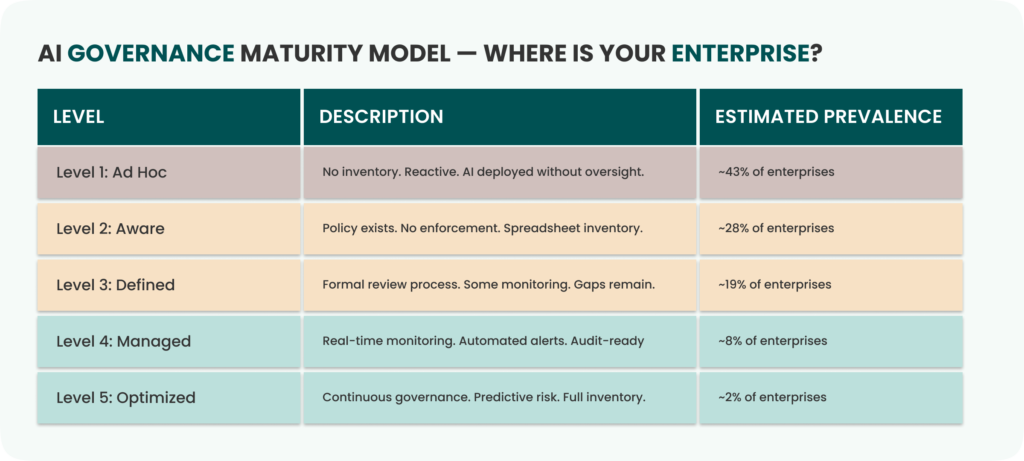
Maturity distribution estimated from IAPP 2025, IBM Cost of Breach 2025, and Infosys KI August 2025 research.
Deloitte’s 2025 global board survey — covering 700 directors across 56 countries — found that 66% of boards
report limited or no AI expertise, and only 14% discuss AI at every meeting. Nearly half had not placed AI on their
agenda at all, even as AI systems were actively making decisions inside their organizations.
The Caremark legal precedent — which holds directors personally accountable for failing to oversee
mission-critical risks — is increasingly being applied to AI systems as they become central to business
operations. Board-level AI liability is no longer theoretical. It is the next frontier of fiduciary duty.
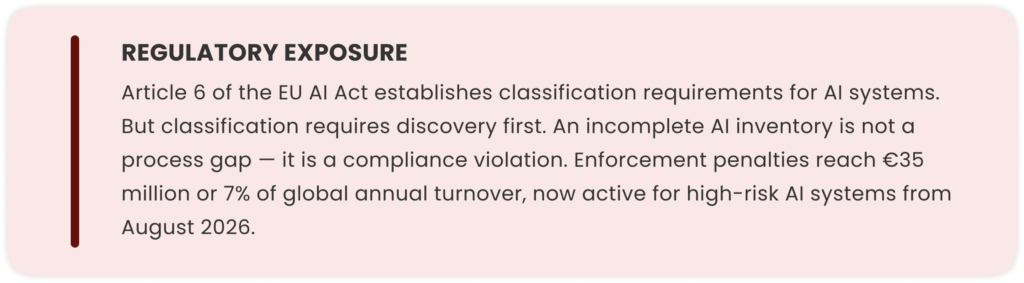
The Regulatory Clock Is Not Waiting for Your Governance Team
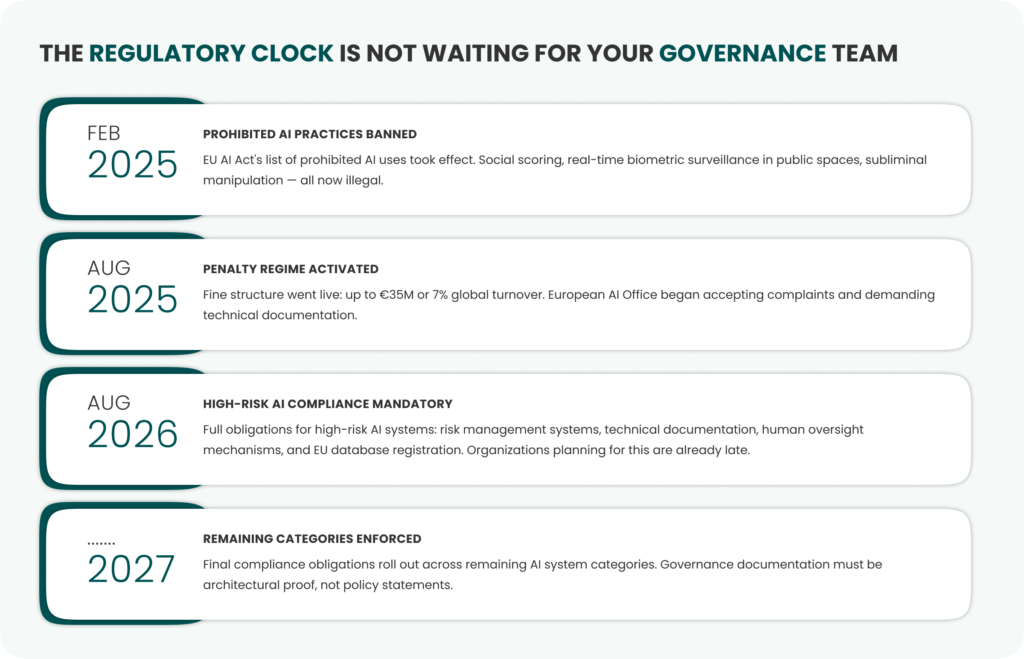
The regulatory environment is not converging on a single framework — it is fragmenting. Over 1,100 AI-related
bills were introduced across U.S. states in 2025 alone. Colorado, Texas, California, and Illinois have each
enacted distinct AI requirements. For any organization operating internationally, this is not bureaucratic
inconvenience. It is a compliance surface area that grows every quarter and cannot be managed through
spreadsheets and annual policy reviews.
What Governance Failure Actually Looks Like at Scale
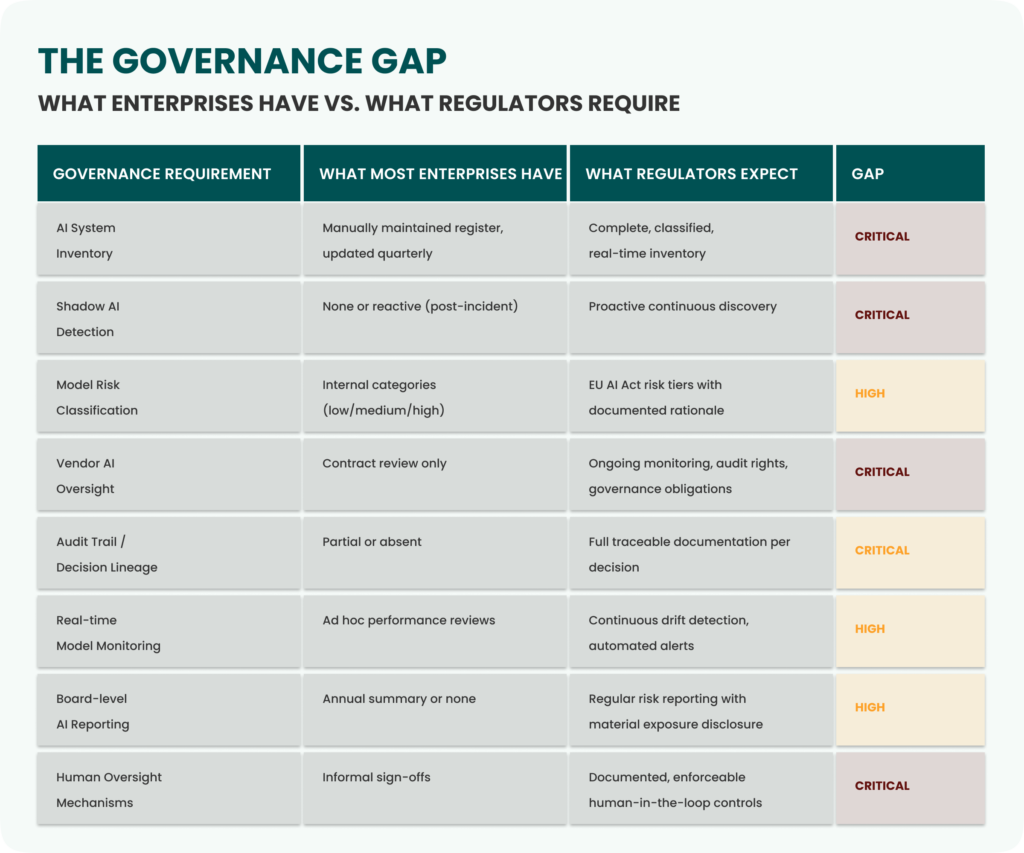
Consider the operational reality that 92% of enterprise CIOs have, according to a Dataiku/Harris Poll survey,
been asked to defend AI outcomes they could not fully explain. That statistic is not about technical ignorance. It is about governance infrastructure — the absence of audit trails, model documentation, decision lineage, and
real-time monitoring that would make explainability possible.
The Infosys Knowledge Institute’s August 2025 research found that 95% of C-suite leaders reported AI incidents
in the past two years. Thirty-nine percent described the resulting damage as extremely severe. The most
common outcomes: financial losses in 77% of cases, followed by reputational and legal setbacks. Most striking:
only 2% of companies currently meet full responsible AI control standards — but those that do experience 39%
lower financial losses when incidents occur.
Governance is not a cost centre. It is risk arbitrage at enterprise scale.
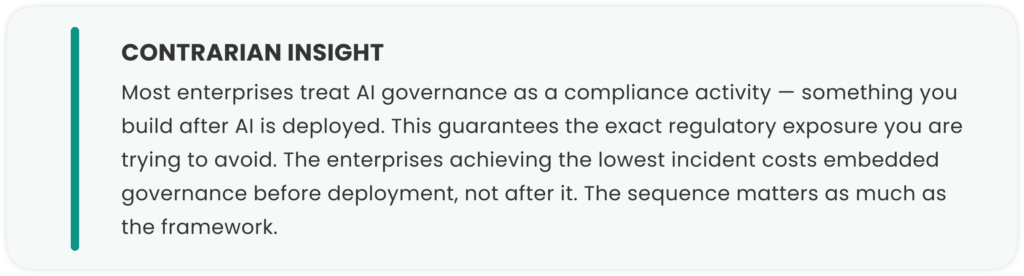
The Vendor AI Problem Nobody Is Talking About
Governance teams focus, understandably, on the AI they built or directly procured. The blind spot is vendor AI — models running inside core business processes through SaaS platforms, APIs, and productivity tools, with no internal oversight, no audit trail, and contract terms that shift liability to the enterprise when something goes wrong.
A third of major breaches in 2025 involved third parties. Yet most enterprise AI registers do not include vendor AI systems at all. The legal fiction that a vendor’s AI is the vendor’s problem evaporates the moment that AI makes a decision affecting your customers, your employees, or your regulatory obligations.
The agentic AI dimension intensifies this further. As AI agents gain the ability to take autonomous actions — drafting emails, placing orders, modifying records, initiating transactions — the governance requirement moves from monitoring outputs to governing behaviors in real time. Static policy frameworks cannot govern dynamic autonomous systems. This is the next frontier of enterprise AI risk, and most governance programs are not architected for it.
What Operational Governance Actually Requires
The organizations achieving genuine governance maturity share a common operational discipline. They treat AI governance not as a policy exercise but as an operational infrastructure — with the same level of engineering rigor and real-time visibility as cybersecurity monitoring. | AI Inventory Management |
This means: continuous AI discovery that catches systems as they appear, not months after deployment. Automated risk classification that maps every AI system to the appropriate regulatory tier without manual review bottlenecks. Real-time model monitoring that detects performance drift, bias emergence, and behavioral anomalies before they become incidents. Vendor AI oversight with contractual audit rights and ongoing governance obligations. And executive-level dashboards that give boards the visibility they need to meet their fiduciary obligations.
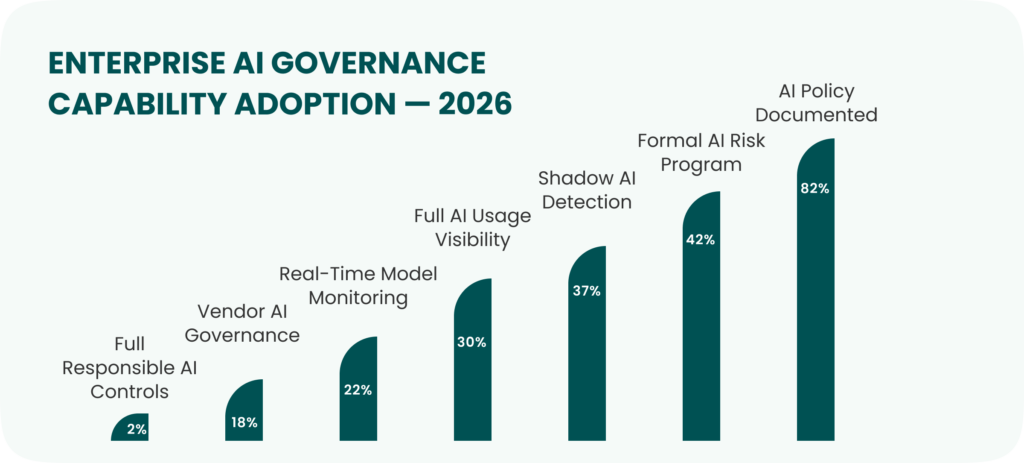
Source: IAPP 2025 AI Governance Report, IBM Cost of Breach 2025, Sprinto CISO Pulse 2026
The distance between what most organizations have — a policy document and a manually-maintained
spreadsheet — and what operational AI governance requires is not small. But the organizations closing that gap
are doing so with measurable results: lower breach costs, faster regulatory response, and the operational
confidence to scale AI adoption without proportionally scaling risk.
Bringing Governance to the Speed of AI
Adeptiv AI is built for the governance reality enterprises are actually operating in — not the one governance
frameworks were designed for. The platform continuously discovers AI systems across the enterprise:
sanctioned, shadow, vendor-embedded, and agentic. It maintains a live, classified AI inventory that reflects your
actual operational environment, not a snapshot from last quarter’s review cycle.
Real-time monitoring surfaces model drift, behavioural anomalies, and compliance signals before they become
incidents. Risk assessment maps every identified AI system to the appropriate regulatory classification — EU AI
Act tiers, NIST AI RMF categories, ISO/IEC 42001 requirements — automatically and continuously. Vendor AI
oversight closes the third-party governance gap that most enterprise programs completely miss.
The result is governance infrastructure that moves at the speed of AI adoption — and executive visibility that
gives boards the information they need to meet their fiduciary obligations before a regulator forces the question.
Find the AI Systems Your Organization No Longer Tracks
Most enterprises discover their true AI inventory during a regulatory inquiry. See how exposed your AI
ecosystem really is — before regulators do.
Request a Governance Gap Assessment.
FAQs
1. What is AI Inventory Management and why is it important?
AI Inventory Management is the process of continuously identifying, tracking, classifying, and governing all AI systems operating across an organization. It helps enterprises maintain visibility into approved, vendor-provided, shadow, and agentic AI systems while supporting compliance, risk management, and audit readiness.
2. What is Shadow AI and why is it a governance risk?
Shadow AI refers to AI tools, models, copilots, browser extensions, or automated workflows used without formal organizational approval or oversight. Shadow AI creates governance challenges because organizations often cannot assess risks, monitor usage, document accountability, or demonstrate compliance for these systems.
3. How does AI Inventory Management support compliance with the EU AI Act?
The EU AI Act requires organizations to understand where AI is being used, classify AI systems based on risk, document oversight mechanisms, and maintain evidence of compliance. AI Inventory Management provides the visibility and governance foundation needed to identify regulated AI systems and support ongoing compliance efforts.
4. How can organizations discover unknown AI systems across the enterprise?
Organizations can discover unknown AI systems through continuous AI discovery processes that identify internally developed models, SaaS-based AI features, AI APIs, browser extensions, vendor AI tools, and agentic AI systems. Automated AI inventory management solutions help maintain an accurate and up-to-date view of the enterprise AI landscape.
5. What are the risks of not maintaining an AI inventory?
Without an AI inventory, organizations may struggle to identify shadow AI, manage third-party AI risks, respond to regulatory inquiries, investigate AI-related incidents, perform risk assessments, or demonstrate compliance with frameworks such as ISO/IEC 42001 and NIST AI RMF. This can increase legal, operational, financial, and reputational exposure.
6. How does AI Inventory Management improve AI governance?
AI Inventory Management enables organizations to establish ownership, classify AI systems by risk, monitor usage, assess regulatory obligations, and maintain audit-ready records. It serves as a foundational capability for effective AI governance, responsible AI programs, and enterprise-wide AI risk management.
7. What is the difference between AI Inventory Management and AI Governance?
AI Inventory Management focuses on discovering and maintaining visibility into AI systems across the organization. AI Governance is the broader framework that includes policies, risk assessments, monitoring, compliance controls, accountability mechanisms, and oversight. Effective AI governance begins with a complete and accurate AI inventory.