At a Glance
- Why most AI governance platforms fail after deployment — despite strong frameworks and documentation.
- The difference between traditional governance workflows and operational AI governance.
- How shadow AI, vendor AI, and runtime drift create invisible enterprise risk.
- Why real-time AI monitoring and continuous compliance are becoming regulatory requirements.
- What enterprises need to become audit-ready under the EU AI Act, ISO 42001, and NIST AI RMF.
- How Adeptiv AI helps organisations operationalise AI governance with live monitoring, AI inventory management, and automated evidence generation.

The AI Governance Gap Enterprises Cannot See
Most enterprises believe they are governed. They have frameworks mapped to ISO 42001, NIST AI RMF, and the EU AI Act. They have AI risk registers, compliance dashboards, and vendor approval workflows. | AI governance platforms |
None of that tells them what their AI systems are actually doing in production right now.
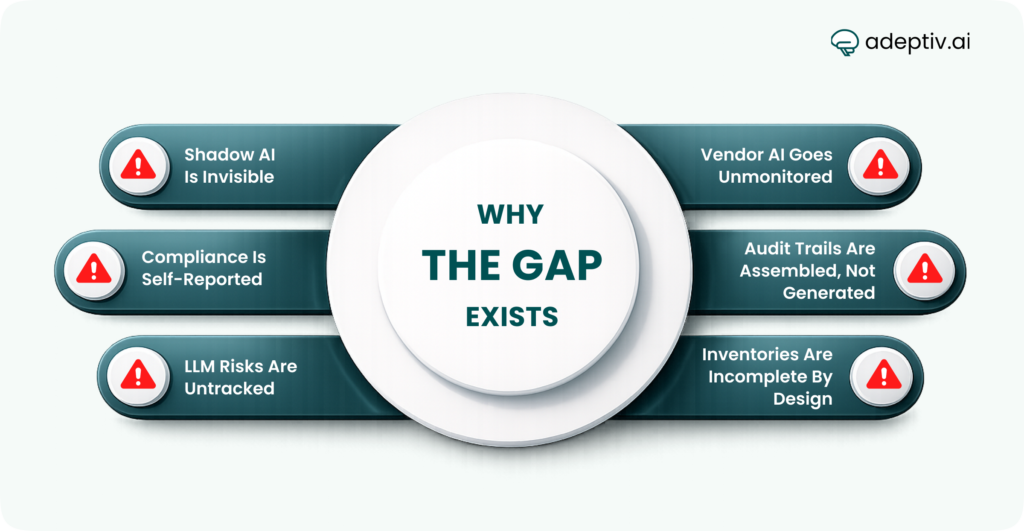
A governance framework tells you what your AI systems are designed to do. Operational AI governance tells you what they are doing — right now, in every decision, in every environment they touch.
The Adeptiv AI Governance Platform: Four Pillars of Operational Governance
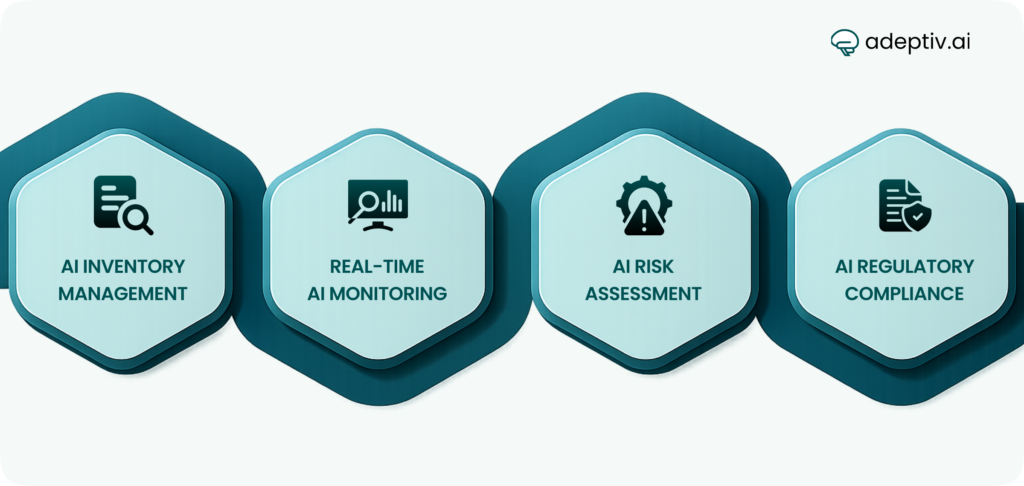
Adeptiv AI is not a compliance documentation tool. It is an operational AI governance platforms infrastructure — the layer that runs continuously alongside enterprise AI systems, from deployment through retirement, whether anyone is actively watching or not.
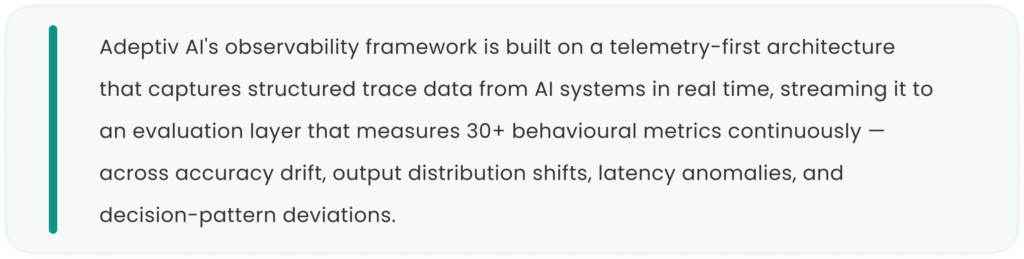
Traditional AI Governance vs. Operational AI Governance
This is not a feature comparison. It is a philosophy comparison — and the difference determines whether your governance survives a regulatory examination.
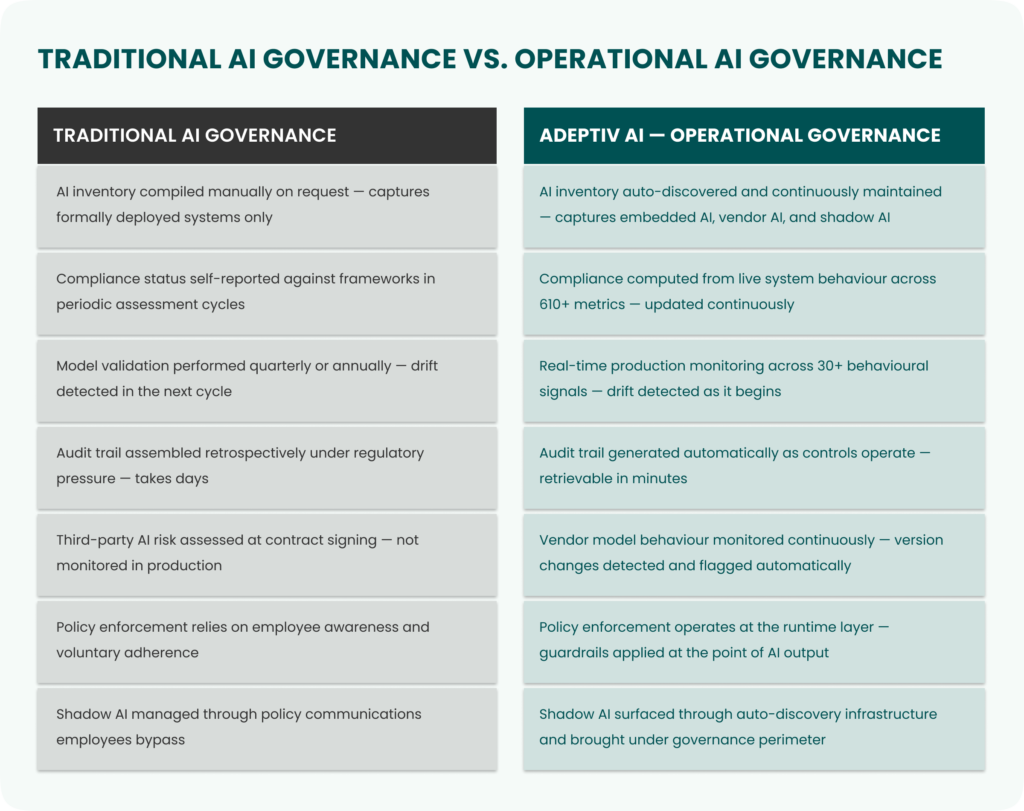
Built for the Regulatory Environment You Are Already Operating In
Adeptiv AI automates compliance across 40+ global regulations — not as a framework-mapping exercise, but as live compliance computation based on actual AI system behaviour. Every regulation below is monitored continuously, with evidence generated automatically. | AI governance platforms |
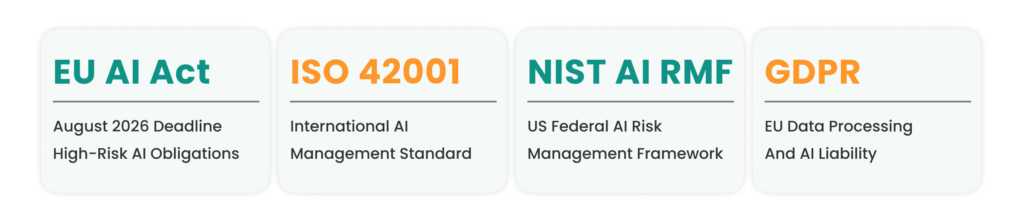
The AI Governance Maturity Framework: Which Stage Are You At?
Enterprise AI governance exists on a spectrum from entirely ungoverned to continuously operational. Most enterprises cluster at Stage 2 or 3 — and believe they are at Stage 4.
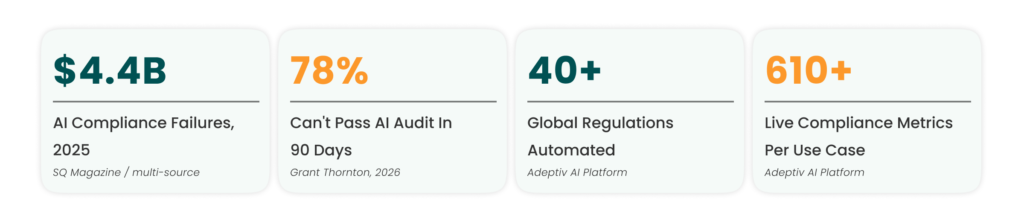
The Grant Thornton 2026 AI Impact Survey found that 78% of executives doubt they could pass an independent AI governance audit within 90 days. Most enterprises are at Stage 2 — documented governance — believing they are at Stage 4. The gap is not aspirational. It is operational.
Purpose-Built for Regulated Industries
Banking & Financial Services
Credit scoring, underwriting, and fraud detection are classified as high-risk AI under EU AI Act Annex III and require continuous risk management, real-time human oversight, and audit-ready evidence. Adeptiv AI provides credit risk governance, adverse action explainability for FCRA compliance, SR 11-7 alignment, and real-time fraud model observability.
→ Internal link: adeptiv.ai/ai-governance-in-banking/1565C0.
Healthcare
AI-powered EHR analysis, diagnostic support, and patient summary tools are high-risk under the EU AI Act. Adeptiv AI delivers real-time observability, clinical AI risk assessment, and cross-jurisdictional compliance management — making AI outputs defensible to regulators, clinicians, and patients.
→ Internal link: adeptiv.ai/ai-powered-ehr-analysis-patient-summary/1565C0.
Insurance
Underwriting pricing models and AI-driven claims adjudication face regulatory scrutiny for bias, explainability, and decision traceability. Adeptiv AI provides continuous monitoring for drift and bias with automated compliance documentation across applicable frameworks.
Government & Critical Infrastructure
AI systems in government operations, border management, and critical infrastructure management are subject to the most demanding EU AI Act obligations. Adeptiv AI’s governance infrastructure is built for the evidence requirements these sectors face.
AI Governance Audit Readiness: 10 Questions Your Organisation Must Answer
This is the standard that a 2026 regulatory examination, external audit, or board governance review will apply. Each question requires operational evidence — not policy assertions.
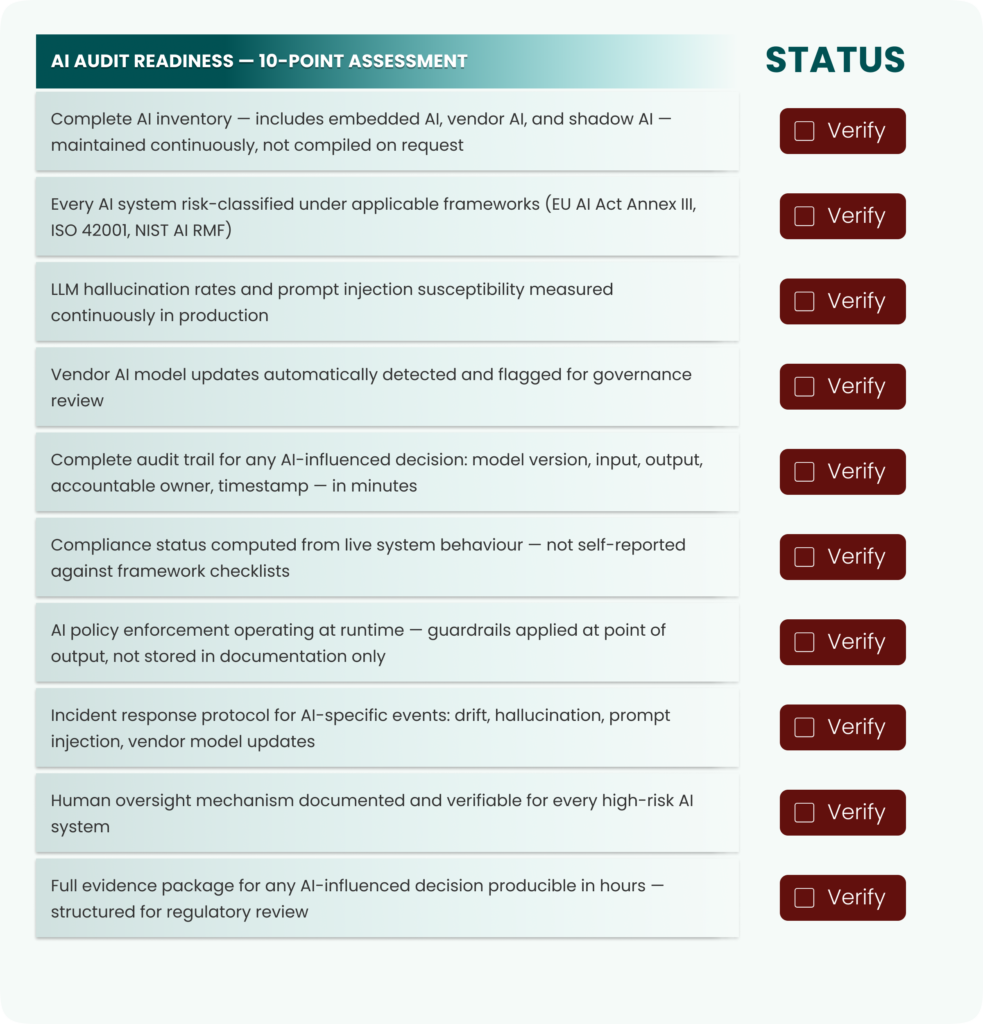
If three or more items above are unchecked, your organisation has a material governance gap — not a planning gap. The systems creating the exposure are already in production.
The Operational AI Governance Standard Is Already Being Set
Finland activated EU AI Act enforcement in January 2026. Italy fined OpenAI €15 million for AI-related GDPR violations. The SEC identified AI governance as its primary 2026 examination priority. Regulators are not waiting — and neither are the enterprises that will be best positioned when they arrive.
The organisations that navigate 2026’s regulatory environment with confidence will not be the ones with the most sophisticated governance frameworks. They will be the ones whose governance was operational before the examination — continuously monitoring, continuously computing compliance, continuously generating evidence.
FAQs
Q1. What is an AI governance platform, and what should it actually do?
An AI governance platform is infrastructure that enables an organisation to manage the risk, compliance, accountability, and performance of AI systems across their full operational lifecycle — from deployment through retirement. A genuinely operational platform provides continuous AI inventory management (including shadow AI and embedded AI), real-time production monitoring, automated compliance tracking across regulatory frameworks, and self-generating audit trail documentation. Most platforms provide only part of this — typically documentation and framework mapping. Adeptiv AI is built for all four capabilities simultaneously.
Q2. What is the difference between AI governance software and an AI governance framework?
An AI governance framework (such as NIST AI RMF, ISO 42001, or an EU AI Act compliance programme) is a set of principles, standards, and requirements that describe how AI should be governed. AI governance software is the operational infrastructure that implements and enforces those requirements in practice — auto-discovering AI systems, monitoring them in real time, computing compliance from actual behaviour, and generating the evidence frameworks require. A framework without software describes intent. Software without a framework lacks structure. Adeptiv AI automates compliance across 40+ frameworks simultaneously.
Q3. How does real-time AI monitoring differ from periodic model validation?
Periodic model validation checks AI system performance at scheduled intervals — typically quarterly or annually. Real-time AI monitoring captures structured trace data from AI systems continuously, tracking 30+ behavioural metrics including accuracy drift, output distribution shifts, latency anomalies, and decision-pattern deviations. The critical difference: a model that begins drifting on Day 3 after a quarterly validation will influence thousands of decisions before the next scheduled review. Real-time monitoring detects it on Day 3. Adeptiv AI’s telemetry-first observability architecture is built specifically for production-grade continuous monitoring.
Q4. What is shadow AI, and why does it matter for AI governance?
Shadow AI refers to AI tools used within an organisation without explicit IT, security, or compliance oversight — including GenAI tools accessed through personal accounts, AI activated in SaaS platform updates, and browser-based LLM tools employees use without approval. Research indicates 71% of knowledge workers use AI tools without IT approval, with unsanctioned tools running undetected for up to 400 days. Shadow AI is directly relevant to EU AI Act compliance, which requires complete AI inventories and AI literacy provisions for all employees involved in AI use. Adeptiv AI auto-discovers shadow AI and brings it under the governance perimeter.
Q5. Does the EU AI Act apply to AI systems already deployed?
Yes. The EU AI Act introduced GPAI model obligations in August 2025 and reaches full applicability for most high-risk AI systems — including credit scoring, fraud detection, healthcare diagnostics, and employment AI — on August 2, 2026. Finland activated EU AI Act enforcement powers in January 2026. Non-compliance can result in fines of up to €15 million or 3% of global annual turnover for high-risk system violations. Adeptiv AI automates EU AI Act compliance continuously, including evidence generation for regulatory examination.
Q6. What AI regulations does Adeptiv AI cover?
Adeptiv AI automates compliance across 40+ global regulations including the EU AI Act, ISO 42001, NIST AI RMF, GDPR, FCRA, SR 11-7, RBI guidelines, DORA, OECD AI Principles, MAS AI governance guidelines, FCA AI regulations, and others. Compliance is computed from live AI system behaviour — not mapped from self-assessment checklists. This means compliance status is current, verifiable, and audit-ready at any point in time.
Q7. How is Adeptiv AI different from traditional AI governance tools?
Traditional AI governance tools focus on documentation: policy workflows, AI registries, risk registers, and framework mapping exercises. Adeptiv AI is operational AI governance infrastructure — auto-discovering AI systems, evaluating them continuously in production, computing compliance from live behaviour across 40+ regulations, enforcing policies at the runtime layer, and generating audit evidence automatically. The difference is not a feature comparison. It is a governance philosophy: documentation versus operation. Adeptiv AI is built for the second — governance that runs whether anyone is watching or not.