| EU AI Act Digital Omnibus | The high-risk deadline was pushed back. Transparency obligations weren’t. Here’s exactly what applies today,
what was deferred, and to whom.
At a Glance
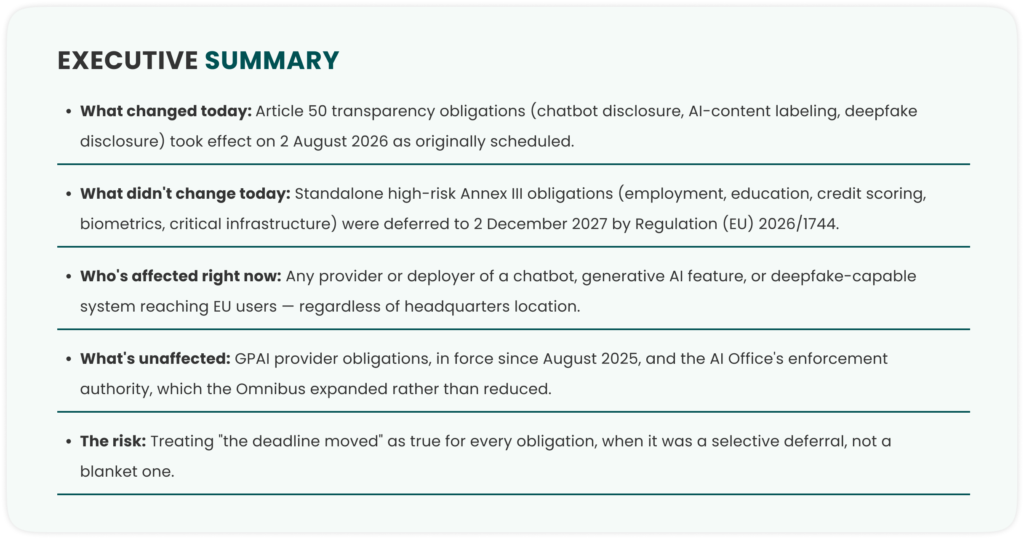
- What changed: The EU AI Act’s Article 50 transparency obligations—including chatbot disclosure, AI-generated content labeling, and deepfake disclosure—are now scheduled to apply from 2 August 2026.
- What was deferred: Several high-risk AI system obligations under Annex III were deferred to 2 December 2027 under the Digital Omnibus on AI (Regulation (EU) 2026/1744).
- Who is affected now: Organizations providing or deploying chatbots, generative AI features, or deepfake-capable systems that reach EU users may already have transparency obligations, regardless of where the organization is headquartered.
- What remains in force: The AI Act’s general application framework, GPAI obligations, and AI Office enforcement powers continue to apply; the deadline change does not remove all compliance responsibilities.
- The key takeaway: The August 2026 change is not a blanket extension of the EU AI Act. Organizations need to distinguish between obligations that were deferred and those that remain applicable now.
QUICK ANSWER
On 2 August 2026, the EU AI Act’s high-risk system obligations for standalone Annex III systems (employment, education, credit scoring, law enforcement, critical infrastructure, biometrics, migration) did not take effect as originally scheduled — they were deferred to 2 December 2027 by the Digital Omnibus on AI (Regulation (EU) 2026/1744), which entered into force on 27 July 2026. What did take effect today: Article 50 transparency obligations — chatbot disclosure, AI-generated content marking, and deepfake labeling — along with the AI Act’s general application date and expanded AI Office enforcement powers. The deadline didn’t disappear. It narrowed to a different, still-substantial set of obligations.
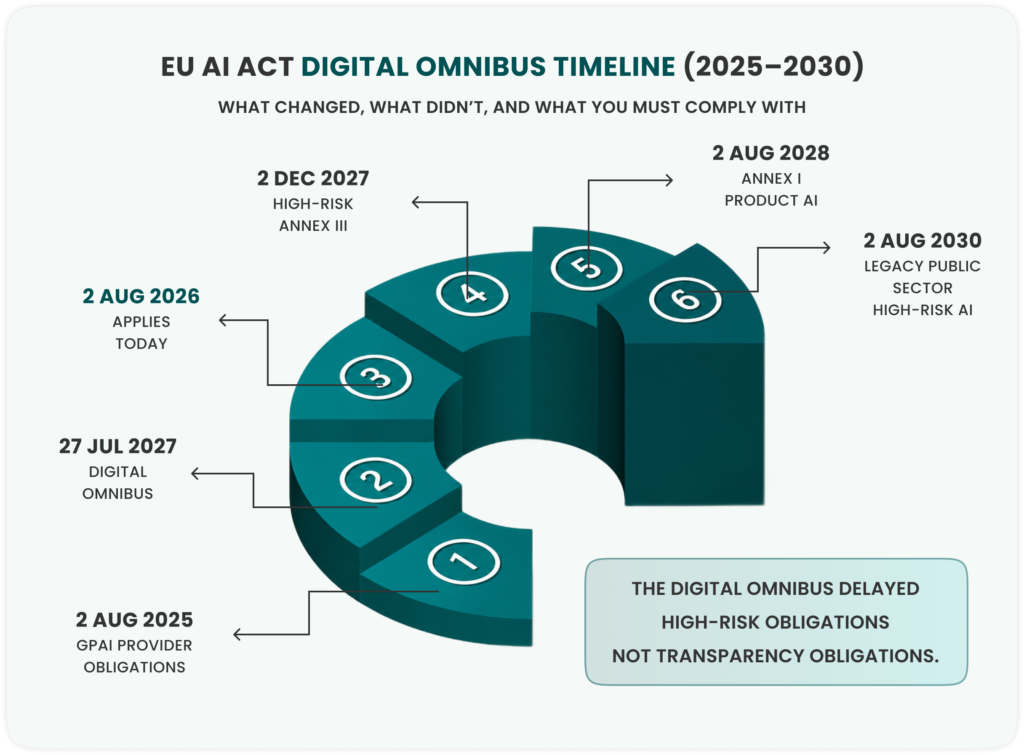
The Digital Omnibus delayed high-risk obligations, not transparency obligations.
The Headline Everyone Read — and the Line Most People Missed
The Digital Omnibus on AI was first proposed by the European Commission on 19 November 2025, in response to well documented delays in the AI Act’s implementation infrastructure — national competent authorities, conformity assessment bodies, and harmonised technical standards for high-risk systems simply weren’t ready. The European Parliament approved the final amendments on 16 June 2026, the Council gave its final sign-off on 29 June 2026, and the regulation was formally published and entered into force in the final days of July — five days before this article, and comfortably before the original 2 August 2026 deadline it was designed to beat.
The coverage that followed, understandably, led with the headline change: high-risk obligations, delayed. What that framing regularly leaves out is that the deferral was selective, not blanket. Article 5 prohibitions and general-purpose AI (GPAI) provider obligations kept their original schedule — GPAI obligations have applied since August 2025. And Article 50’s transparency duties were left entirely untouched, still landing on the original date: today.
What Actually Lands Today — 2 August 2026
- Article 50 transparency obligations — Disclosure requirements for chatbots and conversational AI, labeling for AI generated or manipulated content, and deepfake disclosure. These apply regardless of whether the underlying system is separately classified high-risk.
- The AI Act’s general application date — The baseline provisions of the Act that aren’t tied to a specific risk tier become applicable.
- Expanded AI Office enforcement authority — The Digital Omnibus strengthens the European AI Office’s supervisory powers alongside the timeline changes, meaning the deferral came with more enforcement capacity attached, not less.
- Continuation of GPAI provider obligations — Already in effect since August 2025, unaffected by today’s changes.
The practical effect: any organization deploying a chatbot, a generative AI feature, or a system capable of producing synthetic media or deepfakes for EU users has a live disclosure obligation as of today — a substantially broader population than the eight high-risk sectors whose deadline just moved. Getting this distinction right starts with an accurate AI inventory that separates systems by which obligation — and which deadline — actually applies to each one.
Not sure which of your AI systems trigger Article 50 today?
Adeptiv AI maps every system in your inventory to its correct post-Omnibus obligation in minutes, not weeks.
Request a Demo
What Got Pushed, and By How Long
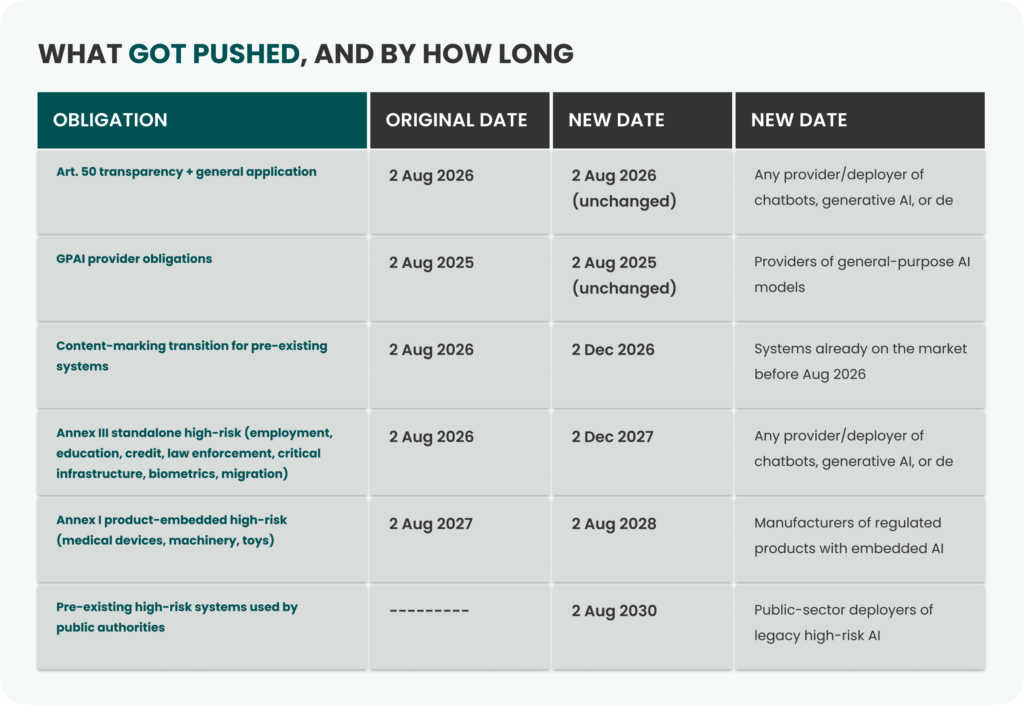
One more detail worth noting for anyone tracking where regulation is heading next: in Annex XIV, the Omnibus names “agentic AI” in EU law for the first time — without yet defining or classifying it, but establishing that dedicated assessment competences for it are coming. It’s an early signal, not a current obligation — worth watching, not yet worth building a compliance program around.
Why the Deferral Doesn’t Mean Less Governance Work
Two things are true at once, and most organizations are only planning around one of them. First: if your AI systems fall under Annex III high-risk categories, you have genuinely more time — use it to build the technical documentation, risk management processes, and conformity evidence properly, rather than against the original compressed timeline. Second: if you deploy anything a user could reasonably mistake for a human, or anything capable of generating synthetic media, your transparency obligations did not move, and “we have more time” is the wrong takeaway.
The AI Office’s expanded enforcement powers under the Omnibus compound this. A longer runway for high-risk
compliance, paired with a more empowered regulator and an unmoved transparency deadline, is not a net reduction in governance urgency — it’s a redistribution of it. This is exactly the kind of shifting, multi-track obligation set that a one time AI Risk Assessment can’t keep up with; it needs real-time AI monitoring that updates as the regulation itself does.
Boardroom Questions Every CIO, CCO, and Legal Counsel Should Be Able to Answer Today
- Which of our AI-facing products or features trigger Article 50 transparency obligations — and can we prove disclosure is actually implemented, not just planned?
- Have we correctly separated “deferred to 2027/2028” obligations from “live today” obligations in our own compliance tracking, or is our roadmap still built on the pre-Omnibus timeline?
- Does our AI inventory distinguish systems by which specific Annex and deadline they fall under, or are we treating “EU AI Act compliance” as one undifferentiated deadline? This is precisely the gap a structured AI regulatory compliance mapping is built to close.
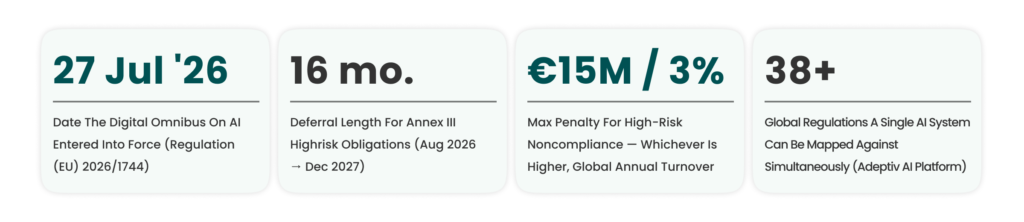
- Who is accountable for the newly extended timeline not becoming an excuse to deprioritize high-risk system work that still needs 16 months of genuine preparation?
Procurement Checklist
Before your next AI governance product evaluation, confirm the vendor can demonstrably do all four — not just
describe them:
- Map each AI system in your inventory to its correct post-Omnibus deadline (Aug 2026, Dec 2026, Dec 2027, Aug 2028, or Aug 2030), not a single generic “EU AI Act” status.
- Flag Article 50 transparency obligations independently of high-risk classification, since the two now run on entirely different timelines.
- Update regulatory mappings automatically when legislation changes, rather than requiring a manual re-audit every time the EU (or any other regulator) amends a framework.
- Produce audit-ready evidence of transparency implementation — not just a policy stating it will be done.
EU AI Act Digital Omnibus Compliance Checklist
A practical checklist covering:
- Article 50 transparency obligations.
- High-risk AI deadlines.
- AI inventory readiness.
- Evidence collection.
- Board reporting.
Download the checklist
Frequently Asked Questions
1. What is the EU AI Act Digital Omnibus?
The Digital Omnibus on AI is Regulation (EU) 2026/1744, the first formal set of amendments to the EU AI Act since its original adoption in 2024. Proposed by the European Commission in November 2025 and finalized by the European Parliament and Council in June–July 2026, it defers most high-risk AI system obligations while leaving transparency obligations and general-purpose AI provider rules unchanged.
2. Did the EU AI Act’s August 2026 deadline get delayed?
Partially. The deadline for standalone high-risk AI systems under Annex III (employment, education, credit scoring, law enforcement, critical infrastructure, biometrics, migration) was deferred from 2 August 2026 to 2 December 2027. Article 50 transparency obligations and the Act’s general application date were not deferred and took effect on the original date, 2 August 2026.
3. Who has to comply with EU AI Act transparency obligations today?
Any provider or deployer of a chatbot, conversational AI system, or technology capable of generating or manipulating synthetic content (including deepfakes) that reaches EU users — regardless of whether that system is separately classified as high-risk, and regardless of where the company is headquartered.
4. Does the EU AI Act apply to companies outside the EU?
Yes. The AI Act applies extraterritorially to providers and deployers whose AI system’s output is used within the EU, which means US, UK, Canadian, Gulf, Singaporean and Indian companies serving EU customers or employees are in scope even without an EU legal entity.
5. What are the penalties for non-compliance?
Non-compliance with high-risk AI system obligations carries penalties of up to €15 million or 3% of global annual turnover, whichever is higher. The Digital Omnibus additionally expanded the European AI Office’s supervisory and enforcement authority alongside the timeline changes.
Know Exactly Which EU AI Act Deadline Applies to Every AI System
The Digital Omnibus changed the timeline — but not the need for continuous AI governance. Adeptiv AI
automatically:
- Discovers AI systems across the enterprise, including vendor-embedded and shadow AI.
- Maps each system to the correct EU AI Act obligations — by Annex, by deadline, not as one undifferentiated status.
- Monitors regulatory changes across 38+ global frameworks, so mappings update when the law does.
- Produces audit-ready evidence for regulators and internal governance teams.
If someone on your board asked which of your AI systems are affected by today’s changes — not the ones delayed to 2027, the ones live right now — could you answer in minutes, or would it take days?