At a Glance
- What AI governance software actually does, and how it differs from a policy or a periodic review.
- Why AI adoption, regulatory complexity and accountability expectations are outpacing manual governance.
- The specific problems AI governance software is built to solve, mapped against the manual alternative.
- The capability stack buyers should evaluate — discovery, risk, compliance, evidence and monitoring — and how they connect.
- The practical difference between AI governance tools, software and platforms.
- An 11-question buyer checklist to use directly in a vendor evaluation.
Most enterprises can describe their AI policy in a sentence. Far fewer can describe, with evidence, which AI systems are actually running across the business, who owns each one, and what would happen if a regulator asked to see proof tomorrow.
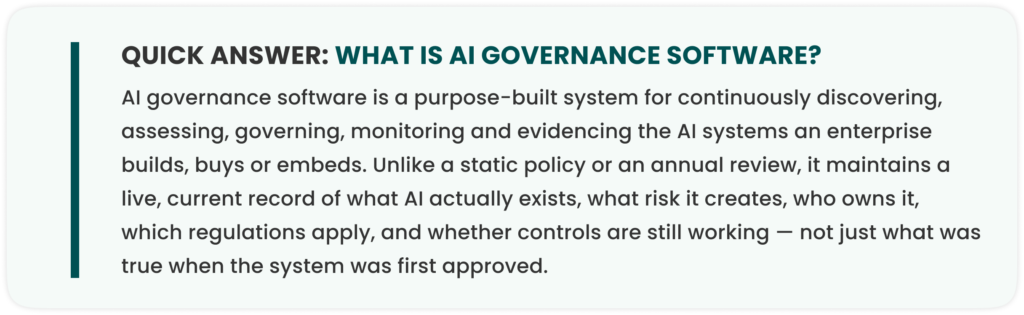
That gap is why AI governance software has become its own buying category rather than a feature inside a broader GRC suite. A policy states intent. Software is what lets an enterprise demonstrate, continuously, that the intent is actually being met.
This guide covers what AI governance software actually does, why manual governance breaks down at enterprise
scale, and exactly what to evaluate before selecting a platform.
Why Enterprises Need Dedicated AI Governance Software
Three forces are pushing AI governance out of the policy binder and into the enterprise software stack: AI adoption moving faster than manual processes can track, regulation becoming an operational requirement rather than a document exercise, and accountability expectations that now demand evidence, not assurance.
AI adoption is outpacing manual governance
Business teams procure AI-enabled SaaS directly. Developers deploy models and agents without always routing
through central review. Vendors add AI features to products that were approved long before those features existed. A governance process built entirely around people remembering to submit a form does not scale against that pattern — and increasingly, it isn’t just a theory.
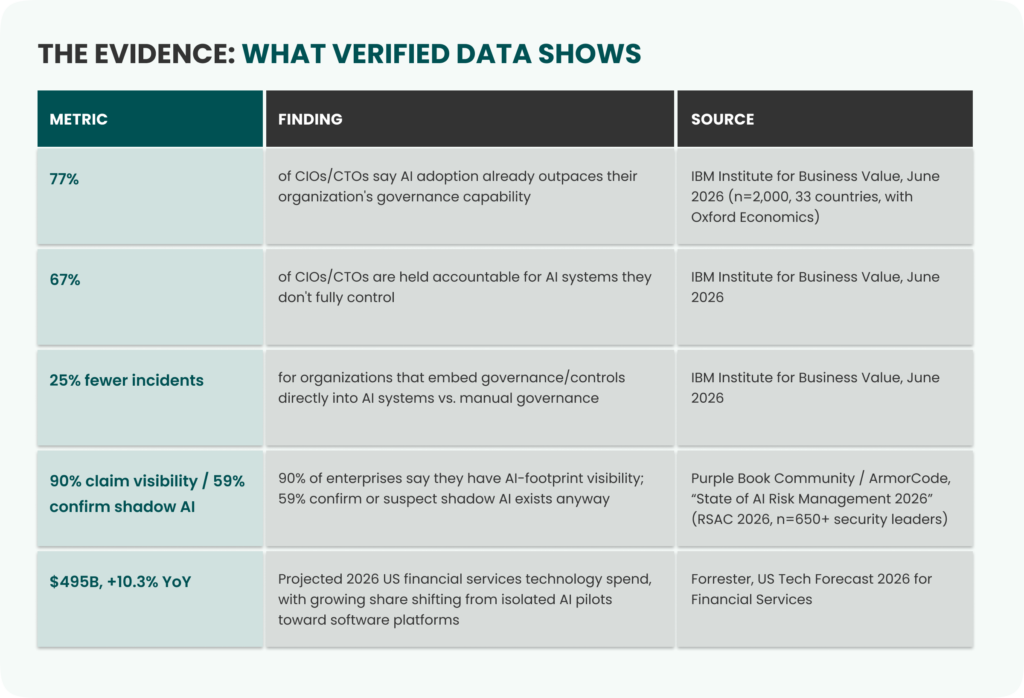
An IBM Institute for Business Value study of 2,000 CIOs and CTOs across 33 countries, conducted with Oxford
Economics and published in June 2026, found that 77% say AI adoption is already outpacing their organization’s
governance capability. That’s not a minority experience — it’s the majority position among enterprise technology
leaders today.
Regulation is becoming an operational requirement
Enterprises increasingly need to translate frameworks into operational controls, ownership, evidence and repeatable process — not just a summary of what a regulation says. Relevant obligations may include the EU AI Act, ISO/IEC 42001, NIST AI RMF, data protection law and sector-specific rules, depending on jurisdiction and industry.
The harder challenge isn’t knowing what a framework requires. It’s keeping that requirement connected to the
specific AI systems, risks, controls and evidence it applies to, as the environment keeps changing underneath it.
Accountability now demands evidence, not assurance
“Which AI systems affect our customers,” “who owns the associated risk,” “what controls are in place” — these have become board and customer questions, not just technical ones. The same IBM research found 67% of CIOs and CTOs are personally held accountable for AI systems they don’t fully control. When the answers to accountability questions are scattered across spreadsheets, email threads and individual teams, the organization is carrying risk it can’t actually see.
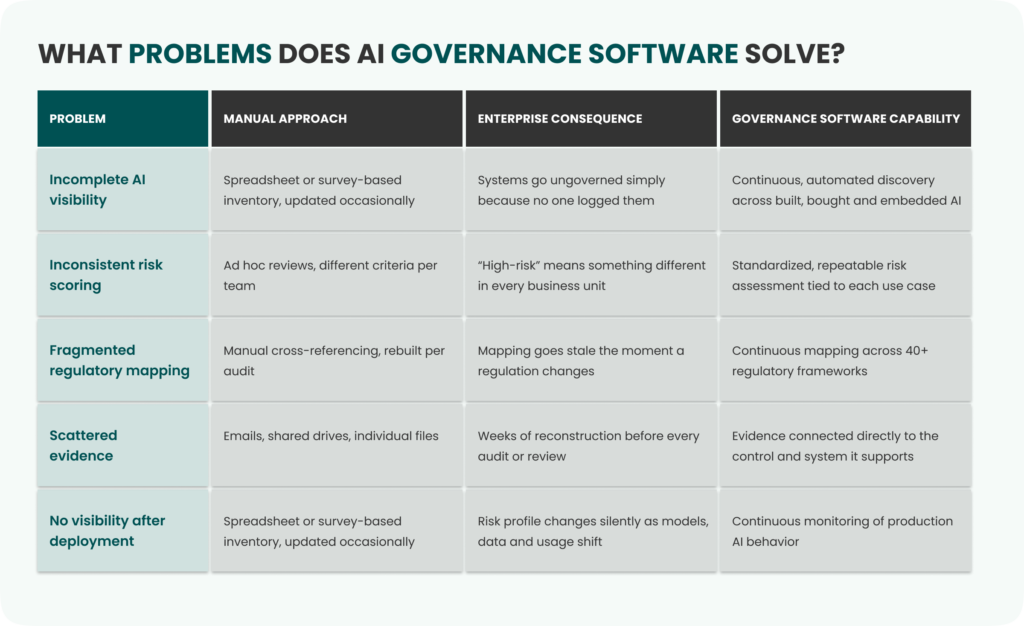
What Problems Does AI Governance Software Solve?
What Should Enterprises Look For in AI Governance Software?
Evaluate connected capabilities, not isolated features. Each of the five areas below should share data with the
others — a system discovered in inventory should be the same system scored for risk, mapped to regulation and
monitored in production, not re-entered manually at each stage.
AI Inventory and Discovery
What it is: a centralized, continuously updated view of every AI system and use case operating across the
enterprise, including systems that would otherwise remain outside formal governance. Why it matters: every
downstream governance activity depends on knowing what exists first. What to check: does discovery happen
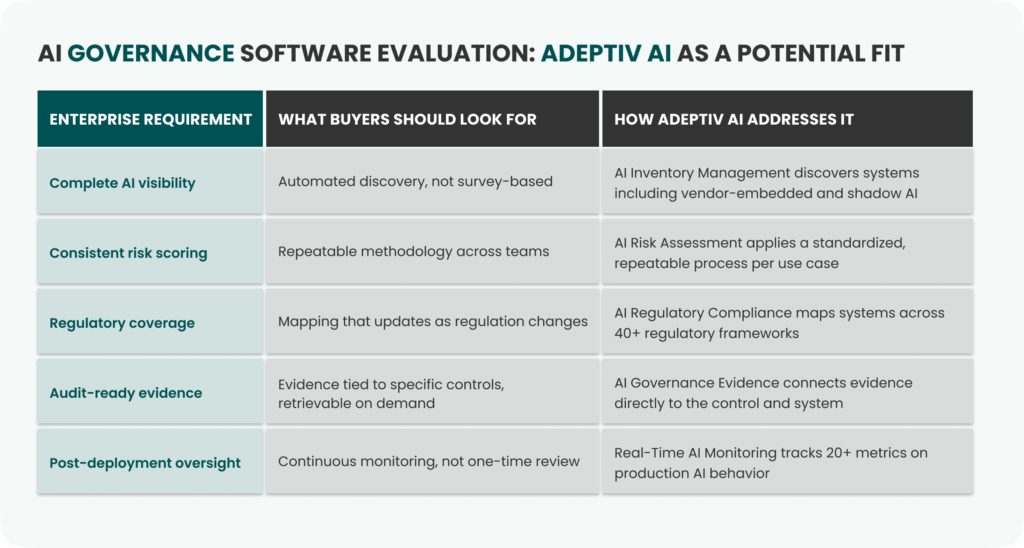
automatically, or does it depend on someone submitting a form? Adeptiv AI supports AI Inventory Management to help organizations build this operational view.
AI Risk Assessment
What it is: a repeatable, documented process for scoring the risk a specific AI use case creates. Why it matters: a risk score from initial approval says nothing about the system six months later, after retraining or a use-case
expansion. What to check: can assessments be re-triggered by a material change, or only performed once?
Adeptiv AI’s AI Risk Assessment is built for this repeatable model.
AI Regulatory Compliance
What it is: the connection between applicable regulatory or standards requirements and the specific systems,
controls, owners and evidence needed to satisfy them. Why it matters: knowing what a regulation says is not the
same as proving a specific system complies with it. What to check: does mapping update automatically when a
regulation changes? Adeptiv AI supports governance across 40+ regulatory frameworks through AI Regulatory
Compliance.
Controls, Evidence and Audit Readiness
What it is: evidence connected directly to the control, system and owner it supports, retrievable on demand. Why it matters: “we have a policy” doesn’t satisfy a regulator or auditor — they’re asking for the specific control, its status and its proof. What to check: can evidence be produced today, or does it require reconstruction under deadline pressure? See AI Governance Evidence.
Real-Time AI Monitoring
What it is: continuous visibility into production AI behaviour after deployment, not only before it. Why it matters:
models drift, vendors change embedded AI features without notice, and risk that wasn’t visible in testing can emerge at scale. What to check: does monitoring continue through the system’s operational life? Adeptiv AI provides 20+ AI monitoring metrics through Real-Time AI Monitoring.
IMPORTANT
AI governance software should not simply create another repository of policies. The objective is to connect
AI inventory, risk, controls, compliance, evidence and monitoring into one operating system for governance
— not five disconnected tools updated on five different schedules.
The Enterprise AI Governance Capability Stack
These capabilities aren’t independent — they’re links in a chain: Discover → Assess → Govern → Comply →
Monitor → Evidence → Improve. Break discovery, and every downstream step scores against a partial picture.
Break monitoring, and everything upstream describes a system that no longer exists in its current form. Enterprise governance maturity is measured by whether an organization can move through this full chain for any system, on demand — not by how many individual capabilities appear on a vendor’s feature list.
AI Governance Tools vs. AI Governance Software vs. AI Governance Platform
These terms are used inconsistently across the market, and no fixed industry definition separates them cleanly. That said, buyers commonly encounter three tiers of breadth:
- AI Governance Tools typically refers to point solutions addressing one activity — a bias-testing tool, a model documentation generator, a policy template library. Useful, but narrow by design.
- AI Governance Software usually describes a broader application meant to manage governance activities systematically, though the term alone doesn’t guarantee the underlying capabilities are actually connected.
- AI Governance Platform generally implies integration: multiple governance functions operating on shared data, so a system discovered in inventory is the same system scored for risk and monitored in production.
What matters for a buyer isn’t which label a vendor uses. It’s whether discovery, risk, compliance, evidence and
monitoring operate on the same underlying record — or require manual reconciliation between separate tools that don’t talk to each other.
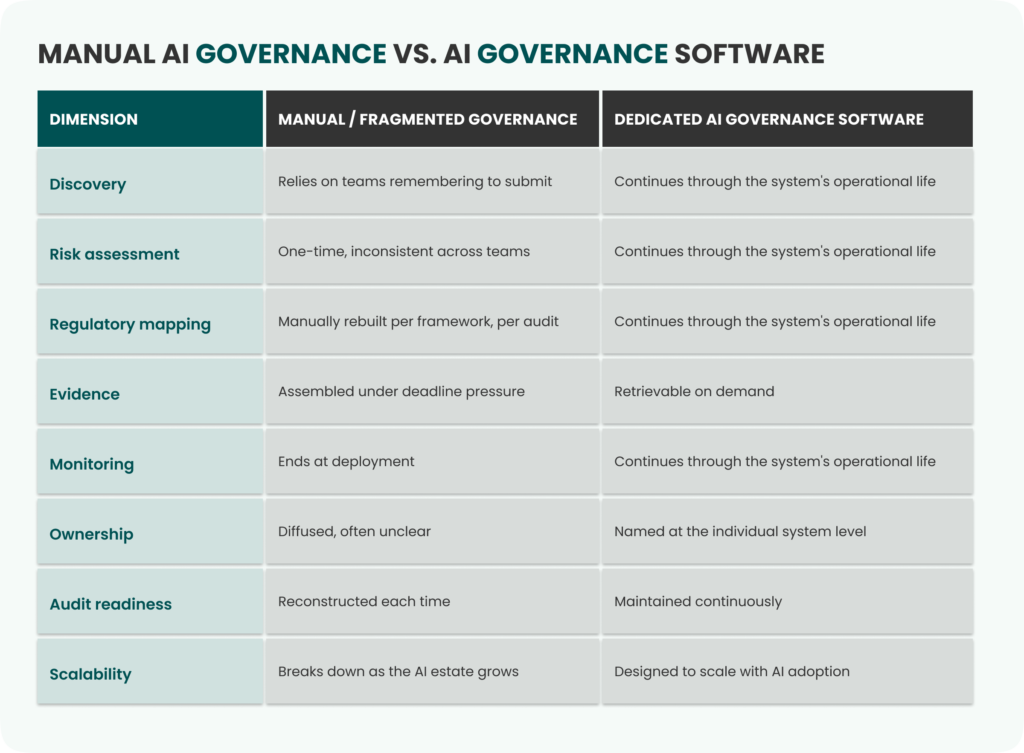
Manual AI Governance vs. AI Governance Software
When Should an Enterprise Move Beyond Manual AI Governance?
A dedicated platform becomes increasingly valuable when several of these are already true:
- The AI portfolio is growing or spread across multiple business units.
- Business units adopt AI independently, or through third-party vendors, without central review.
- Risk assessments live in spreadsheets or disconnected documents.
- Compliance teams map multiple regulations or standards by hand.
- Evidence is scattered across repositories and hard to retrieve quickly.
- AI systems need monitoring after deployment, not just before it.
- Leadership, customers, auditors or regulators expect faster proof of governance than the current process can produce.
See How Adeptiv AI Connects This Lifecycle
Adeptiv AI’s AI Governance Product brings inventory, risk assessment, regulatory compliance, evidence
and real-time monitoring into one connected environment. Explore the AI Governance Product.
How to Evaluate AI Governance Software: Buyer Checklist
Use these questions directly in a vendor evaluation:
- Can the platform discover AI systems automatically, including vendor-embedded and employee-adopted tools?
- Can risk assessments be repeated and re-triggered when a system changes, not just performed once at approval?
- Can each AI system be mapped to the specific regulations that apply to it, with evidence?
- Can evidence be traced directly to the control and system it supports?
- Can the platform monitor AI systems continuously in production, not only before deployment?
- Can ownership be assigned and tracked at the individual system level?
- Can the platform integrate with existing enterprise systems — identity, ticketing, GRC, data catalogs?
- Can governance scale across business units and jurisdictions without manual reconciliation?
- Can the vendor demonstrate these capabilities live, on a real AI system, rather than only in a slide deck?
- How quickly can the platform become operational — weeks, or a multi-quarter implementation?
- Does the platform distinguish clearly between what’s automated and what still requires human judgment?
IMPORTANT
A vendor demo that shows every feature individually is not the same as a platform that connects them. Ask
any AI governance vendor to walk through one AI system, live, from discovery through risk score, applicable regulation, control and current monitoring status — in a single continuous view, not five separate screens.
The Evidence: What Verified Data Shows
Where Adeptiv AI Fits
Adeptiv AI is an enterprise AI Governance Platform built to connect the governance lifecycle — from discovery and inventory through risk assessment, regulatory compliance, evidence and real-time monitoring — in one environment rather than as separate, disconnected tools.
The platform brings together AI Inventory Management, AI Risk Assessment, compliance mapping across 40+
regulatory frameworks through AI Regulatory Compliance, evidence and audit readiness via AI Governance
Evidence, and continuous oversight through Real-Time AI Monitoring’s 20+ monitoring metrics.
The objective isn’t simply documenting governance. It’s operationalizing it — so an organization can answer what AI it has, what risk it creates, who owns that risk, what requirements apply, and what has changed, without
reconstructing the answer from scratch each time someone asks.
AI Governance Software Evaluation: Adeptiv AI as a Potential Fit
Talk to an AI Governance Expert
If your AI estate has grown faster than your governance process can track it, that gap is worth mapping
now — before an auditor, regulator or board finds it first. Talk to an AI Governance Expert.
Frequently Asked Questions
1. What is AI governance software?
AI governance software is a platform that helps organizations continuously discover, assess, govern, monitor and document AI systems across their lifecycle — maintaining a live record of what’s actually happening, rather than a static policy describing what should happen.
2. What is the difference between AI governance software and an AI policy?
An AI policy defines expectations for how AI should be used. AI governance software operationalizes those expectations through inventory, risk management, controls, evidence, ownership and monitoring — turning intent into something that can be demonstrated and proven.
3. What is the difference between AI governance software and AI governance tools?
There’s no fixed industry line between the terms, but in practice, “tools” often describes point solutions for one activity, while “software” or “platform” implies broader, connected coverage. The distinction worth evaluating is whether capabilities share data or require manual reconciliation between separate systems.
4. What features should an AI governance platform have?
At minimum: automated AI inventory and discovery, repeatable risk assessment, regulatory mapping, control and evidence management, accountability workflows, and continuous post-deployment monitoring — connected as one system rather than five separate ones.
5. How does AI governance software support regulatory compliance?
It connects AI systems to the specific requirements, controls, owners and evidence that apply to them, and keeps that mapping current as regulations change — rather than requiring compliance teams to manually rebuild the mapping before every review.
6. Can AI governance software manage Shadow AI?
Yes, when discovery is continuous and automated rather than dependent on manual submission. That’s what allows a platform to surface AI systems that were never formally reported — including vendor-embedded and employee-adopted tools.
7. How does AI governance software support audit readiness?
By keeping evidence connected to specific systems and controls on an ongoing basis, so it’s retrievable on demand — rather than assembled under deadline pressure before each audit.
8. When should an enterprise invest in AI governance software?
When several conditions are already true: a growing or distributed AI portfolio, AI adoption happening independently across business units, risk assessments living in spreadsheets, evidence scattered across repositories, and a need to demonstrate governance faster than the current process allows.