AT A GLANCE
- AI Governance Revenue Strategy is quickly becoming one of the most important competitive advantages for enterprises deploying AI at scale.
- Enterprise buyers now evaluate AI governance maturity alongside security, compliance, and technical capabilities during vendor selection.
- Organizations with documented AI governance programs are seeing higher win rates, shorter sales cycles, and stronger customer trust.
- AI governance has evolved from a compliance requirement into a commercial asset that influences procurement decisions.
- Regulated industries such as banking, healthcare, insurance, aviation, and government increasingly require governance evidence before approving AI vendors.
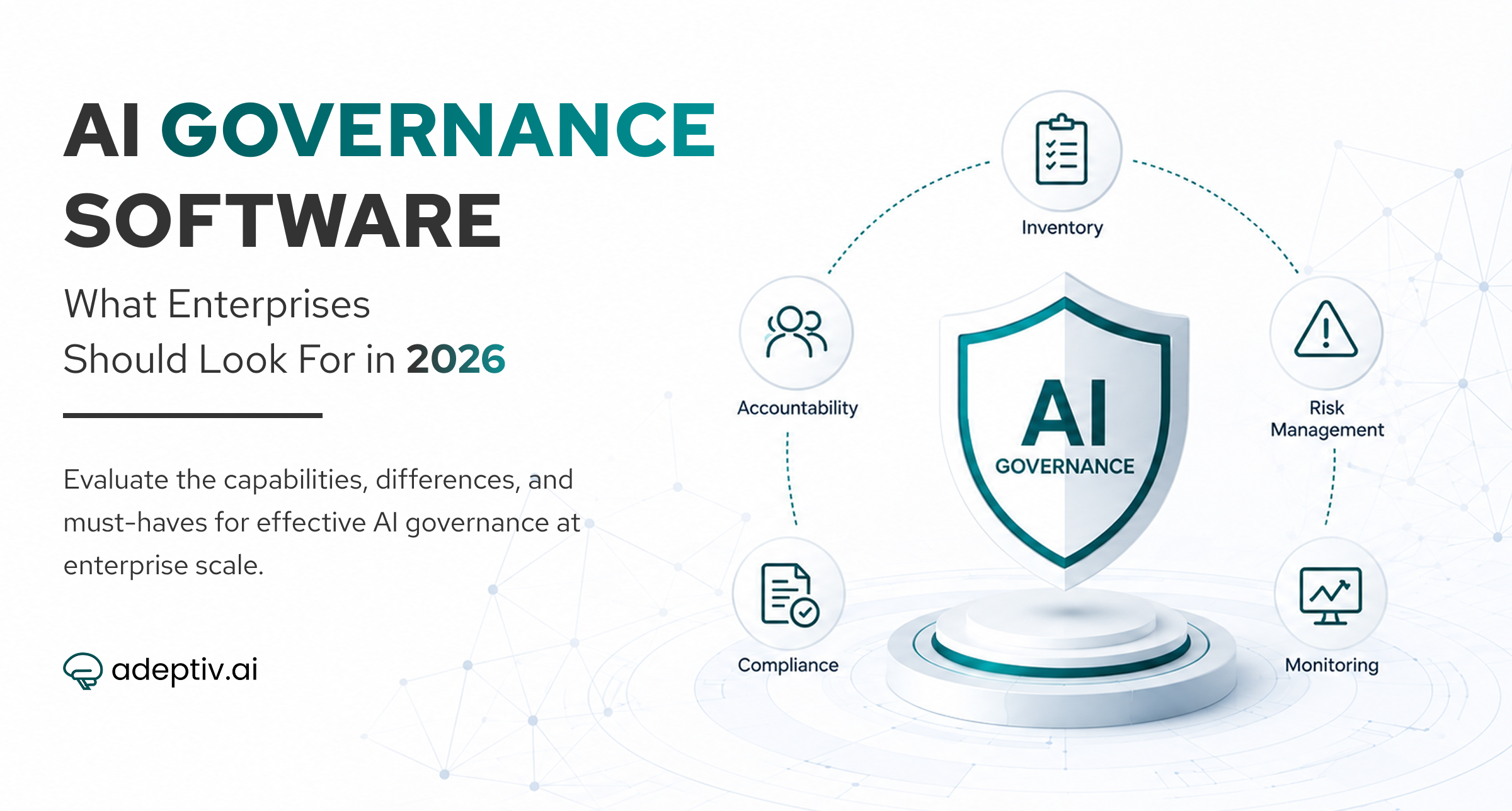
- Companies that can demonstrate AI inventories, risk assessments, compliance mappings, and monitoring capabilities reduce buyer uncertainty.
- Forward-thinking enterprises are using AI governance to differentiate themselves from competitors and unlock scalable AI adoption.
Most risk teams I speak to have the same quiet panic: they know their AI programs are live, they
know regulators are circling, and somewhere between legal, IT, and the CIO, nobody has formally
owned the audit trail. What they don’t see—yet—is that this exact gap is costing them contracts.
In 2026, enterprise procurement teams are no longer asking whether your organisation uses AI.
They’re asking how you govern it. And the answers—or the absence of them—are now determining
who wins regulated-market deals worth millions.
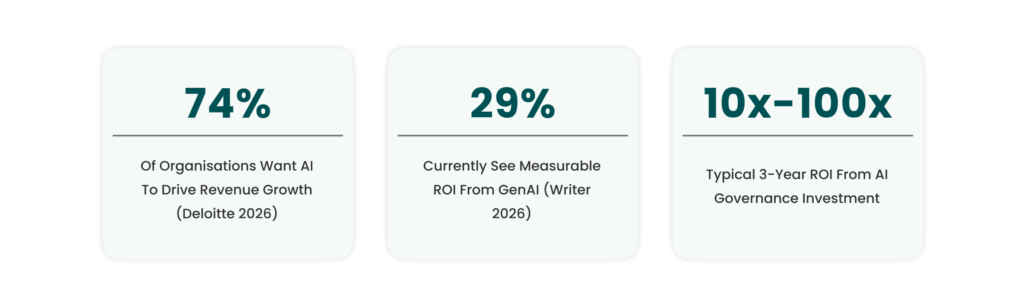
The gap between those two numbers—the 74% hoping and the 29% achieving—is not a model quality
problem. It is a governance problem. Companies that close that gap stop treating governance as risk
management overhead. They treat it as an asset that makes their AI commercially deployable at scale.
The Procurement Shift Nobody Warned You About
Here is a sentence from a real enterprise RFP published in May 2026: ‘AI governance and MCP agentic AI
governance is the differentiating capability for 2026 —and the section most vendors will struggle with.’
Procurement scoring frameworks now weight AI governance at 20-25% of total vendor evaluation in
regulated sectors. That is on par with security certifications and infrastructure fit. Three years ago,
governance barely appeared in AI RFPs. Today, 12 distinct governance criteria appear in standard enterprise
checklists—and failure on any one of them can remove a vendor from consideration entirely.
California’s Governor Newsom signed Executive Order N-5-26 in March 2026, directing state agencies to
develop AI vendor certification requirements. The state’s procurement authority—the largest sub-federal AI
buyer in the US—is now a de facto national benchmark. What California requires, enterprise procurement
teams across industries will mirror within 18 months.

The Revenue Math Your CFO Can Defend
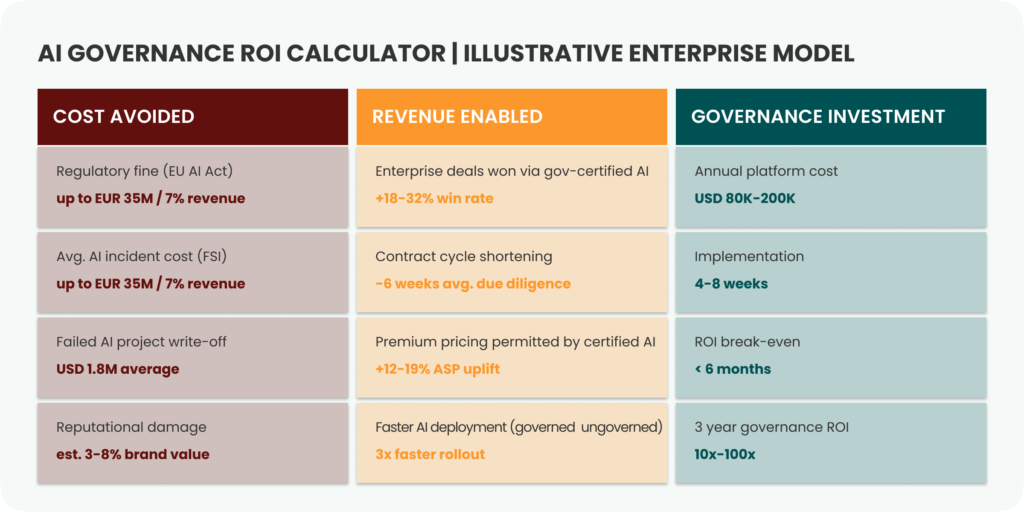
The ROI case for AI governance has two sides. Most organisations only model one of them. They calculate
cost avoidance: regulatory fines avoided, incidents prevented, audit remediation avoided. That case alone is
compelling—the EU AI Act carries penalties of up to EUR 35 million or 7% of global annual revenue,
whichever is higher.
But the revenue-enabling side is where the real numbers live. Enterprises with documented AI governance
programs are seeing 18-32% higher win rates in regulated-market deals. Contract due diligence cycles are
shortening by an average of six weeks when governance documentation is provided proactively. And in
financial services, healthcare, and public sector—where trust is the primary purchase criterion—AI
governance certification is now commanding a 12-19% average selling price premium.
McKinsey’s production deployment data shows a 5.8x ROI on AI investment within 14 months for enterprises
that reach enterprise-wide scale. Only 16% of organisations reach that scale. The primary barrier is not
model quality or compute cost. It is the inability to demonstrate governed, auditable AI to internal
stakeholders, regulators, and enterprise buyers.
Key Insight

Governed AI Wins Deals. Ungoverned AI Loses Them
The data on enterprise AI procurement outcomes is becoming hard to ignore. Across regulated
sectors—financial services, healthcare, legal, and public sector—a clear pattern is emerging: the higher an
organisation’s AI governance maturity, the higher its win rate in competitive enterprise deals.
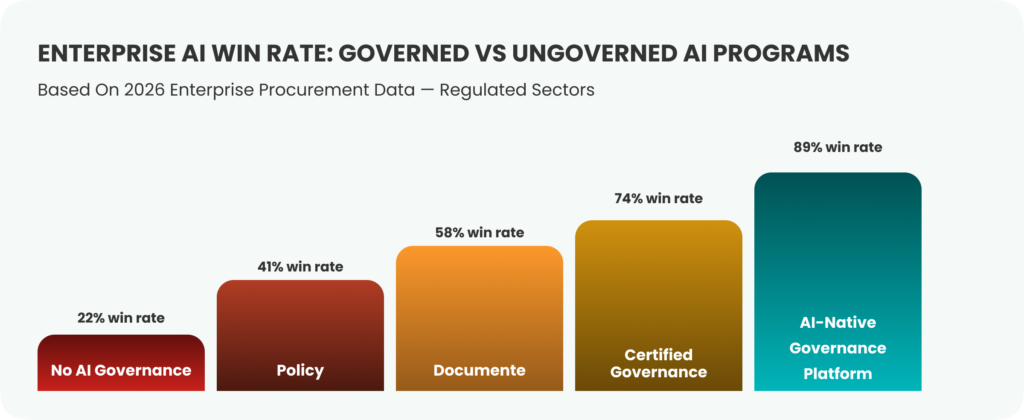
A key reason: AI governance documentation has become a risk proxy for enterprise buyers. When a CIO’s
procurement team evaluates two AI vendors with similar capabilities, the one that can produce an AI
inventory, a risk classification, a compliance mapping, and a real-time monitoring dashboard removes
uncertainty from the buyer’s decision. Uncertainty is the enemy of enterprise sales cycles. Governance
removes it.
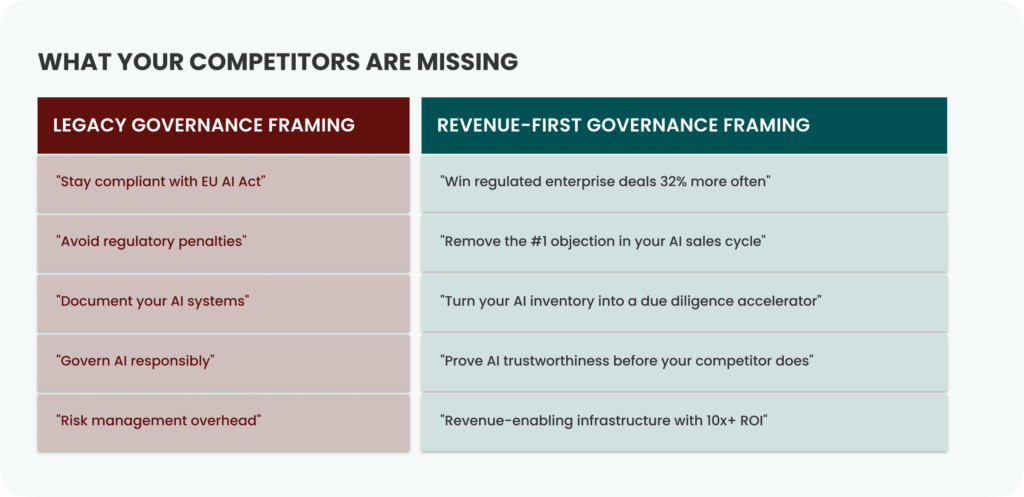
What Your Competitors Are Missing
Spend an hour reviewing the content and positioning of Collibra, Credo AI, Holistic AI, Fiddler AI, VerifyWise,
and OneTrust. Every one of them frames AI governance as risk management. None of them are making the
commercial case. None are telling their customers’ sales and commercial teams: your governance program is
a procurement weapon.
That gap is not accidental—it reflects how those organisations built their products: from compliance teams
inward. The commercial reality has overtaken that framing. Procurement teams at JPMorgan, Barclays, NHS
England and the European Commission are now rejecting AI programs on governance grounds, not
capability grounds.
Five Ways AI Governance Generates Direct Revenue

What ‘Governance-Ready’ Actually Means in Practice
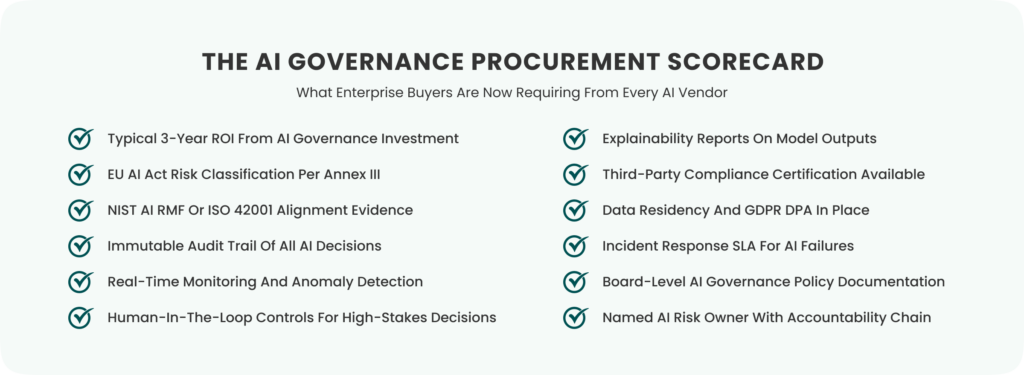
The phrase gets used loosely. In procurement contexts, governance-ready means something specific: you
can answer these questions with documented evidence, not with a description of your intentions.
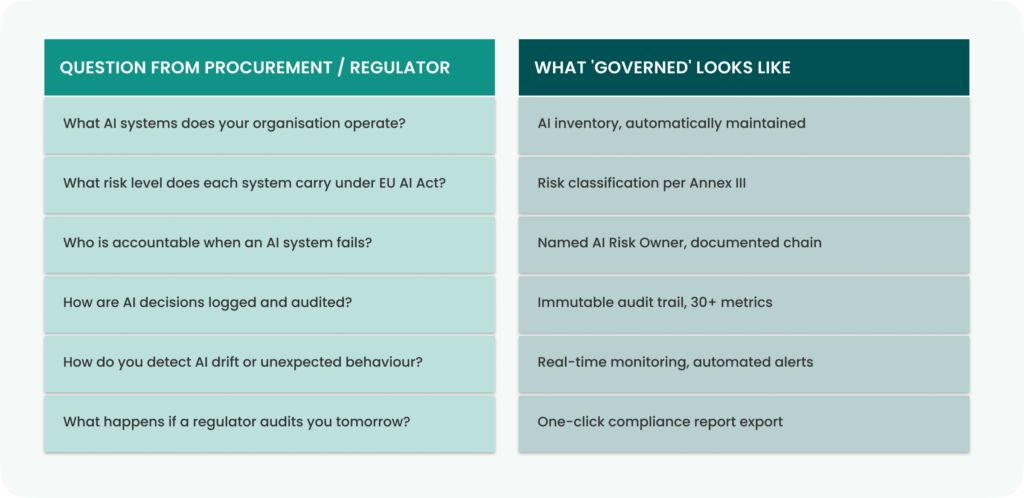
None of this requires building a governance team from scratch. It requires a platform that maintains these
records continuously, maps them to regulatory frameworks automatically, and surfaces them as board-ready
reports on demand.
Start Building Your Governance Advantage Today
Adeptiv AI was built for exactly this transition: from governance as a compliance cost to governance as a
competitive asset. The platform auto-discovers AI systems across your organisation, classifies risk against
40+ global regulations, maps to EU AI Act and NIST AI RMF automatically, and provides real-time monitoring
with 30+ metrics—all with one-click audit-ready exports.
Every feature was designed with one question: what do enterprise buyers, boards, and regulators need to
see? When you can answer that in minutes rather than months, governance stops being a blocker. It
becomes the thing that opens the door.
Your governance program is either winning deals—or
losing them
Adeptiv AI gives you everything you need to turn AI governance into a commercial asset:
auto-discovered inventory, regulation-mapped risk assessments, real-time monitoring, and audit-ready
compliance documentation.
Book a Free AI Governance Assessment
FAQs
1. What is an AI Governance Revenue Strategy?
An AI Governance Revenue Strategy is the practice of using AI governance capabilities to improve trust, accelerate procurement, win enterprise deals, and generate business growth.
2. How does AI governance help increase revenue?
AI governance reduces buyer risk, shortens due diligence cycles, improves procurement outcomes, and helps organizations qualify for regulated-market opportunities.
3. Why are enterprise buyers asking about AI governance?
Enterprise buyers need assurance that AI systems are transparent, compliant, monitored, and aligned with regulatory requirements before deployment.
4. Can AI governance improve procurement success rates?
Yes. Organizations with documented AI governance programs often experience higher win rates and faster procurement approvals in regulated industries.
5. What evidence do enterprises need to demonstrate AI governance?
Organizations typically need AI inventories, risk assessments, compliance mappings, monitoring records, audit trails, and governance documentation.
6. Which industries benefit most from an AI Governance Revenue Strategy?
Banking, healthcare, insurance, aviation, manufacturing, government, and other regulated industries benefit significantly because trust and compliance directly influence purchasing decisions.