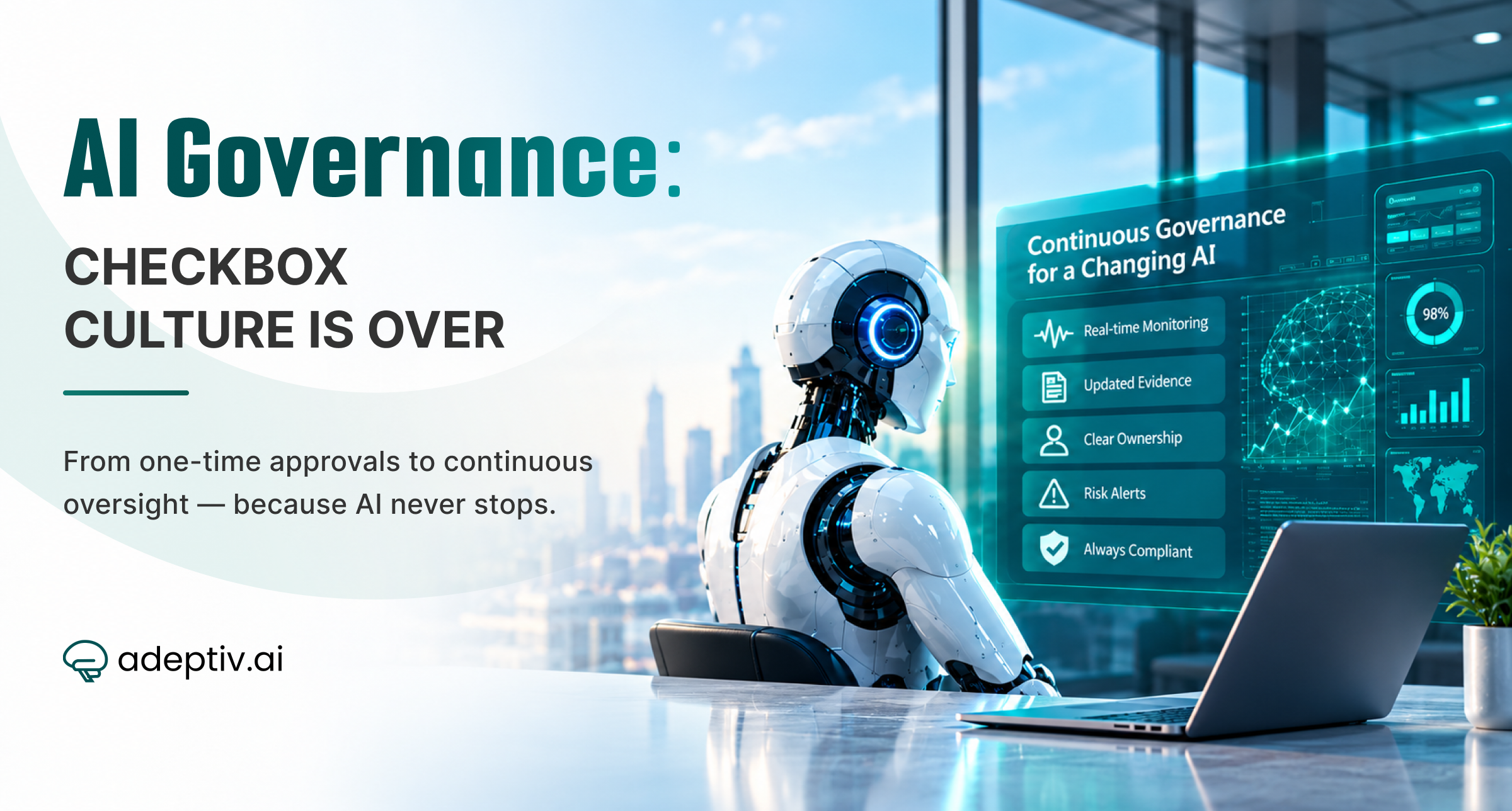
This era of AI Governance will not be the same as the past, as it is no longer a checkbox culture.
Continuous AI Governance is fast emerging as a crucial part of most enterprise AI initiatives. AI governance has basically just been reviewed, signed and documented for the past several years. A committee meets, a model card is filled out, a Risk Score is assigned, and someone signs their name at the bottom. Once the box is ticked, most organisations progress, the system is “governed” and governance moves on.
However, the AI system doesn’t come to stop when the box is ticked. There is no end to it, no end to the decisions it makes, no end to the behavior it displays, new data, new integrations, and more and more, autonomous actions nobody looked at at sign-off. Meanwhile, Governance remains as it is when it is taken on approval day, and is only looked at again half a year or a year later when the next audit is held.
We scanned the industry to find out what exactly was causing governance issues right now, and it’s the same problem: Governance has been designed to approve AI once, but AI operates continuously. This is the role of continuous AI governance, which is designed to fill that gap.
The one mismatch, a one-off process for a system constantly under change, is subtly emerging as the largest threat in enterprise AI initiatives. And it’s not a hypothetical problem. It’s appearing in the ways that organizations put the AI systems they thought they had in place into service, track and lose sight of those systems, and lose them altogether. | Continuous AI Governance |
The need for Continuous AI Governance in Agentic AI.
This divide between the approval and the actual action is most evident with agentic AI. Despite the rapid uptake of agents across all aspects of the business, less than a third of organizations have a mature governance model for autonomous agents. With every new tool or permission that an agent gets, its behavior changes: A one-time approval doesn’t guarantee it’s doing one thing months down the road, after it’s been granted access to three additional systems and begins to link decisions across workflows that it didn’t originally get permission to touch.
Consider the typical evolution of an agent following launch. It begins at a narrow end; perhaps it composes customer support responses for a man to check. After just a few months, it has been granted the ability to send responses directly for low-complexity tickets. After a couple of months, it is linked up to a billing system, to automatically give a bill back if it drops below a certain level. All of these adjustments could seem manageable and logical on their own.
At each of those stages, however, no one re-ran the governance process, since none of them were really a “new deployment” as it were a “new deployment,” the agent approved at launch doesn’t look remotely like the agent running in production a year later. If AI governance is not in place, none of this drift is detected until it fails.
Remarkably, security and risk concerns are now the most often-known barrier to scaling agentic AI – and it beats out cost or talent. The engineers, the security teams, the risk officers are the ones who can see the differences between “this was approved” and “this is still behaving as approved. But almost no one is confidently answering the latter question. | Continuous AI Governance |
The same was echoed by ISACA, the international organization for the certification of IT auditors, in 2026: AI oversight is not a one-and-done task. The most dangerous failures don’t make sound noises or are very easy to see, but instead are those systems that were accepted, but then continued to function in another manner and everyone thought it was still approved. These are the failures that don’t make the newspaper. The comeuppance is eighteen months later, when a regulation goes astray, and someone says, “who said this was OK to do?” and the honest reply is “Nobody, it developed after approval — and nobody was monitoring it.
This is not a bug, it is a feature.
Governance norms were taken from a world of legacy software in which initial behavior would remain constant over time. For a traditional application that had been shipped and tested, most of the action took place on day 1000 that it did on day one. It made sense to review it once, to document that review and then to revisit it on a regular basis, since the system itself wasn’t changing quickly.
AI shattered that assumption altogether. Models get retrained. New tools are provided for agents. Vendors promote updates that alter the way that a system operates, and do not initiate a formal change-management procedure on the customer’s side. Where there is a system under the approval, it keeps moving, even if the paperwork that accompanies it doesn’t.
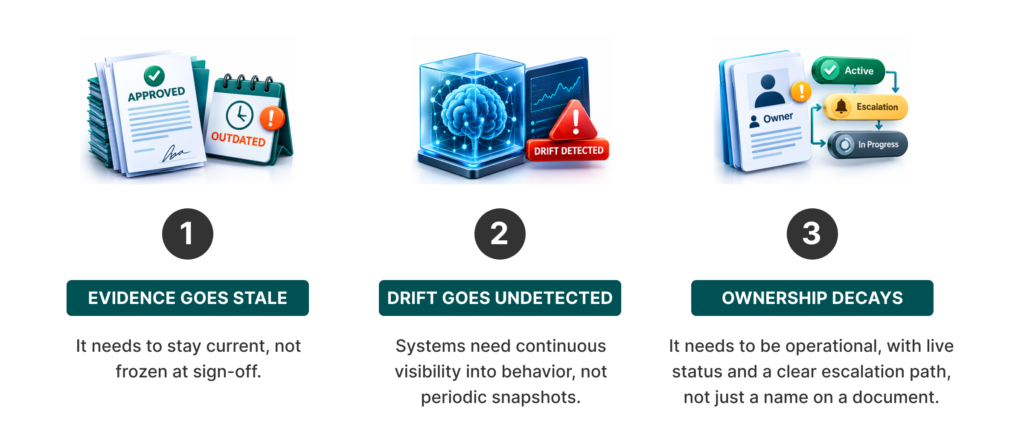
It is not an either-or proposition, closing this gap does not entail throwing away approvals or redoing all of it every time something shifts — otherwise any AI program would come to a standstill. It does not imply that governance should cease once it has been approved, it simply implies that it must continue to operate after approval. This is the recipe for three things to fail in the business of continuous AI governance: management without governance, and governance without management.
Evidence goes stale. A control that had been proved to be unbiased on the day of approval remains unbiased only for that day, since it can be shown to have been unbiased on the day of approval. If the model is retrained, then this evidence must be regenerated and reattached, and not just left in a folder and assumed to still apply to the current system.
Drift goes undetected. Model drift, behavioral drift, scope creep are slow-moving changes. A faulty system that is correct 95% of the time may have a slight error that is not worrisome on an individual week, but becomes apparent when looked at over longer periods of time such as six months. If you don’t see it, you can’t tell it’s going down until something downstream breaks.
Ownership decays. The person who signed off on a system one year ago might have moved on to other priorities, retired, or changed his or her job. When governance does not monitor who owns the control and what is happening with escalation, a control can easily become orphaned — it may be technically owned by someone, but it is not effectively monitored. | Continuous AI Governance |
How Adeptiv delivers Continuous AI Governance
Adeptiv’s understanding of governance is not a one-time project, but a continuous process that accompanies the AI system. It’s not a one-off entryway, but a continuous AI governance system that will last as long as the AI system itself. Here’s what that looks like. | Continuous AI Governance |
Maintains up to date proof automatically. Adeptiv will match new evidence (from your systems, uploaded files, or connected repositories) directly to the control it supports and automatically update the status of your control. If evidence becomes out-of-date, the control is identified in advance and before becoming an issue, and not discovered as a ‘shock’ at the next audit.
It takes a look at the AI system after it becomes live. After deployment, not before, Adeptiv’s monitoring and observability module will track 20+ metrics of every AI system. It does so by continuously pulling logs and telemetry directly from your AI systems and taking that real-time activity back to the specific governance controls it impacts.
This is why governance is more of a continuous process than a periodic one: when a system is approved, you don’t have to assume that it is still performing as it did, you can actually look and see what it’s doing in real time, detect any differences early, and be warned when a difference falls outside of a risk boundary – not only on audit, but immediately after a customer complains.
Ensures that someone is always in charge. Each governance action, such as approving a use case, signing off on a control is on a clear workflow with a named owner. When a control slips out of compliance, it’s immediately returned to that person to correct, rather than being left to the next time it comes up during a review cycle. Ownership does not “go stale” from being a name on an old document.
All systems are simultaneously checked prior to going live. Whether team A or team B developed it, no AI system would get to production without being subjected to a production readiness review.No AI system would go to production without being subjected to a production readiness review. The model is developed by a central AI team and one developed by a product squad; it is the same bar before deployment, filling in the space that shadow projects have long ignored altogether.
Everything is done in one going picture and not in old records. Adeptiv maintains an up-to-date inventory of all the AI systems and use cases in an organization, and every risk check, control, and piece of evidence is constructed from what exists today, not what existed when the system was launched, 6 months or a year ago. This single view is the replacement for most governance programs which are still using the disjointed spreadsheets and obsolete documents.
Let’s take a look at what Continuous AI Governance involves in practice.
This is a transformation of the role for a compliance team. The evidence is up-to-date – it has been kept continuously, not assembled after weeks of preparation before an audit. Drift is reported the week it begins – not at an annual review, and it’s not a big problem, but a small one that is manageable. An ownership is no longer questioned and there is no silence any more, it is visible and enforced through workflow, not memory. | Continuous AI Governance |
This isn’t a slower way to go if a business is trying to go faster with AI. With continuous AI governance, that friction can be eliminated—typically at the last minute: just before a launch, just before an audit, or just after an incident. If it’s baked into the way the system works from the beginning, then governance is not a thing you need to contend with, it’s infrastructure you don’t have to worry about until you need it.
The Bottom Line
The culture of checkbox governance was a concept that completed governance. You have reviewed, received signoff, submitted and walked away. For software that was not subject to much change after installation, that was a good model. It simply doesn’t seem like it should be possible to have a system that adapts, learns new permissions and changes its actions all the time, with often no one actually acknowledging that there was any change at all.
AI never stops. So governance can’t either. It is not the organization with the most complete one time review process that will do it well. They are the ones who have embraced continuous AI governance — the idea of not just doing governance as an end in and of itself, but as an infrastructure that continues to operate alongside the AI, all the way to the end. | Continuous AI Governance |
FAQ
1. What is Continuous AI Governance?
It’s an approach where AI oversight doesn’t stop at approval — evidence, monitoring, and ownership stay active for as long as the system runs, not just at sign-off.
2. Why isn’t one-time approval enough?
AI systems keep changing after approval — models retrain, agents gain new permissions — so a single review quickly stops reflecting real behavior.
3. Why does this matter most for agentic AI?
Agents evolve fast as they gain new tools and access. Fewer than a third of organizations have mature governance for this, which is why risk is now the top barrier to scaling agentic AI.
4. What breaks down without continuous governance?
Three things: evidence goes stale, drift goes undetected, and ownership decays as people change roles.
5. How does Adeptiv AI deliver this?
By keeping evidence auto-updated, monitoring 20+ metrics in real time post-deployment, assigning live ownership, and maintaining one current inventory of all AI systems.