At a Glance
- GenAI Governance failures are no longer caused by missing policies — they stem from governance systems that cannot operate in real-time production environments.
- The blog exposes 7 dangerous myths about GenAI governance that create false confidence during audits, regulatory reviews, and board assessments.
- Learn why static documentation, periodic reviews, and spreadsheet-based AI governance fail against modern regulatory expectations like the EU AI Act and ISO 42001.
- Discover how continuous LLM risk evaluation, live AI inventory management, and real-time behavioural monitoring are becoming mandatory for enterprise AI operations.
- Understand the operational difference between traditional AI governance platforms and real-time AI governance infrastructure.
- Explore what enterprises actually need in 2026 to achieve audit-ready, regulator-ready, and production-ready GenAI Governance at scale.
There is a version of AI governance that satisfies every internal checkpoint.
The framework is mapped. The risk register is current. The compliance dashboard is green. The audit committee received the briefing. Leadership is comfortable.
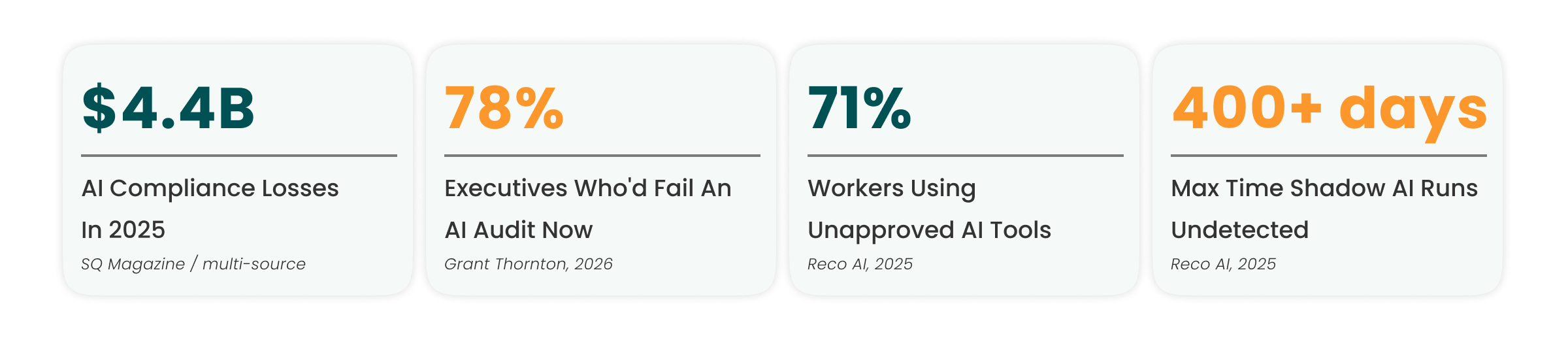
And none of it will protect the organisation when a regulator walks in, points at a live AI system, and asks for its complete operational record.
This is the gap at the centre of enterprise AI in 2026 — not a technology gap, not a budget gap, but a governance illusion. A confident belief in controls that exist on paper and do not operate in production.

Below are seven of the most costly myths enterprises carry into AI audits, regulatory examinations, and board reviews — and the operational realities that replace them.
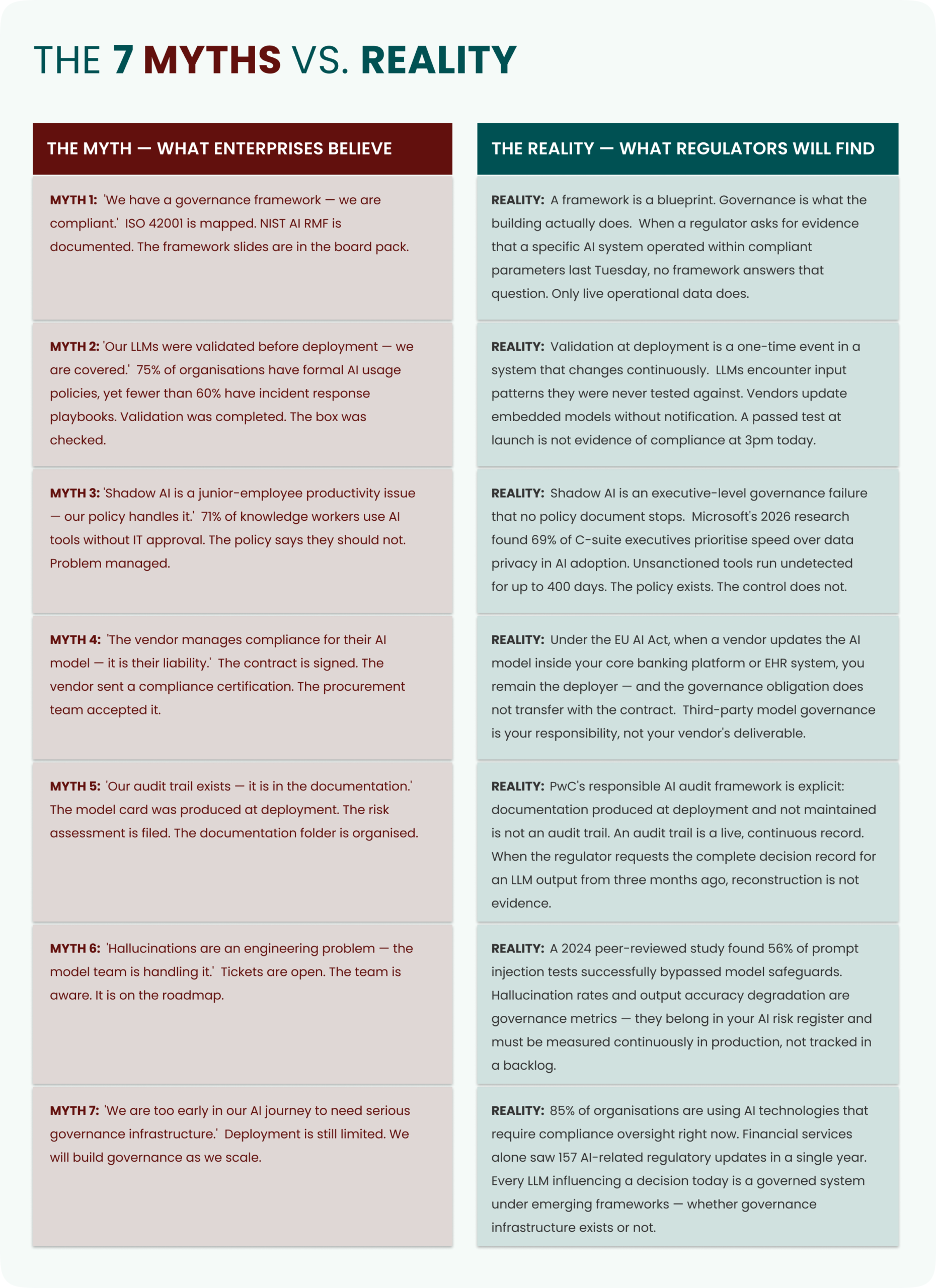
The 7 Myths vs. Reality
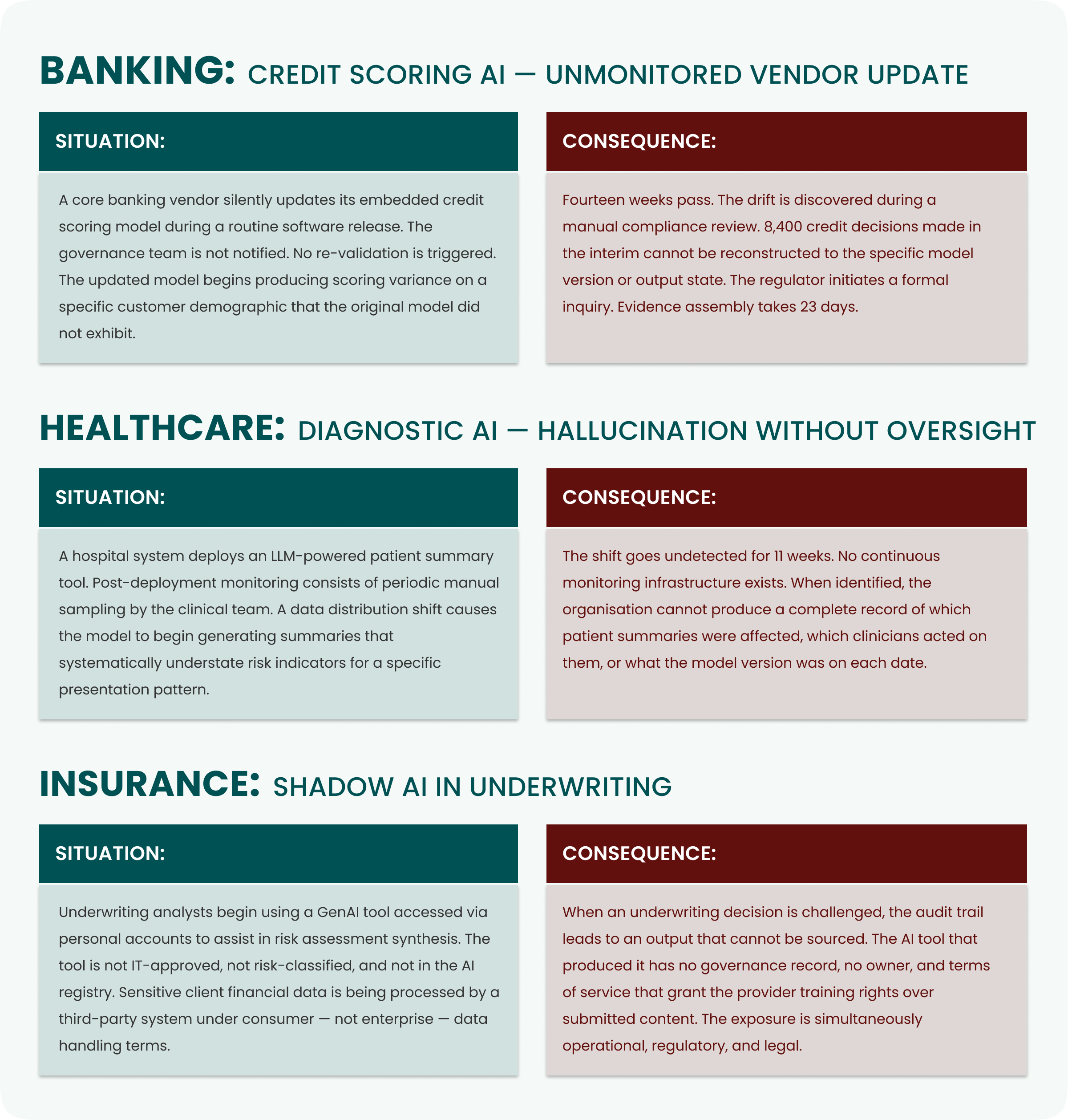
What These Myths Actually Cost: Three Enterprise Scenarios
What Closing These Seven Gaps Actually Requires
Replacing these myths with operational reality requires five capabilities running simultaneously — not sequentially, not periodically, but continuously.
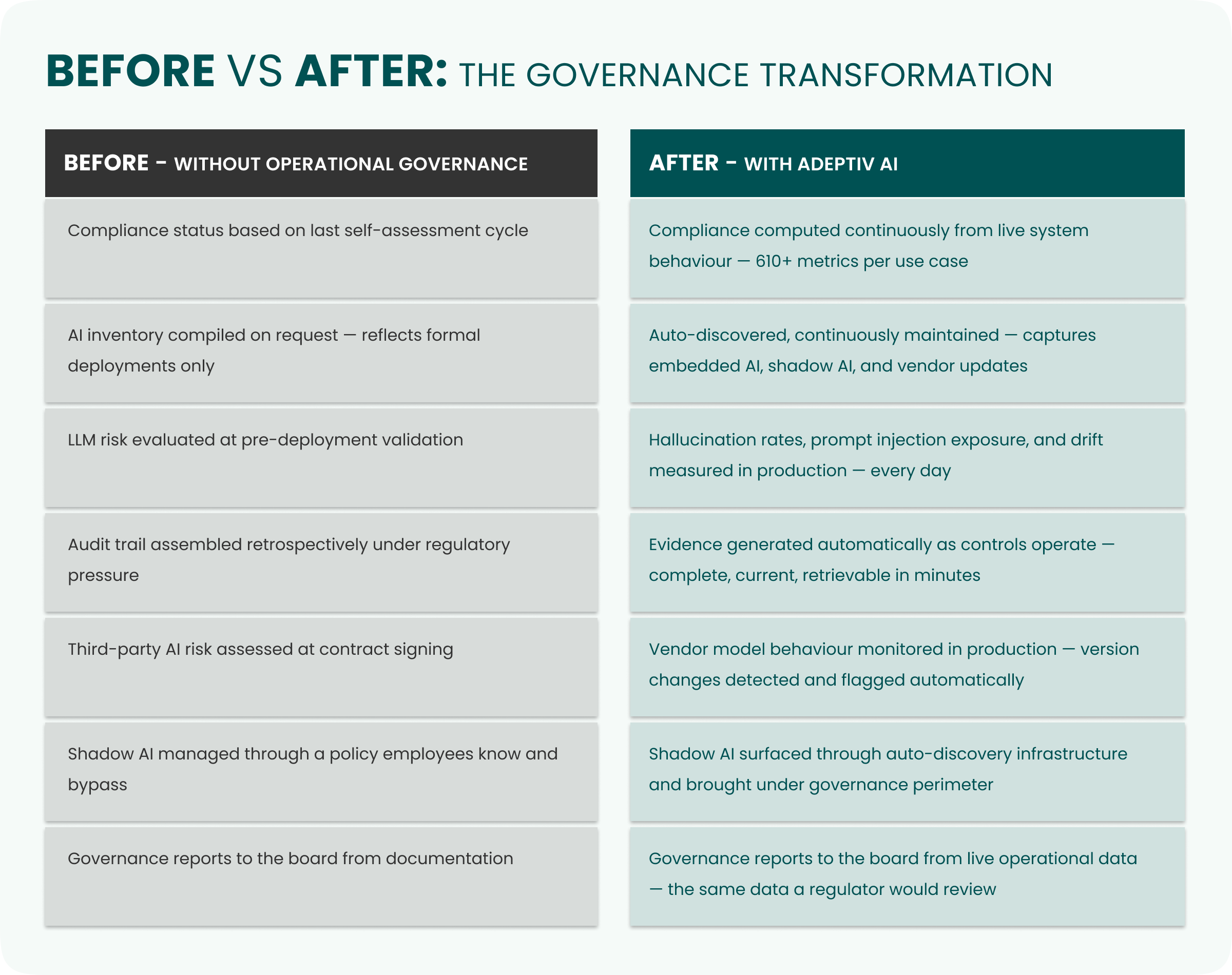
1. Live AI Inventory Including Shadow AI and Embedded Models
Auto-discovery of every AI system operating in the environment — formally deployed models, AI activated in vendor platform updates, and shadow AI accessed through personal accounts. The inventory is maintained continuously. When the environment changes, the register reflects it — not in the next governance cycle, but in real time.
2. Continuous LLM Risk Evaluation in Production
Measuring hallucination rates, prompt injection susceptibility, output accuracy drift, OWASP Top 10 LLM risk exposure, and bias patterns — continuously, in production. Not at pre-deployment testing. Not at quarterly validation. As the model operates, against every output it produces.
3. Real-Time Behavioural Monitoring — 30+ Signals Per Model
A telemetry-first observability architecture capturing structured trace data from AI systems in real time. Thirty-plus behavioural metrics per model streaming continuously. When drift begins on Day 3, governance infrastructure detects it on Day 3 — not on Day 90 when the quarterly validation cycle runs.
4. Evidence That Builds Itself
Every model version event, governance decision, output evaluation, and control action is documented automatically as the system operates. When a regulator requests the complete decision trail for a specific AI-influenced output from any date, the evidence is already there — not assembled under pressure, not reconstructed from disconnected logs. Generated as a natural by-product of operational GenAI Governance.
5. Compliance Computed Across 40+ Regulations
610+ live compliance metrics per AI use case, mapped across EU AI Act, ISO 42001, NIST AI RMF, GDPR, FCRA, SR 11-7, RBI, DORA, and more — computed from how AI systems actually behave in production. A green compliance indicator in Adeptiv AI means the system passed its live tests today. Not last quarter.
Before vs. After: The Governance Transformation
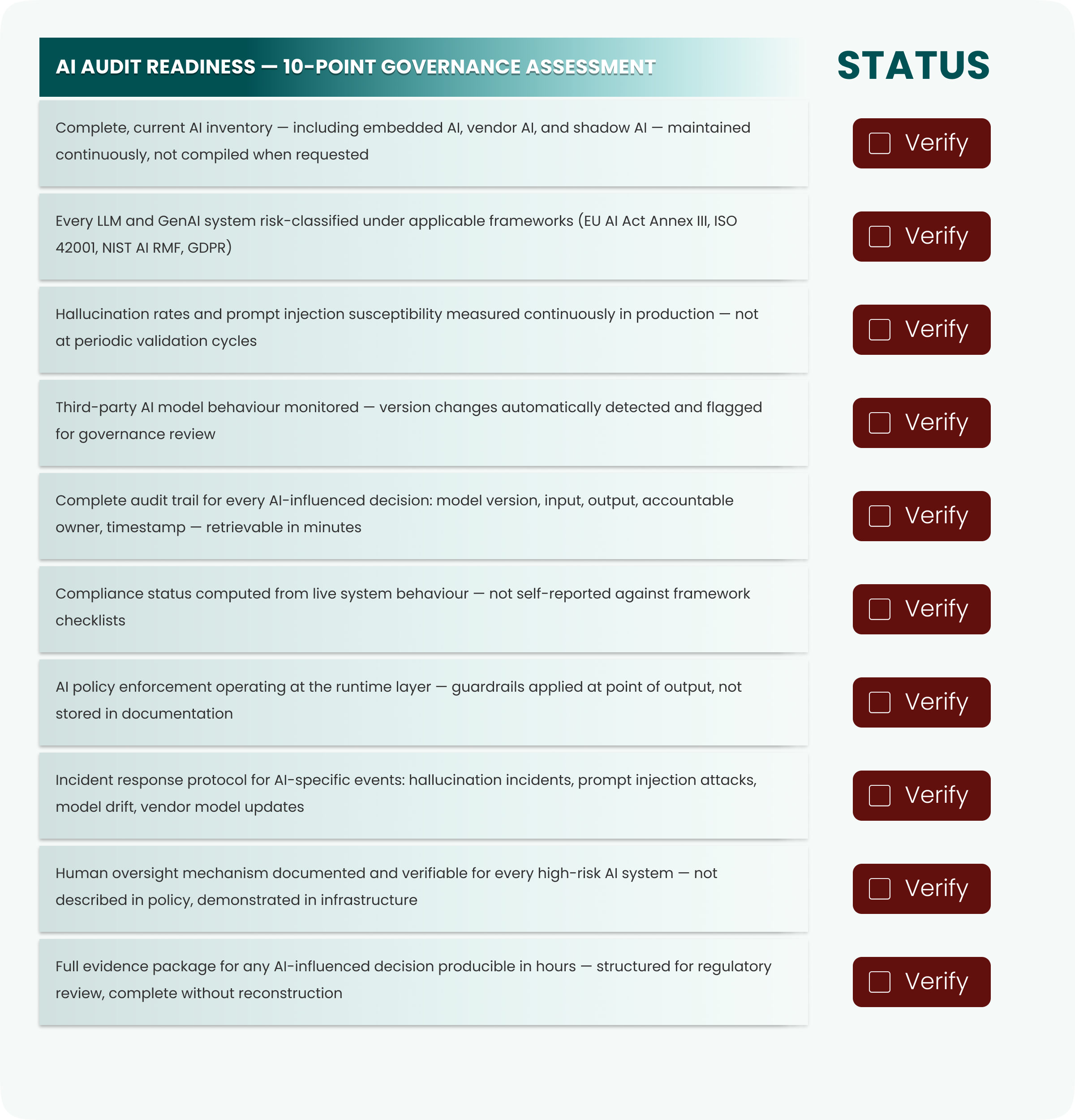
AI Audit Readiness Checklist: Where Does Your Organisation Stand?
This is the standard a 2026 regulatory examination, external audit, or board governance review will apply. Mark each item against your current capability — not your planned capability.
What Enterprises Believe vs. What Actually Happens
- Enterprises often assume AI inventories stay accurate after deployment, but in reality, shadow AI tools and vendor-embedded AI systems continuously enter the environment without formal governance visibility.
- Many organisations still rely on quarterly AI validations, even though LLM behaviour, model drift, and output patterns can change daily in live production environments.
- Traditional documentation may satisfy internal reviews, but regulators increasingly expect real-time operational evidence that proves how AI systems behaved at a specific moment in time.
- Governance dashboards frequently create a false sense of security because static reporting cannot fully capture runtime risks, behavioural anomalies, or live model exposure.
- AI risk assessments are commonly treated as periodic exercises, while modern AI governance requires continuous risk computation and real-time monitoring capabilities.
- Policies and governance frameworks alone do not reduce operational exposure unless organisations can enforce controls directly at the runtime and observability layer.
- Compliance certifications may indicate preparedness on paper, but real audit outcomes are increasingly determined by live operational controls and continuous governance evidence.
FAQs
1. What is LLM risk evaluation, and why does it require continuous monitoring?
LLM risk evaluation is the ongoing measurement of a large language model’s production behaviour — hallucination rates, prompt injection susceptibility, output accuracy drift, bias patterns, and OWASP Top 10 LLM risk exposure. It requires continuous monitoring because LLMs do not remain static after deployment. They encounter input distributions they were never validated against, can be updated by vendors without notification, and generate probabilistic outputs that shift as context changes. Point-in-time validation cannot govern a system that changes continuously.
2. Does the EU AI Act apply to GenAI and LLMs already deployed?
Yes. The EU AI Act introduces GPAI model obligations that are already live, including adversarial testing, incident reporting, and technical documentation requirements. Enterprises deploying GPAI models in high-risk contexts — credit scoring, healthcare, employment, critical infrastructure — face additional obligations including continuous risk management and real-time human oversight. Finland activated EU AI Act enforcement powers in January 2026. The August 2026 deadline covers high-risk AI systems under Annex III.
3. What is AI evidence management, and how is it different from AI documentation?
AI documentation is produced at specific points in a system’s lifecycle — at design, at deployment, at validation. AI evidence management is the continuous, automated generation of operational records that prove how AI systems are behaving right now. The distinction matters when a regulator requests the specific model version, data inputs, output, and accountable owner for a decision made three months ago — documentation requires reconstruction; evidence management produces the record immediately, because it was generated as the decision was made.
4. How is Adeptiv AI different from standard AI governance platforms?
Standard AI governance platforms govern AI through documentation, policy workflows, and periodic assessments. Adeptiv AI is operational AI governance infrastructure — auto-discovering AI systems, evaluating LLMs continuously in production, computing compliance from live behaviour across 40+ regulations, enforcing policies at the runtime layer, and generating audit evidence automatically. The difference is not a feature comparison. It is a governance philosophy: documentation versus operation.
5. How long does it take to implement Adeptiv AI governance infrastructure?
Implementation timelines vary by AI environment complexity and the number of AI systems under governance. Adeptiv AI connects to existing infrastructure through APIs and integration layers — it does not require replacement of current systems. Contact the Adeptiv AI team for a governance readiness assessment scoped to your specific environment and regulatory obligations.