At a Glance
- AI GRC applies governance, risk management, and compliance practices to the AI systems an enterprise builds, buys, and deploys.
- AI in GRC and GRC for AI solve different problems: one uses AI to improve GRC processes; the other governs enterprise AI itself.
- Traditional GRC remains important, but AI introduces continuous discovery, changing risk, system-level accountability, and production monitoring requirements.
- An operational AI GRC approach connects AI inventory, risk assessment, regulatory mapping, controls, evidence, third-party governance, and continuous monitoring.
- Enterprises need governance that extends beyond internally developed models to applications, agents, shadow AI, and vendor AI.
- For enterprise buyers, the key question is whether the existing GRC stack can govern AI after deployment and produce current evidence on demand, or whether an AI-specific governance capability is required.
AI GRC is the application of governance, risk management, and compliance discipline to an
organization’s own AI systems — the models, applications, agents, and vendor AI it builds,
buys, or deploys. It borrows its name and much of its structure from traditional GRC, but it exists
because AI systems behave differently than the assets traditional GRC was designed to control: they
can change after approval, retrain on new data, and produce different outputs in production than they
did in testing.
Most enterprises already have a GRC function. Very few have adapted it to account for AI systems
that keep moving after they’re signed off. That gap is what this article is about.
AI in GRC vs. GRC for AI: two different problems sharing one name
“AI GRC” gets used loosely in the market, and it’s worth separating the two things it usually means,
because they solve different problems for different teams.
AI in GRC means using AI technology to make existing governance, risk, and compliance work
faster — machine learning that scores risk, natural language processing that reads regulatory text,
generative AI that drafts policy language, or agents that run continuous control testing. This is largely
an efficiency play inside functions that already exist: internal audit, third-party risk, regulatory change
management.
GRC for AI means the reverse: applying governance, risk management, and compliance rigor to the
AI systems an enterprise is building or buying. That includes knowing which AI systems exist,
classifying their risk, mapping them to applicable regulation, monitoring them once they’re live, and
producing evidence that all of this actually happened. This is a newer, less mature discipline, and it’s
the one enterprise AI governance platforms — Adeptiv AI included — are built to run.
Both are legitimate uses of the term. But an enterprise trying to solve “we don’t know what AI
systems we’re running or whether they’re compliant” is solving a GRC-for-AI problem, and no
amount of AI-powered audit automation inside the existing GRC stack will fix it. That distinction
matters when a compliance leader is deciding what to actually buy.
Why enterprise AI creates governance requirements that traditional GRC wasn’t built for
Traditional GRC assumes a relatively stable asset. A vendor contract, a business process, a financial
control — once reviewed and approved, these don’t quietly change their own behavior. AI systems do.
A model can be retrained on new data. A large language model integration can be swapped out by a
vendor without notice. A GenAI feature can be added to a SaaS tool an employee already had access
to, with no procurement review at all. An agent can be given new tools or a wider scope well after the
governance committee last looked at it.
That creates three problems traditional GRC processes generally don’t handle well:
- Discovery. Governance can’t cover what it doesn’t know exists. AI adoption is happening inside business units, embedded in SaaS tools, and through individual employee use — often faster than any central register can capture it.
- Drift. A risk assessment performed at approval time describes the system as it was at that moment. It says nothing about how the system behaves six months and several retraining cycles later.
- Accountability at the system level. Traditional GRC assigns ownership to processes and business units. AI systems need an owner at the level of the individual model, application, or agent — someone accountable for what that specific system does in production, not just for the department that uses it.
Traditional GRC vs. AI GRC
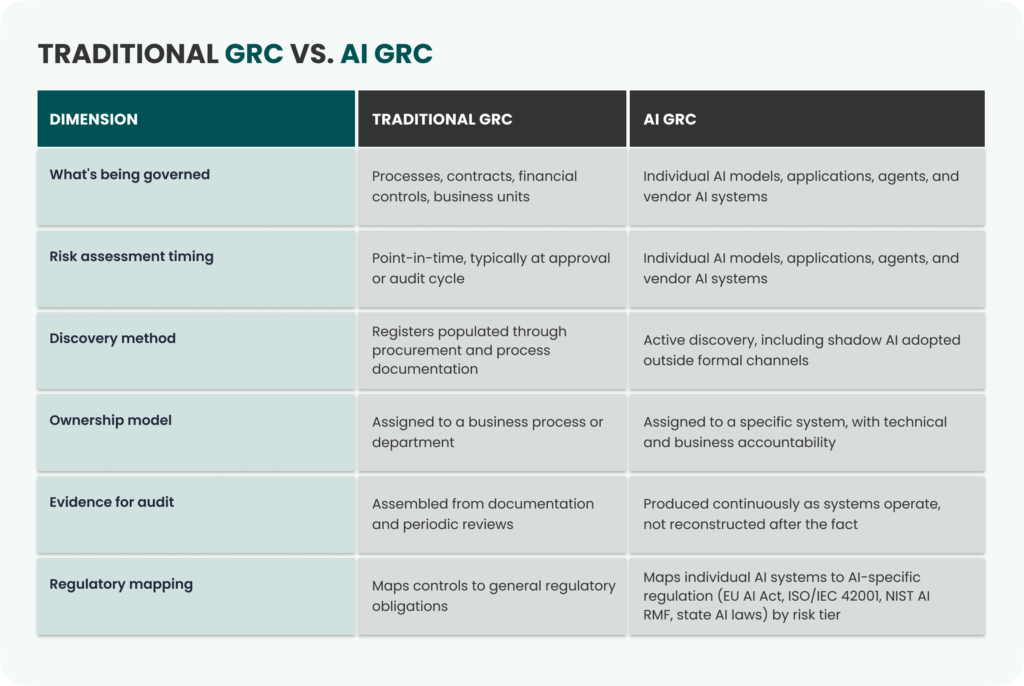
None of this means traditional GRC is obsolete. Enterprise risk committees, control frameworks, and
audit functions still matter, and AI GRC generally sits alongside them rather than replacing them. The
difference is that AI GRC has to connect those existing governance expectations to systems that
operate and change on their own timeline.
Seven operational capabilities an AI GRC approach needs
Defining AI GRC on paper is the easy part. Running it day to day requires seven connected
capabilities:
- AI inventory and discovery — a live, accurate record of every AI system in use, including shadow AI that entered through a SaaS subscription or an individual team’s initiative rather than procurement.
- Structured risk assessment — scoring each system against consistent risk dimensions (data sensitivity, decision impact, autonomy, explainability) rather than an ad hoc checklist that varies by reviewer.
- Regulatory and standards mapping — connecting each system, at its assessed risk tier, to the specific obligations of frameworks like the EU AI Act, ISO/IEC 42001, and the NIST AI RMF, plus relevant state and sector rules.
- Controls and evidence generation — producing audit-ready documentation as a by product of normal operation, instead of reconstructing it under deadline pressure when an audit or regulator inquiry lands.
- Vendor and third-party AI governance — applying the same rigor to AI embedded in vendor products and supply-chain tools as to internally built systems, since a vendor’s model update can change your risk exposure without any action on your part.
- Continuous monitoring and reassessment — watching deployed systems for drift, degraded performance, or behaviour changes, and triggering a fresh risk review when something material shifts rather than waiting for the next scheduled audit.
- Agentic AI oversight — extending governance to AI agents that can take multi-step actions and use tools autonomously, which raises the stakes on ownership and monitoring beyond what a single-output model requires. (Adeptiv AI’s Agentic AI Governance article goes deeper on this specific capability.)
Where data governance fits
Data governance for AI and AI GRC overlap but aren’t the same thing. Data governance addresses the
inputs — data quality, lineage, access, and privacy for the datasets that train and feed AI systems. AI
GRC addresses the system itself — what it does, how risky its outputs are, and whether it’s compliant.
A well-run AI GRC program depends on solid data governance underneath it, because an AI system
can’t be assessed accurately if no one can trace what data trained or feeds it, but data governance
alone doesn’t answer questions about model risk classification, regulatory mapping, or production
monitoring. Enterprises evaluating AI GRC platforms should expect data lineage to feed into the risk
assessment, not stand in as a substitute for it.
Third-party and vendor AI: the risk you didn’t sign up for
A growing share of enterprise AI exposure doesn’t come from anything built in-house. It arrives
through a CRM’s new AI feature, a document tool’s embedded summarization model, or a recruiting
platform’s automated screening add-on — capabilities that get switched on by a vendor, sometimes
silently, inside a contract that was reviewed long before AI was part of the product. Traditional vendor
risk management, focused on data security and contractual terms, generally wasn’t built to ask
whether the AI inside a vendor’s product is high-risk under the EU AI Act or whether it’s making
decisions that affect people. AI GRC extends vendor risk assessment to cover exactly that, and it
needs to keep reassessing as vendors update their own AI capabilities.
Continuous monitoring and reassessment
A risk assessment is a snapshot. Once a model is in production, its behavior can shift — through
retraining, through changes in the data it sees, or through the way people actually use it versus how it
was tested. AI GRC treats monitoring as part of governance, not a separate operational concern: drift,
degraded accuracy, or unusual output patterns should be able to trigger a reassessment automatically,
so risk classification stays current instead of describing a system as it existed months earlier.
Evidence and audit readiness
When a regulator, auditor, or customer due-diligence team asks an enterprise to prove its AI
governance works, the honest answer often depends on how much manual reconstruction is required.
If evidence has to be assembled from scattered spreadsheets, emails, and someone’s memory of a
review meeting, that’s a sign governance was documented but not actually operated continuously. AI
GRC treats evidence generation as a continuous output of the discover-assess-monitor cycle, so an
audit-ready pack reflects current state rather than a rushed retrospective.
What enterprise buyers should evaluate
For CIOs, CISOs, Chief Compliance Officers, and enterprise risk leaders assessing whether to extend
an existing GRC stack or bring in a dedicated AI GRC capability, the practical questions are:
- Can it discover AI systems that were never entered into a formal register, including shadow AI?
- Can every material AI system be mapped to an accountable owner at the system level, not just the department level?
- Does risk assessment update when a system changes after initial approval, or only at the next scheduled review?
- Do controls extend across models, applications, and agents — or only the model layer?
- Is vendor and third-party AI governed with the same rigor as internally built systems?
- Can evidence be produced on demand, without a manual scramble before an audit?
An enterprise that can’t answer most of these with confidence today is describing a governance gap,
not a governance program.
Want to pressure-test your existing GRC stack?
We’ve also outlined 7 questions enterprise buyers should ask before extending traditional GRC to AI, covering AI discovery, ownership, post-approval risk, third-party AI, runtime reassessment and evidence.
Read the LinkedIn article: AI GRC vs. Traditional GRC: 7 Questions Enterprise Buyers Should Ask Before Extending Their GRC Stack.
From documentation to a connected governance lifecycle
The organizations furthest ahead on AI GRC tend to have moved past treating governance as a
document — a policy, a committee charter, a risk framework binder — and started running it as a
connected lifecycle: discover the AI systems, assess their risk, map them to compliance obligations,
monitor them in production, and prove it with evidence, continuously. That’s the operating model
behind Adeptiv AI’s AI Governance Product, which unifies AI inventory and discovery, structured
risk assessment, regulatory compliance mapping, and real-time monitoring into one connected system
rather than five disconnected tools stitched together by hand.
S E E I T I N C O N T E X T
If your enterprise is trying to work out whether its current GRC stack actually covers its AI systems, the AI Governance Product page walks through how discovery, risk assessment, compliance mapping, and monitoring connect into one governance lifecycle.
FAQs
1. What is AI GRC?
AI GRC is the application of governance, risk management, and compliance practices to an
organization’s AI systems — discovering what AI is in use, assessing its risk, mapping it to relevant regulation, and monitoring it once deployed.
2. What is the difference between AI GRC and traditional GRC?
Traditional GRC governs relatively stable assets like processes and contracts through point-in-time reviews. AI GRC governs AI systems that can change after approval, so it requires continuous risk assessment, active discovery of shadow AI, and system-level ownership rather than department-level ownership.
3. Can traditional GRC tools manage AI governance?
Traditional GRC tools can track policies and general risk registers, but most weren’t built to discover shadow AI, classify AI-specific risk, map systems to AI regulation like the EU AI Act, or monitor model drift in production. They typically need to be extended or paired with AI-specific governance capability.
4. What should an AI GRC solution include?
At minimum: AI inventory and discovery, structured risk assessment, regulatory and standards
mapping, controls and evidence generation, vendor and third-party AI governance, and continuous production monitoring.
5. How do enterprises govern AI after deployment?
By treating deployment as the start of an ongoing monitoring cycle rather than the end of a review — watching for drift, performance degradation, or behavior changes, and triggering reassessment when something material shifts.
Where this leads
The question worth asking isn’t whether an enterprise has AI governance documented somewhere. It’s
whether that governance can see every AI system currently running, assign it an accountable owner,
keep its risk classification current, and produce evidence of all of that without a scramble. If the
honest answer is no, that’s a specific, addressable gap — and a conversation worth having before the
next audit or regulatory inquiry forces the question.
N E X T S T E P
Discuss your AI GRC gaps with the Adeptiv AI team to see how the platform maps to your existing GRC and compliance structure.