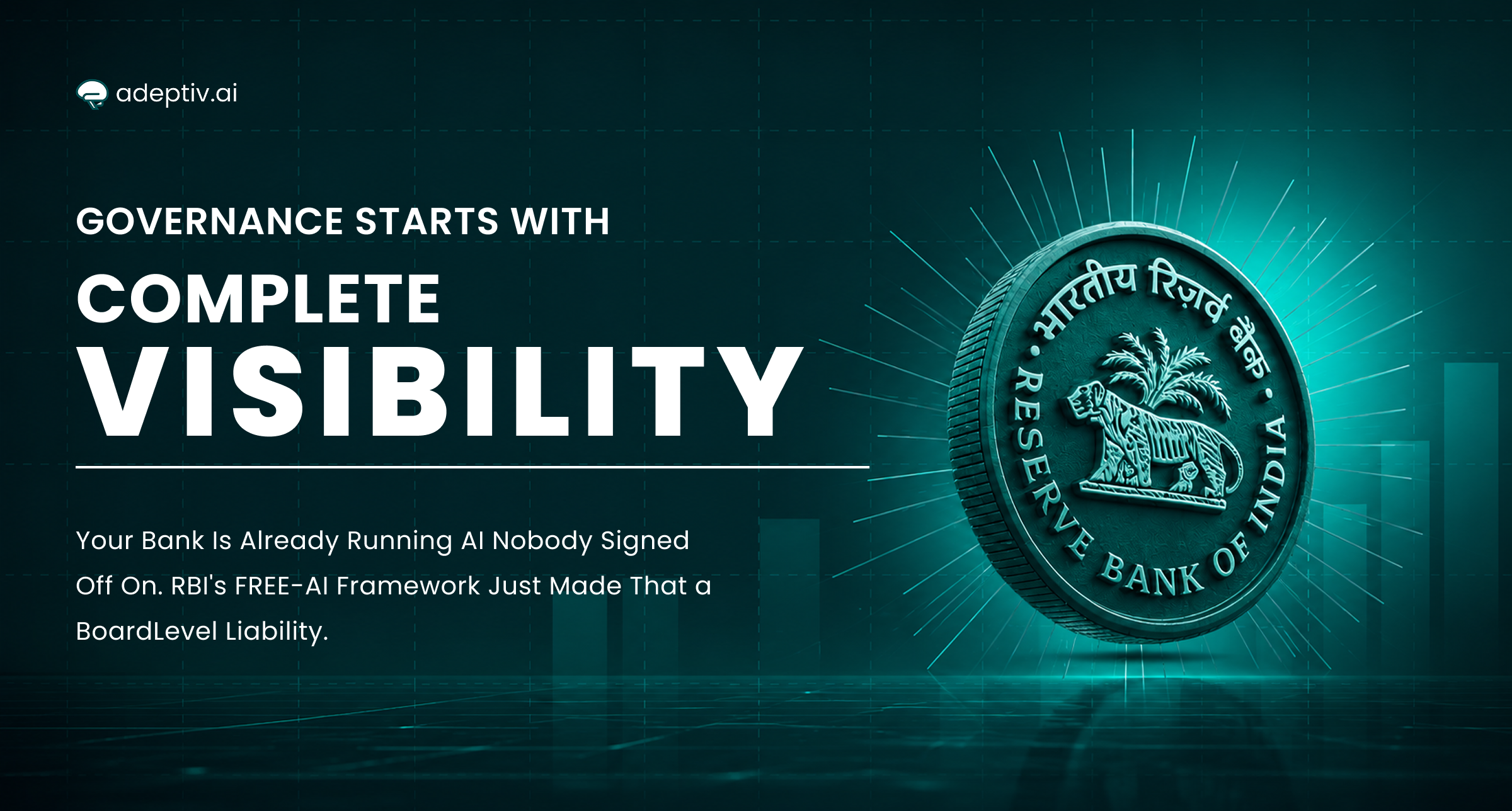
A practical AI governance in banking briefing for CIOs, CROs, CCOs, and Heads of AI at Indian banks, NBFCs, insurers, and fintechs — built around RBI’s FREE-AI framework, real BFSI failure patterns, and what “audit-ready” actually requires in 2026.
AT A GLANCE
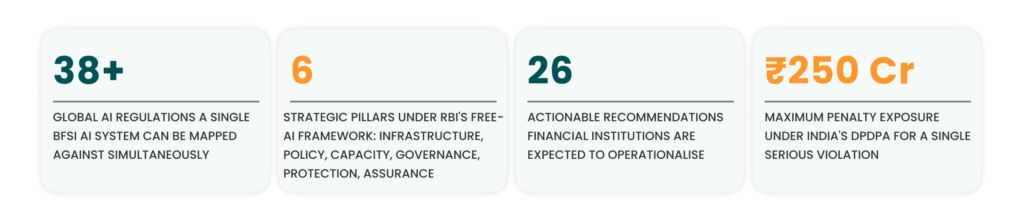
- RBI’s FREE-AI framework (6 pillars, 26 recommendations, released August 2025) is moving from voluntary guidance toward supervisory expectation for every regulated BFSI entity.
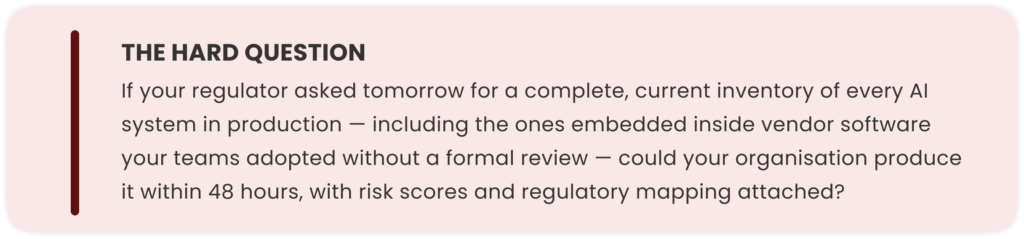
- Most Indian financial institutions cannot currently produce a complete, board-ready inventory of every AI model, co-pilot, and vendor-embedded AI tool running in production.
- Shadow AI — AI systems adopted by teams without formal governance sign-off — is the single largest blind spot auditors and regulators are now probing in BFSI.
- Penalty exposure is real and stacking: EU AI Act fines up to €35M, GDPR up to €20M, DORA up to €5M, and India’s DPDPA up to ₹250 Crore — all of which can apply to a single cross-border BFSI AI deployment.
- Manual governance doesn’t scale to how fast BFSI ships AI — risk assessments that take 6 weeks and regulatory mapping that takes a month are structurally incompatible with weekly model releases.
- Governance is becoming a competitive differentiator, not just a compliance cost — institutions that can prove explainability and control win regulator trust, board confidence, and customer trust faster.
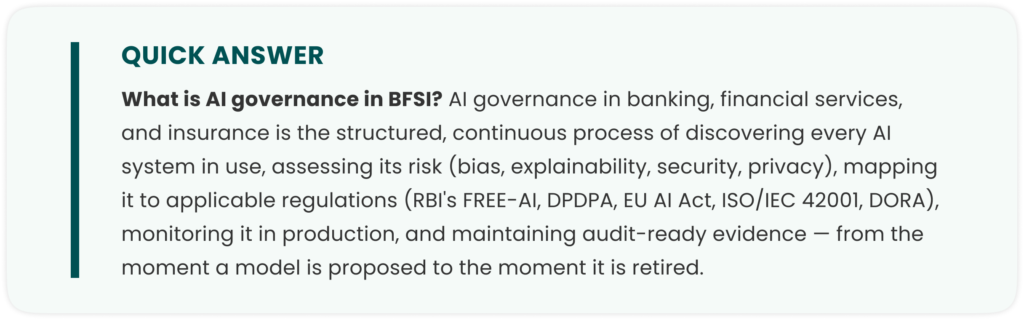
Walk into any risk committee meeting at a large Indian bank or NBFC this quarter and ask a simple question: how many AI systems does your organisation currently run in production? The honest answer, more often than not, is “we’re not fully sure.” Not because leadership is negligent — but because AI adoption in BFSI has outpaced the governance infrastructure built to track it. Credit models, fraud engines, Gen AI co-pilots in relationship-manager tools, chatbots stitched into net banking, vendor-embedded scoring APIs — each was approved individually, by a different team, at a different time, under a different level of scrutiny. Nobody owns the full picture.
This is not a hypothetical governance gap. It is the exact gap the Reserve Bank of India’s Framework for Responsible and Ethical Enablement of Artificial Intelligence (FREE-AI) was built to close — and the exact gap regulators, auditors, and boards are now expected to ask hard questions about. With India’s BFSI Tech Innovation Summit convening this week in Mumbai to debate exactly this shift — AI agents approving loans, detecting fraud, and managing wealth, under RBI, NPCI, and SEBI’s tightening data and trust expectations — the timing could not be more direct. Governance is no longer a back-office checklist. It is boardroom infrastructure.
The BFSI AI Boom Nobody Fully Governs
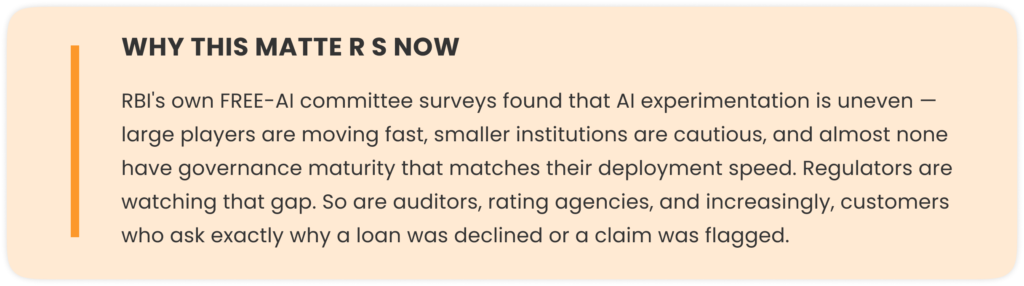
AI adoption inside Indian financial services has moved from pilot to production faster than almost any other sector — credit underwriting, wealth advisory copilots, fraud detection, KYC automation, and customer-facing chat agents are now standard infrastructure, not experiments. Large banks and fintechs are experimenting aggressively; even more cautious institutions are catching up under competitive pressure. The result is a widening gap between how much AI is deployed and how much of it is actually governed with the same rigor as core banking systems.
RBI’s FREE-AI Framework Just Turned Governance Into a Board Mandate
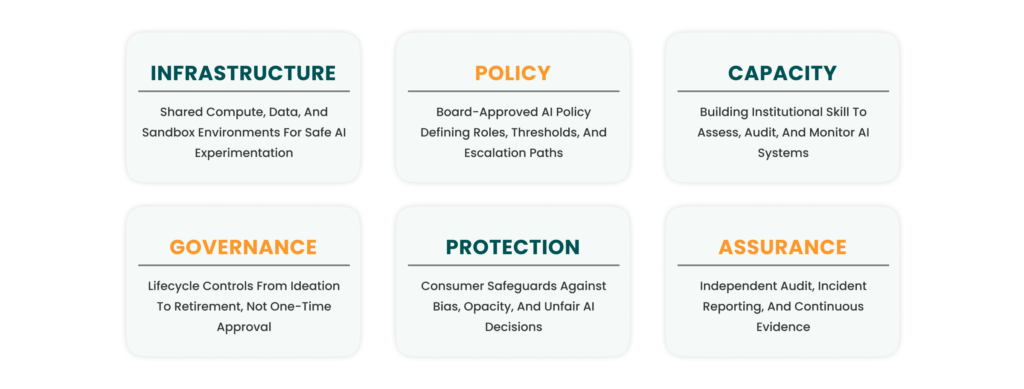
FREE-AI was developed by a committee of banking, technology, and academic experts and released in August 2025 after extensive consultation across banks, NBFCs, fintechs, and global regulators. It is built on seven guiding principles — trust as the foundation, people first, innovation over restraint, fairness and equity, accountability, understandable-by-design, and safety, resilience and sustainability — organised into six strategic pillars.
What makes FREE-AI different from a typical advisory note is its direction of travel. Committee members and RBI officials have publicly indicated that these voluntary principles are expected to translate into hard governance obligations — board-approved AI policies, audit-plan inclusion, and eventually, formal disclosure requirements similar to existing cyber-security reporting. SEBI-listed banks and NBFCs should expect AI governance disclosure to follow the same trajectory that cyber-risk disclosure did a few years ago.
Where BFSI AI Governance Actually Breaks
Governance failures in financial services rarely happen because nobody cared. They happen because governance was designed as a one-time gate, not a continuous discipline. Four patterns show up again and again in BFSI risk reviews:
1. Shadow AI inside “approved” software
A core-banking vendor quietly ships a generative AI feature in a routine update. A wealth advisory platform adds an AI copilot. A collections tool starts using an ML scoring layer under the hood. None of these went through a formal AI risk review — they arrived bundled inside software the bank already trusted. This is exactly the blind spot Adeptiv AI’s Shadow AI capability is built to close, by continuously surfacing every AI system operating across the enterprise, including the ones nobody explicitly approved.
3. Credit and underwriting models that can’t explain themselves
Credit scoring is the highest-scrutiny use case in Indian BFSI — it directly affects a person’s access to capital, and it sits squarely inside every major regulation’s “high-risk” category. A model that can’t produce a clear, borrower-facing explanation for a decision is not just a compliance gap; it’s a fair-lending liability. Adeptiv AI’s AI-driven credit risk governance approach exists precisely to make these systems explainable, auditable, and defensible to both regulators and borrowers.
3. Investment and advisory co-pilots handling sensitive financial data
AI copilots assisting relationship managers and investment research teams increasingly touch high-risk categories under global frameworks — because they influence financial decisions and process sensitive personal and proprietary data at scale. Institutions deploying these tools without a documented risk classification are building on unstable regulatory ground. Adeptiv AI’s AI Investment Research & Client Advisory Co-pilot governance work maps exactly this exposure.
4. Fraud and monitoring models that drift silently
A fraud detection model tuned for last year’s transaction patterns degrades quietly — false positives climb, genuine fraud slips through, and nobody notices until an audit or a loss event forces the question. Without continuous observability, model drift is invisible until it’s expensive.
See exactly which of these four patterns exist inside your institution
A 30-minute session with Adeptiv AI maps your current AI footprint against RBI’s FREE-AI pillars — before your next audit does it for you.
Request a Demo →
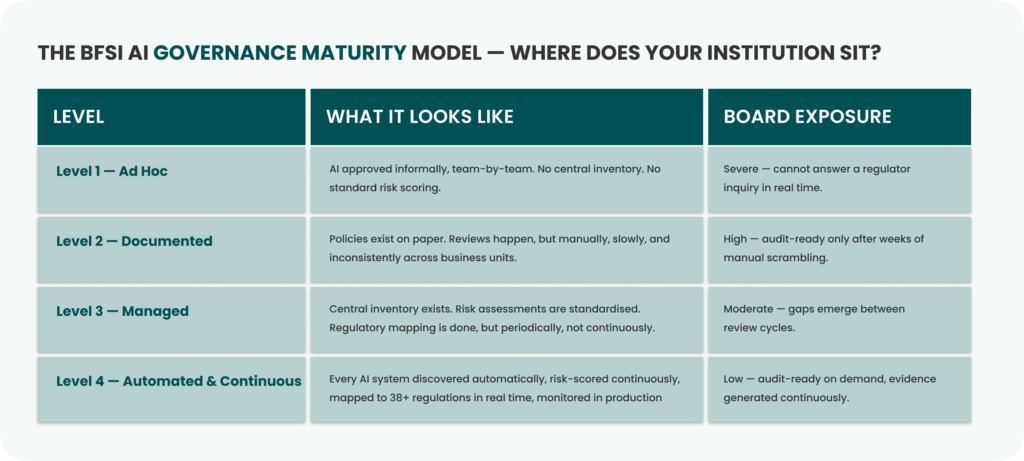
The BFSI AI Governance Maturity Model — Where Does Your Institution Sit?
Use this model in your next risk committee meeting. Most Indian financial institutions, honestly assessed, sit at Level 1 or Level 2 — despite running dozens of AI systems in production.
From Governance Debt to Governance Infrastructure
The core tension in BFSI AI governance is speed versus rigor. Traditional, consultant-led governance processes were built for a world where a handful of models launched per year. That world is gone. Manual risk assessment, framework-building from scratch, and manual regulatory mapping simply cannot keep pace with how fast BFSI institutions now ship AI-driven products.
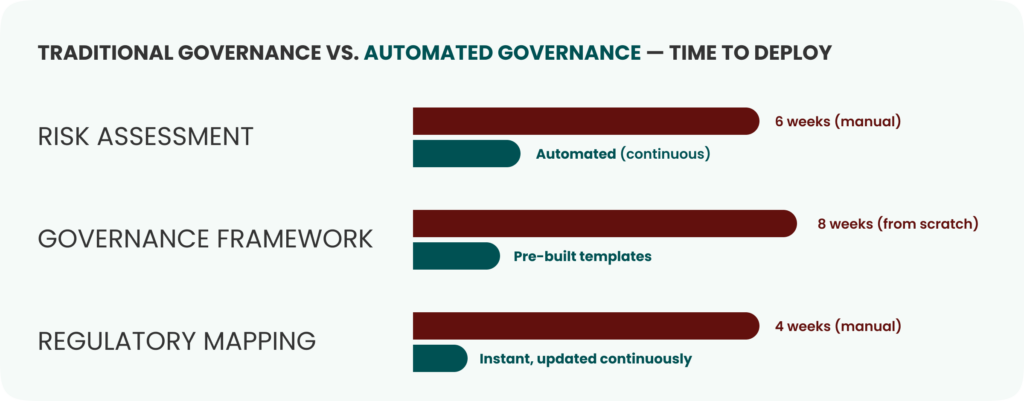
Governed deployment pipeline: up to 60% faster with an automated AI governance platform.
This is the shift Adeptiv AI’s AI Governance Platform is built for — replacing fragmented tools, manual a 12-pillar documentation, and consultant queues with one continuously operating system covering AI inventory discovery, risk assessment framework, real-time observability, and compliance mapping across 38+ global regulations — including RBI’s FREE-AI expectations.
Build It In-House, or Buy the Infrastructure?
Some BFSI technology teams still ask whether AI governance can be built internally with spreadsheets, a GRC add-on, and a policy document. It can — for a while, and for a handful of models. It stops working the moment an institution crosses into dozens of AI systems across multiple business lines and jurisdictions, which is exactly where most mid-to-large Indian BFSI institutions already are. Adeptiv AI has published a detailed, vendor-neutral breakdown of this decision — see AI Governance: Build vs. Buy — along with objective, side-by-side comparisons against other governance platforms to help enterprise buyers evaluate the market before committing: Adeptiv vs. OneTrust, Adeptiv vs. Credo AI, Adeptiv vs. Holistic AI, and Adeptiv vs. IBM Watsonx Governance.
HAPPENING THIS WEEK
The BFSI Tech Innovation Summit convenes in Mumbai on 29 July 2026, bringing together 200+ senior BFSI technology leaders to debate exactly the theme of this briefing: AI agents now approve loans, detect fraud, and manage wealth — while RBI, NPCI, and SEBI rewrite the rules around data, trust, and reporting. If your team is attending, or simply weighing how FREE-AI changes your governance roadmap this year, this is the right week to get a clear picture of where your institution actually stands.
Talk to Adeptiv AI Before You Walk In →
The Boardroom Questions Every BFSI CIO, CRO, and CCO Should Be Able to Answer Today
These are not rhetorical. They are the questions RBI examiners, external auditors, and increasingly, your own board risk committee, are starting to ask.
- How many AI systems — including vendor-embedded ones — are running in production right now, and who owns that list?
- Which of those systems would be classified high-risk under RBI’s FREE-AI, the EU AI Act, or India’s DPDPA, and can you prove that classification?
- If a customer disputes an AI-driven credit or claims decision tomorrow, can you produce a clear explanation within your regulatory response window?
- How long would it take your team to assemble complete, audit-ready evidence for every AI system, right now, without weeks of manual scrambling?
- Who is accountable if a third-party AI model embedded in vendor software causes a compliance breach?
- Is your AI governance evidence continuous, or does it only exist because an audit forced someone to reconstruct it
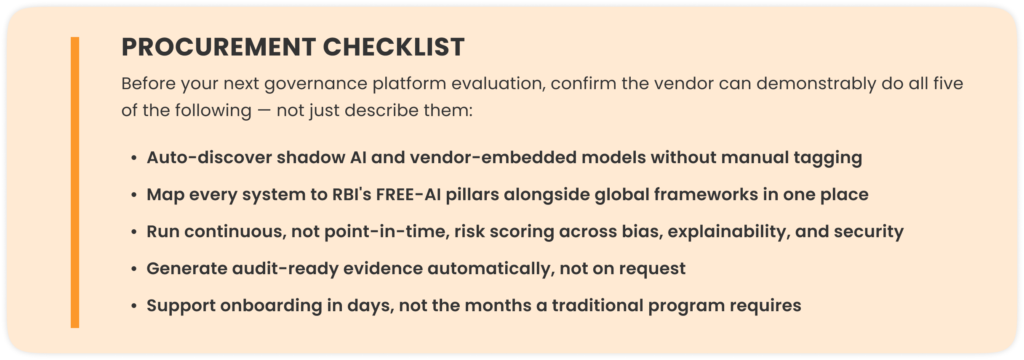
Governance debt compounds. It doesn’t wait for your next audit cycle.
Explore how Adeptiv AI’s platform maps your entire AI estate to RBI’s FREE-AI framework and 38+ global regulations — automatically, continuously, and in a fraction of the time a traditional program takes.
Explore the AI Governance Platform →
Frequently Asked Questions
1. What is RBI’s FREE-AI framework, in simple terms?
FREE-AI (Framework for Responsible and Ethical Enablement of Artificial Intelligence) is RBI’s guidance for how banks, NBFCs, and payment companies in India should responsibly build, deploy, and govern AI. It was released in August 2025 and is organised around six pillars — Infrastructure, Policy, Capacity, Governance, Protection, and Assurance — with 26 specific recommendations.
2. Is FREE-AI legally mandatory for banks and NBFCs?
FREE-AI currently sets out voluntary principles rather than binding law, but RBI officials and the committee have signalled that its expectations are expected to move into supervisory practice — including board-approved AI policies, audit-plan coverage, and potential future disclosure requirements. Treating it as optional is a short-term view.
3. What is “shadow AI” and why does it matter for BFSI?
Shadow AI refers to AI systems and models operating inside an organisation without formal governance review or sign-off — often bundled inside vendor software or adopted informally by individual teams. In BFSI, shadow AI is especially risky because it frequently touches credit decisions, fraud detection, or customer data without ever going through a risk assessment.
4. How is AI governance different from AI risk management?
AI risk management identifies and scores the risks of an individual model — bias, security, explainability. AI governance is the broader, continuous structure around it: policies, inventory, lifecycle checkpoints, regulatory mapping, and audit evidence across every AI system an organisation runs. Risk assessment is one component inside a governance programme.
5. What regulations should Indian BFSI institutions map their AI systems against?
At minimum: RBI’s FREE-AI framework, India’s DPDPA, and — for institutions with cross-border operations, vendors, or customers — the EU AI Act, GDPR, DORA, ISO/IEC 42001, and NIST AI RMF. Most enterprise AI governance platforms, including Adeptiv AI, map a single system against 38+ global frameworks simultaneously.
6. How long does it take to become “audit-ready” for AI governance?
With manual, consultant-led processes: typically months, and the position decays again as soon as new AI systems are deployed. With an automated AI governance platform that discovers systems, scores risk, and maps regulations continuously, institutions can reach audit-ready status in days and maintain it on an ongoing basis rather than reconstructing it before every review.
Ready to see where your institution actually stands against FREE-AI?
Adeptiv AI onboards a custom AI compliance policy for your organisation in under 24 hours.