At a Glance
- AI governance is shifting from static policy frameworks to operational control systems embedded into execution.
- The rise of agentic AI is redefining risk, authority, and accountability across enterprises.
- Governance limited to design-time or deployment-time reviews creates a false sense of safety.
- Fragmented global regulation forces organizations to build adaptive, jurisdiction-aware governance mechanisms.
- Unified AI governance platforms are emerging as critical infrastructure, not optional tooling.
- In 2026, strong AI governance will differentiate organizations that scale safely from those that stall under risk.
Introduction
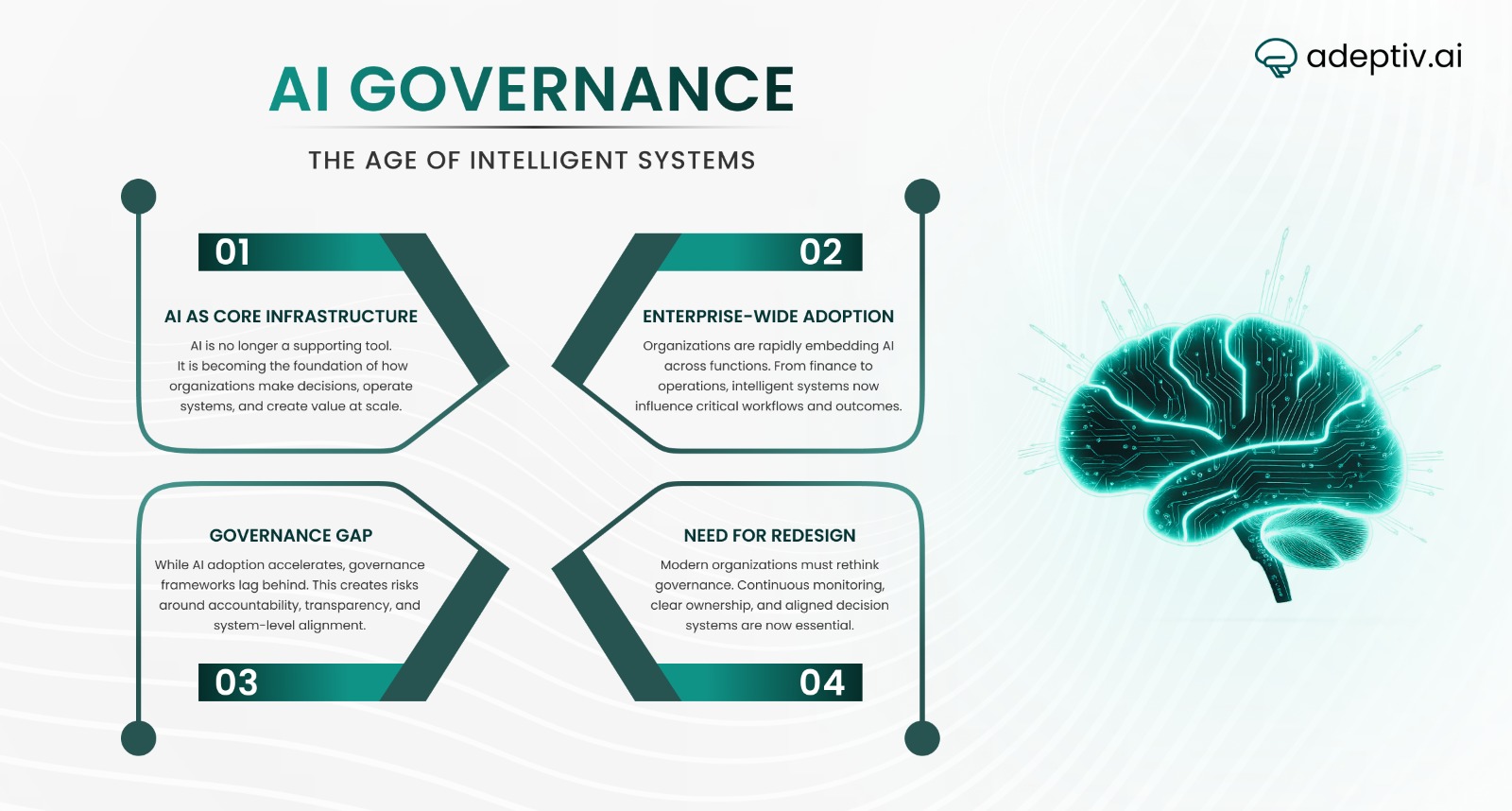
For most of the last decade, AI governance lived comfortably inside documents. Policies were drafted, ethical principles were endorsed, and committees were formed, often with sincere intent to guide responsible innovation. These efforts were not misguided. They reflected the reality of early AI adoption, where systems were experimental, bounded, and relatively easy to reason about.
As organizations move into 2026, that governance model is no longer sufficient. AI systems are no longer peripheral tools supporting narrow use cases. They are embedded deeply into revenue generation, operational decision-making, customer interaction, and increasingly into autonomous execution paths. AI now shapes outcomes in real time, often at scale, and often without direct human intervention.
This shift fundamentally changes what governance must be. It can no longer function as an advisory overlay or a compliance artifact reviewed periodically. AI governance is becoming operational infrastructure, as essential to enterprise resilience as cybersecurity, financial controls, or identity and access management. Organizations that fail to recognize this transition are discovering that traditional governance models cannot keep pace with modern AI behaviour, no matter how well-intentioned or comprehensive those models appear on paper.
Why Governance Must Move Beyond Policy
The central limitation of first-generation AI governance was its reliance on static assumptions. Models were evaluated at a moment in time, risks were documented, and compliance was verified against known conditions. Once these steps were completed, governance was often considered “done,” subject only to periodic review or audit.
Modern AI systems do not operate under static conditions. They evolve continuously through data drift, model updates, changes in user behaviour, shifting organizational workflows, and integration with other systems. Each of these changes can materially alter risk profiles, sometimes in subtle ways that are difficult to detect through periodic review alone.
By 2026, governance that operates only at design or deployment time creates a dangerous illusion of control. Real risk emerges during execution, when AI systems interact with live environments and real users under conditions that were never fully anticipated. This is especially true for generative and agentic AI systems, which can produce novel outputs or initiate actions that were not explicitly programmed.
Operational governance does not eliminate risk. Instead, it ensures that risk remains observable, bounded, and controllable as conditions change. It shifts governance from a retrospective exercise to a continuous discipline that operates alongside the system itself.
The Rise of Agentic AI and the Limits of Oversight
Agentic AI represents a structural break from earlier generations of AI. Instead of producing outputs for humans to interpret and act upon, these systems increasingly initiate actions, coordinate tasks, and interact directly with tools, APIs, and downstream systems.
This evolution expands the governance challenge well beyond traditional concerns such as bias, explainability, or model accuracy. The core issues now include authority, escalation, and permissioning. The question is no longer simply whether an output is correct or fair, but whether the system should be allowed to act at all under certain conditions.
The most critical governance question becomes whether a system is permitted to proceed under uncertainty, not whether it performs optimally under ideal conditions. Organizations that treat agentic AI as an extension of traditional automation often discover that they have unintentionally delegated decision authority without establishing enforceable boundaries.
Effective governance in this context requires explicit design of refusal, pause, and escalation mechanisms. Monitoring alone is insufficient. A system that can be observed but cannot be constrained is not governed in any meaningful sense.
Regulatory Fragmentation as a Design Constraint
By 2026, the global regulatory environment for AI is defined less by harmonization and more by divergence. The EU AI Act introduces a comprehensive, risk-based framework with strong obligations around documentation, transparency, human oversight, and post-market monitoring. In contrast, the United States continues to evolve through a combination of federal guidance, sector-specific regulation, and an expanding patchwork of state-level laws.
For multinational organizations, this fragmentation introduces a fundamental governance challenge. Compliance cannot be hard-coded to a single jurisdictional model. Governance systems must be designed to adapt dynamically to the most restrictive applicable requirements while remaining flexible enough to accommodate future regulatory change.
This reality forces organizations to move away from manual, jurisdiction-by-jurisdiction compliance processes toward unified governance architectures. These architectures abstract regulatory complexity into operational controls, enabling organizations to manage compliance without redesigning systems for every regulatory update.
In this environment, regulation becomes a design constraint rather than a checklist. Governance maturity is measured not by how many rules are documented, but by how effectively systems can adapt as those rules evolve.
Why Governance Platforms Are Becoming Core Infrastructure
As AI usage scales across enterprises, governance managed through spreadsheets, manual reviews, and ad hoc approvals becomes unsustainable. These approaches do not scale with system complexity, deployment velocity, or regulatory pressure.
Organizations increasingly require systems that translate governance intent into enforceable execution. Modern AI governance platforms fulfill this role by embedding oversight directly into the AI lifecycle, from development and testing through deployment and runtime operation.
These platforms enable continuous observability, structured risk assessment, and real-time or near-real-time control without relying on constant human intervention. More importantly, they establish a single source of truth that aligns engineering, risk, legal, and executive teams around shared visibility and accountability.
By 2026, the absence of such infrastructure increasingly signals governance immaturity, regardless of how extensive an organization’s policy documentation may appear. Governance without operational tooling becomes brittle, slow, and disconnected from reality.
Governance as a Competitive Capability
One of the most persistent misconceptions about AI governance is that it slows innovation. In practice, the opposite is increasingly true. Organizations with clear, enforceable governance controls are able to deploy AI faster because they have confidence in their ability to detect, contain, and respond to issues before they escalate into failures.
Trust becomes a multiplier. Internally, teams are more willing to experiment when guardrails are explicit and escalation paths are clear. Externally, customers are more likely to adopt AI-enabled services when systems behave predictably and transparently. Regulators are more receptive when governance is demonstrably operational rather than theoretical.
In this sense, governance evolves from a defensive posture into a strategic capability. It enables sustainable scale by reducing uncertainty, aligning stakeholders, and preventing small failures from becoming systemic risks.
Conclusion
The defining feature of AI governance in 2026 is not the presence of regulation, policy documents, or oversight committees. It is the degree to which governance is operationalized and embedded into execution paths.
Organizations that succeed will be those that treat governance as infrastructure rather than overhead. They will design systems that can sense risk, make informed decisions, and intervene before harm occurs, even as conditions change.
AI governance is no longer about proving intent. It is about demonstrating control under real-world conditions.
FAQs
1. Why is AI governance changing in 2026?
AI systems are becoming autonomous, continuously evolving, and deeply embedded in core business processes, which requires governance that operates at runtime rather than only at design or deployment.
2. What makes agentic AI harder to govern?
Agentic AI can initiate actions and interact with systems independently, which introduces new risks around authority, escalation, and unintended outcomes that monitoring alone cannot manage.
3. Is compliance with regulations like the EU AI Act enough?
Regulatory compliance establishes a baseline, but it does not guarantee operational safety. Effective governance requires adaptive controls that go beyond minimum legal requirements.
4. Why are AI governance platforms becoming essential?
Manual governance processes cannot scale with modern AI complexity. Platforms embed governance into workflows, enabling continuous oversight and enforceable controls.
5. How does strong AI governance support innovation?
Clear guardrails reduce uncertainty, allowing teams to deploy AI faster and more confidently while maintaining trust with customers and regulators.