
Auto AI Discovery & Inventory Management
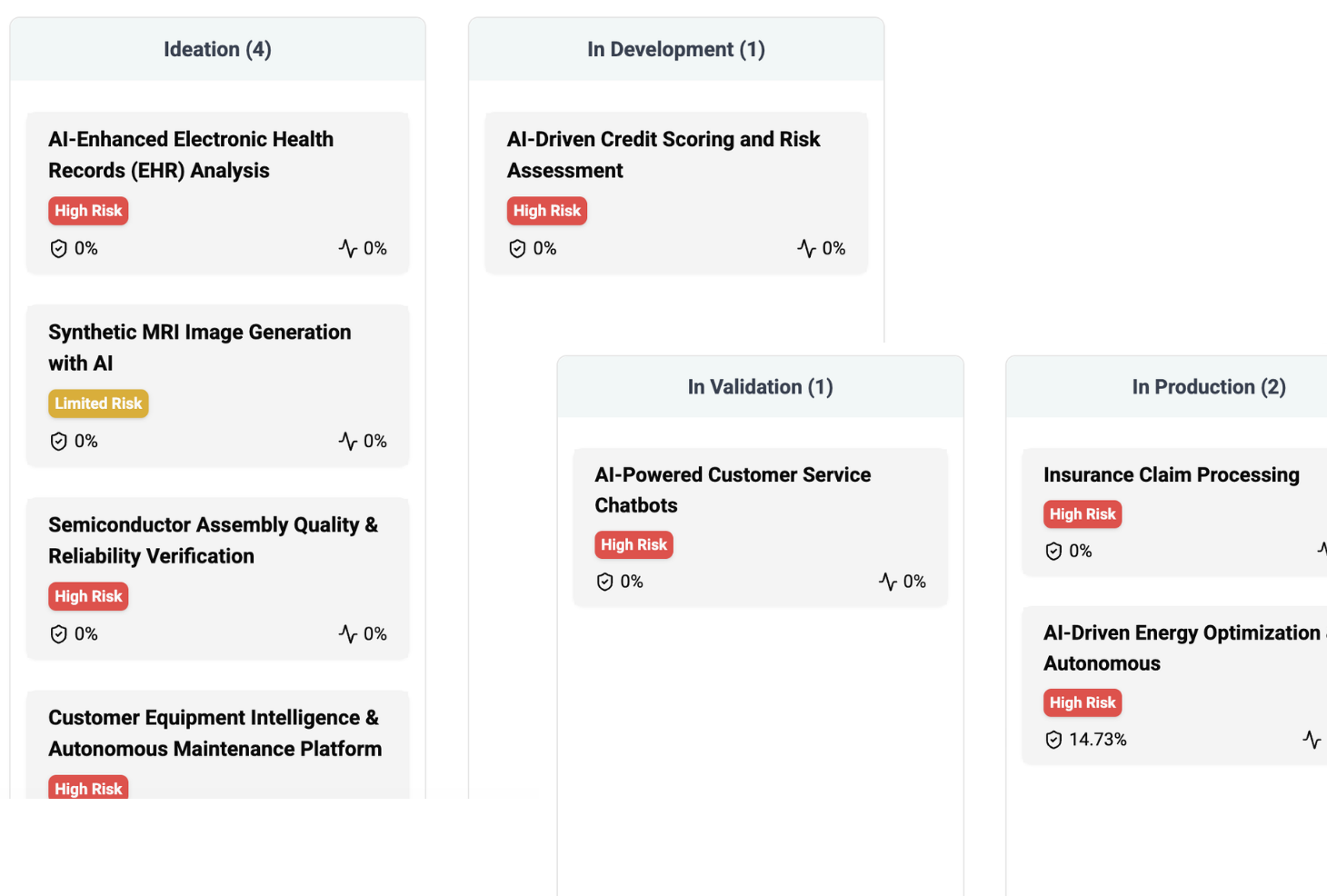
Adeptiv AI addresses the AI visibility problem, our platform auto-discover and manageme AI inventory of every AI system, use case, and model running across the organization.
The Problem: Why AI Inventory Remains Unsolved
Most enterprises approach AI inventory as a project, a point-in-time effort to catalog AI systems, typically triggered by a compliance audit or a regulatory deadline. This approach fails structurally for three interconnected reasons.
The Multi-Cloud Proliferation
Enterprise AI systems do not live in one place. A single organization may have ML models running on AWS SageMaker, foundation model APIs deployed via Azure OpenAI, LLM pipelines orchestrated through n8n or Airflow, RAG applications hosted on GCP Vertex AI, and autonomous agents embedded in SaaS platforms like Salesforce, Workday, and ServiceNow.
The Lifecycle Blindspot
Even when organizations catalog their AI systems at a point in time, they lack mechanisms to track these systems across their full lifecycle. A model validated for use in Q1 may be retrained, fine-tuned, or replaced by Q3 without triggering a governance review. Use cases move from proof of concept to production without formal sign-off or AI models are retired informally.
The Multi-Stakeholder Coordination
Effective AI inventory and governance require coordination among AI engineers, compliance officers, data privacy teams, and business owners, each operating with different tooling, terminology, and priorities. OECD research published in 2025 found that 58% of organizations cite fragmented systems as their primary AI governance challenge.
How It Works
The Auto Discovery and Inventory Management module operates through three integrated technical layers that work together to provide continuous, accurate, and actionable AI visibility.
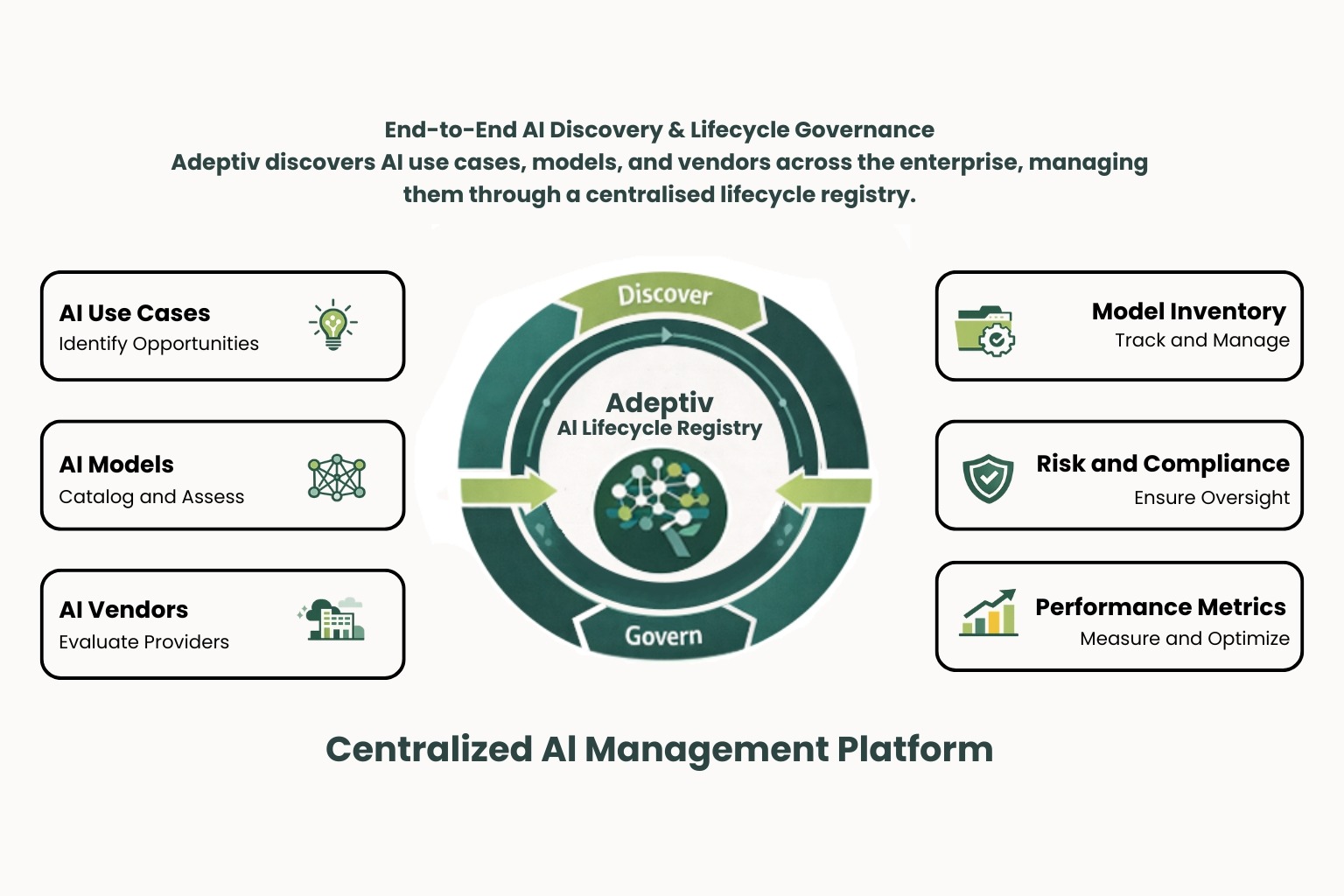
End-to-End AI Discovery & Lifecycle Governance
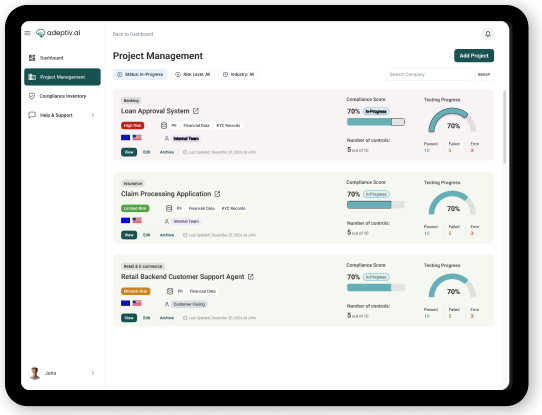
Adeptiv discovers AI use cases, models, and vendors across the enterprise, managing them through a centralized lifecycle registry.
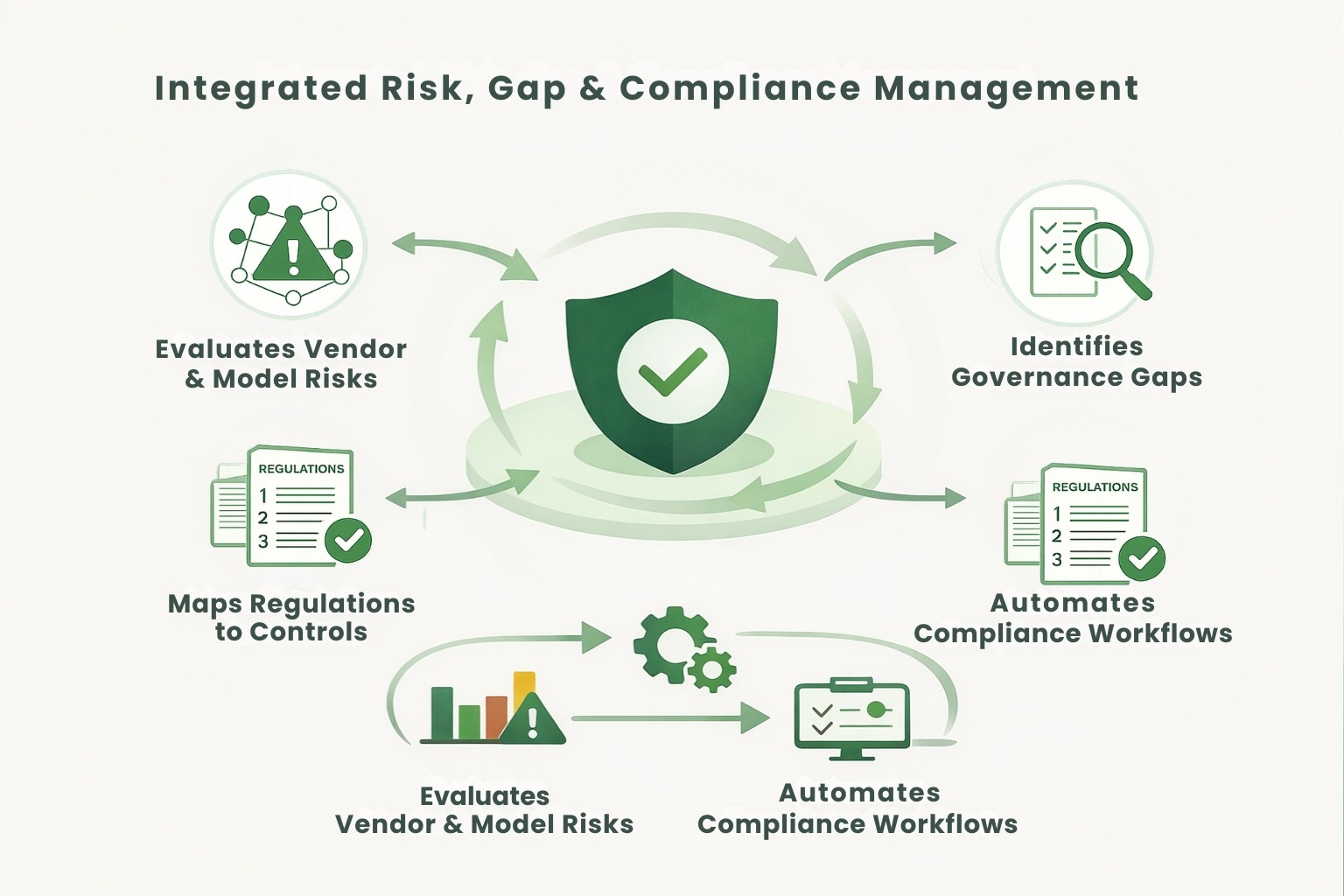
Integrated Risk, Gap & Compliance Management
The platform evaluates vendor and model risks, identifies governance gaps, maps regulations to controls, and automates compliance workflows.
Continuous Monitoring, Control & Audit Readiness
Adeptiv connects inventory data to real-time monitoring, controls, and automated reporting, enabling risk evaluation and audit-ready dashboards.
How We Fixed This Problem
The Auto Discovery and Inventory Management module operates through three integrated technical layers that work together to provide continuous, accurate, and actionable AI visibility.
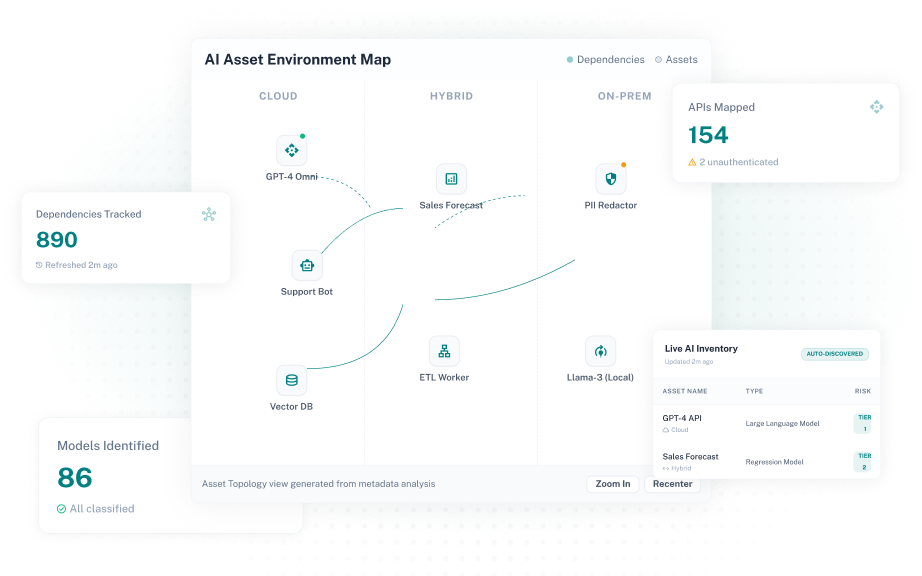
Complete AI Visibility, Instantly
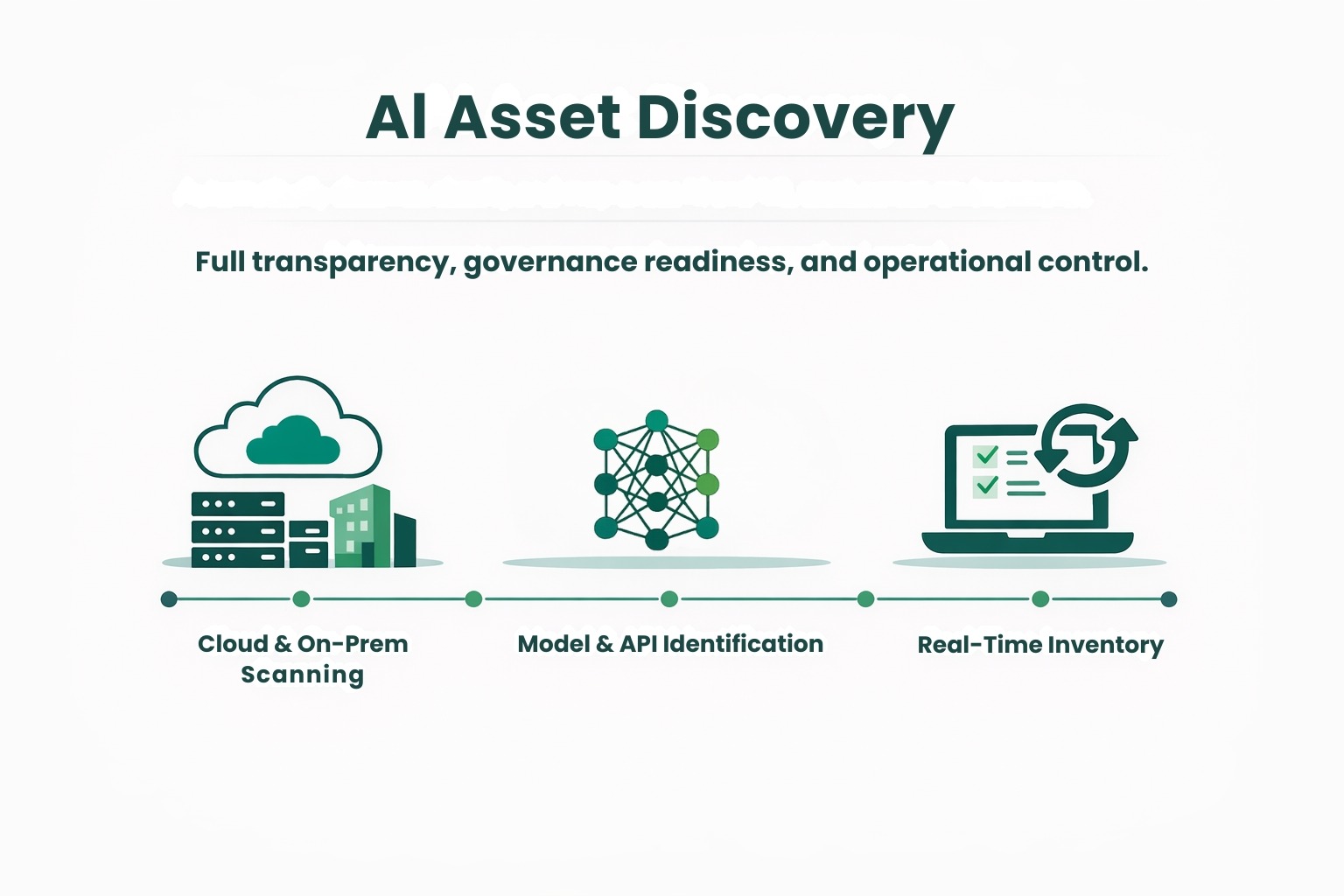
AI Asset Discovery
Automatically discover, classify, and map every AI and ML asset across environments, ensuring full transparency, governance readiness, and operational control.
- Scan cloud, on-prem, hybrid systems
- Identify models, APIs, dependencies automatically
- Maintain continuous, real-time inventory updates
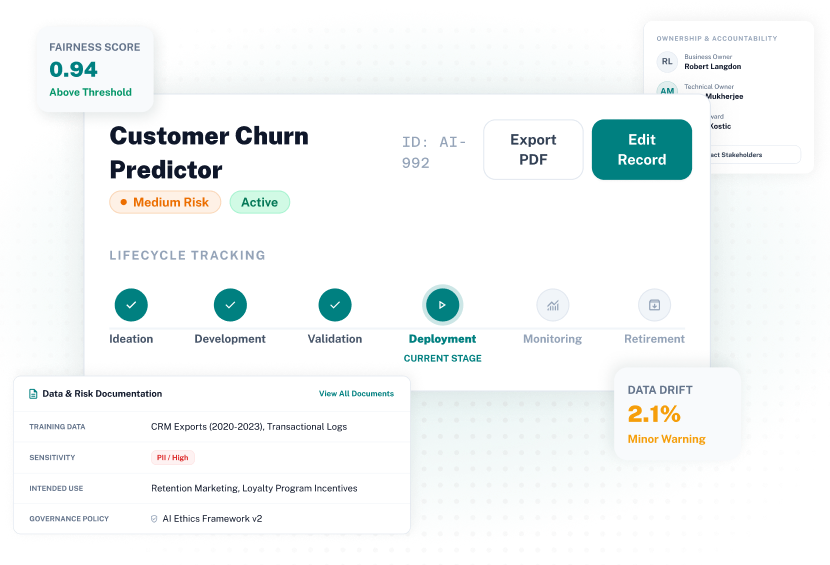
One Trusted AI Record
Unified AI Registry
Establish a centralized system of record capturing ownership, lifecycle stages, data sources, usage purpose, and risk insights for every AI asset.
- Track ownership, accountability, stewardship details
- Monitor lifecycle stages and status
- Document training data and risk classification
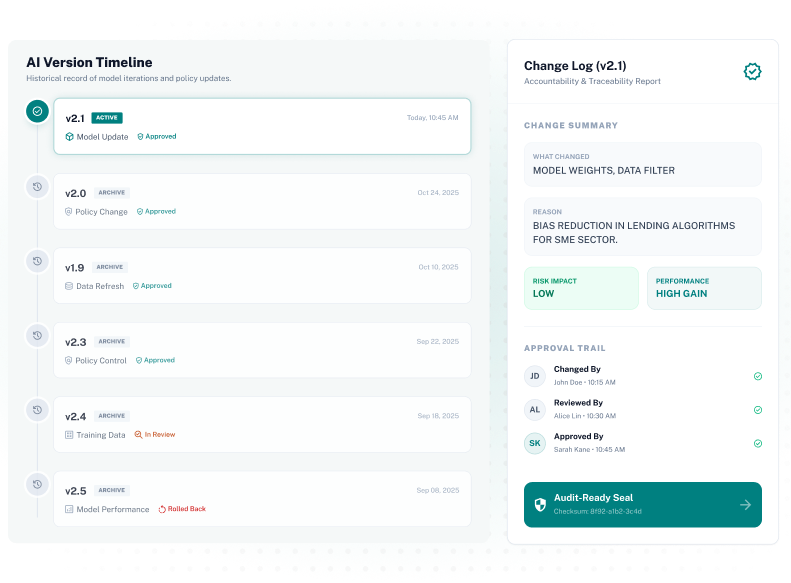
Transparent Change, Total Accountability
AI Lifecycle Control
Track every modification across the AI lifecycle, maintaining detailed version histories and update logs to ensure traceability, governance alignment, and operational clarity.
- Monitor model updates and revisions
- Maintain detailed version history records
- Ensure audit-ready change documentation
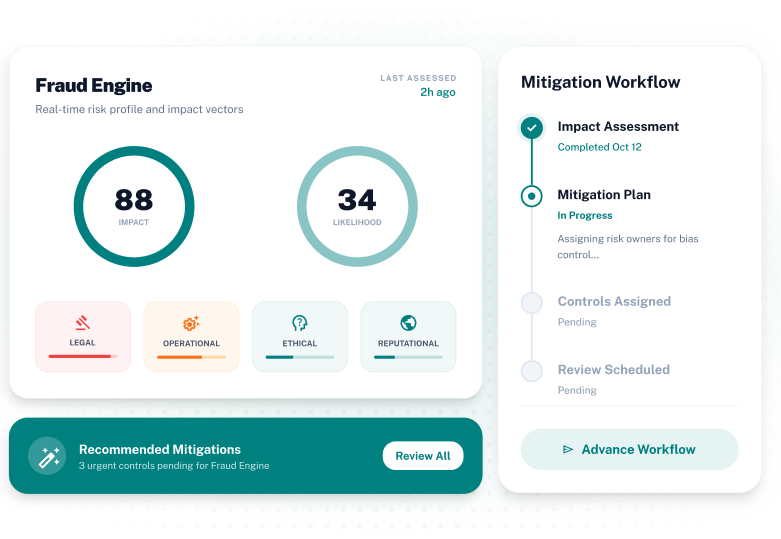
Proactive Risk, Informed Decisions
Integrated Risk Oversight
Link AI inventory data with risk management workflows to quickly surface high-impact systems and enable structured impact assessments and mitigation planning.
- Identify high-risk AI systems
- Connect inventory to risk workflows
- Support structured impact assessments
Measurable ROI & Business Impact
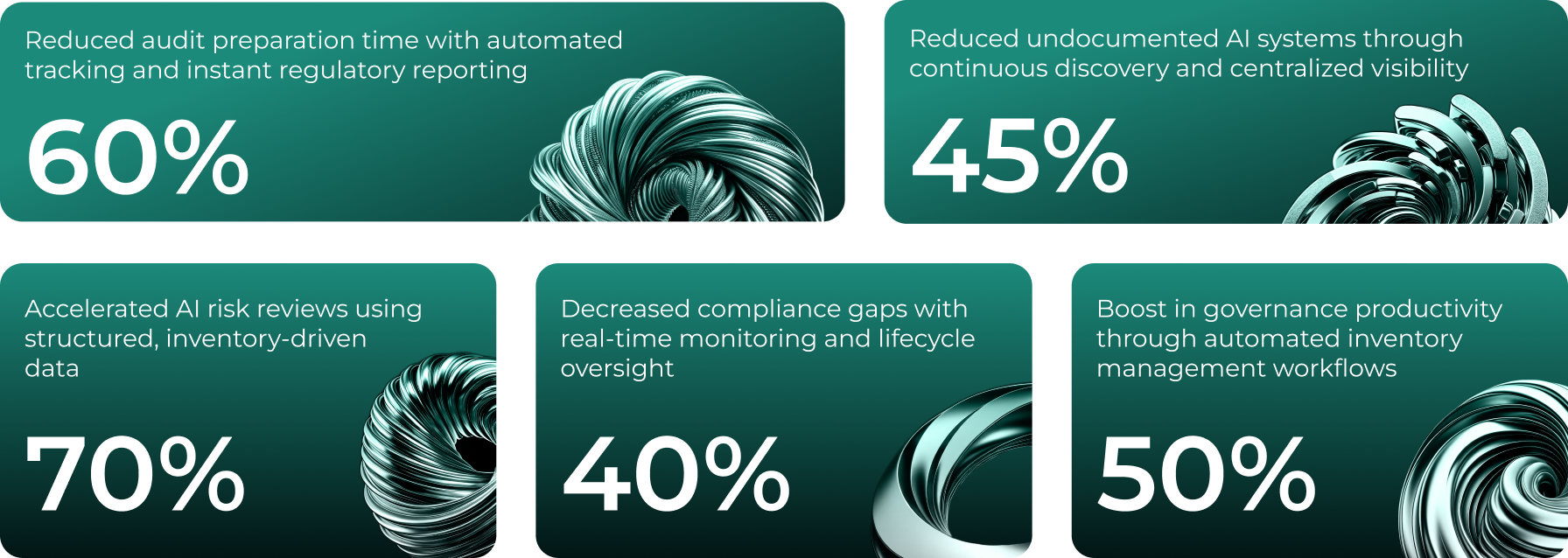
AI Inventory Management – Why it matters?
AI inventory management creates a single source of truth for all AI systems, reducing shadow AI, clarifying ownership, enabling continuous risk monitoring, ensuring regulatory compliance, accelerating audits, and allowing enterprises to scale innovation safely and confidently forward.
frequently asked questions (FAQs)
What is AI Inventory Management?
- AI Inventory Management involves keeping track of all the AI systems, models, agents, data sources, and third-party tools in use throughout an organization. It’s about cataloging and maintaining an up-to-date record of everything related to AI.
Why is AI Inventory Management critical for AI governance?
- You can’t really govern, secure, or audit AI systems unless you're aware of their existence. Having a full inventory of AI tools gives you the essential visibility needed for assessing risks, ensuring compliance, maintaining accountability, and overseeing their entire lifecycle.
What types of AI systems should be included in an AI inventory?
- When it comes to putting together an AI inventory for your business, you’ll want to think about including a few key things. This should cover models you've built yourself, any third-party AI tools you’re using, SaaS applications that include AI, large language models, agents, APIs, plugins, and those AI features that are part of your business apps.
What is Shadow AI, and why is it risky?
- Shadow AI is all about those AI tools that employees or teams start using without any official approval or oversight. The problem is, these tools can lead to issues like data leaks, exposing intellectual property, violating compliance rules, and bringing regulatory risks into the mix.
How does AI Inventory Management support regulatory compliance?
- AI inventory management helps companies stay compliant with regulations like the EU AI Act, GDPR, and ISO 42001. These rules ask organizations to keep records of their AI systems, evaluate potential risks, and show how they’re monitored. Having an AI inventory in place makes it easier to track everything, assign ownership, and be ready for audits.