
AI Compliance & Global Regulation Management
The global AI regulatory environment has crossed a critical threshold: it is no longer possible for an enterprise to track, interpret, and operationalize applicable AI obligations through manual processes.
The Problem: Why Current Approaches Are Failing
38% of organizations cite regulatory compliance as their top barrier and 76% plan to adopt a structured AI compliance framework within the next 12 months (CSA, 2025). The challenge is not awareness. It is execution at scale across a landscape that is simultaneously fragmented, Jurisdiction-specific, and continuously evolving.
Excel & Spreadsheet Sprawl
85% of organizations report compliance requirements have grown more complex over 3 years (MindStudio, 2025), yet most still manage AI compliance across disconnected spreadsheets, email threads, and shared drives. Controls are duplicated, evidence is mislinked, and version control is a fiction. When a regulation changes — and they change frequently — every spreadsheet becomes instantly stale.
Siloed Stakeholder Fragmentation
AI compliance spans legal, compliance, engineering, data science, security, and business units — none of whom share the same tooling, vocabulary, or visibility. Deloitte (2025) identifies fragmented ownership as the primary operational failure mode in ISO 42001 implementations. Without a shared system of record, governance collapses into asynchronous coordination overhead.
Multi-Framework Duplication
Organizations operating across jurisdictions must satisfy overlapping obligations from the EU AI Act, NIST AI RMF, ISO 42001, and regional regulations simultaneously. Without automated cross-framework mapping, teams re-examine the same AI systems multiple times from different compliance lenses — duplicating effort that a unified controls library would eliminate entirely.
Point-in-Time Compliance Failure
AI compliance is not a project with a completion date. It is a continuous operational discipline. Organizations that treat compliance as a periodic audit exercise — scrambling every 6–12 months — operate in permanent exposure between audit cycles. As the EU AI Act's post-market monitoring obligations make clear, continuous compliance is now the regulatory expectation, not the exception.
How It Works
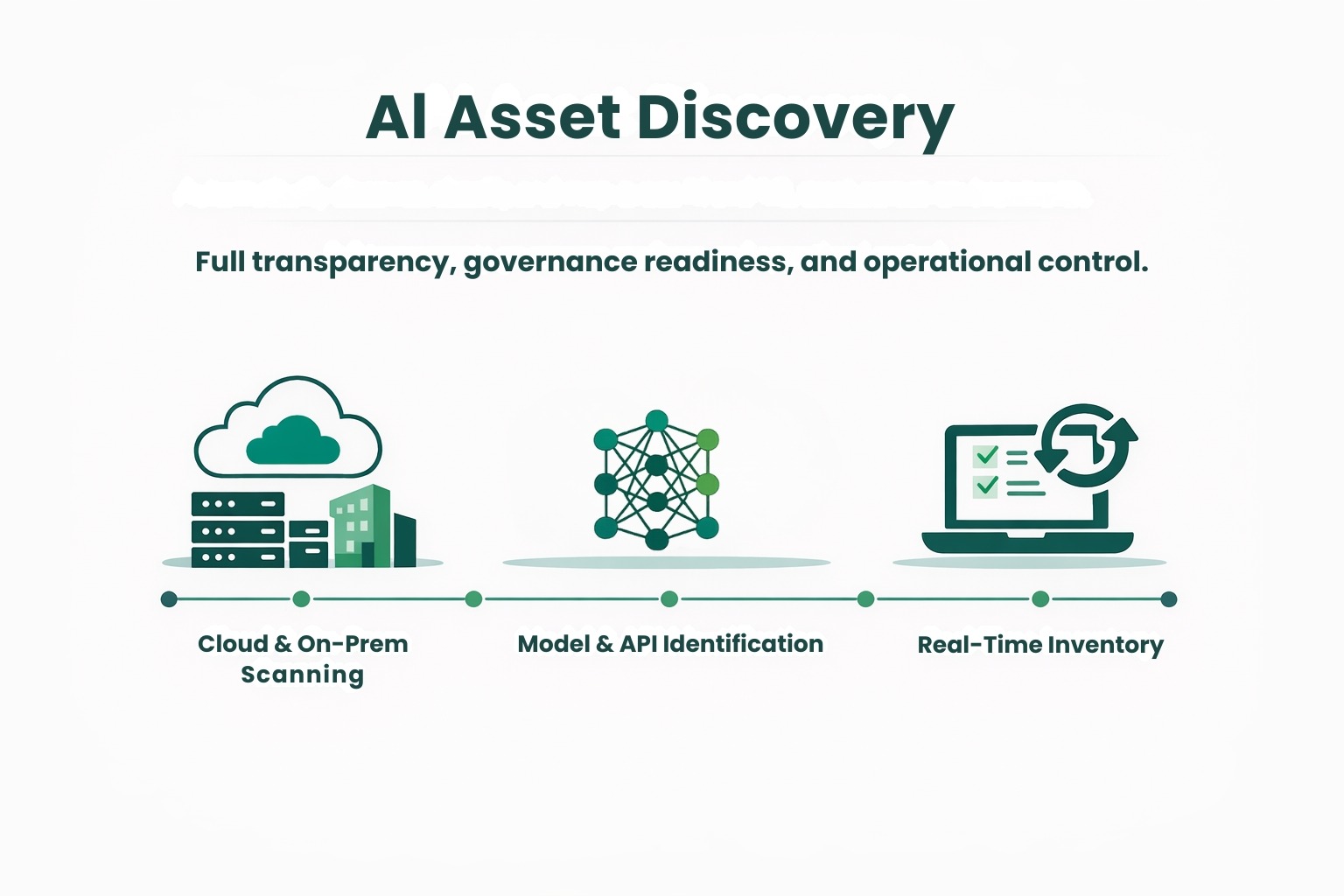
The Auto Discovery and Inventory Management module operates through three integrated technical layers that work together to provide continuous, accurate, and actionable AI visibility.
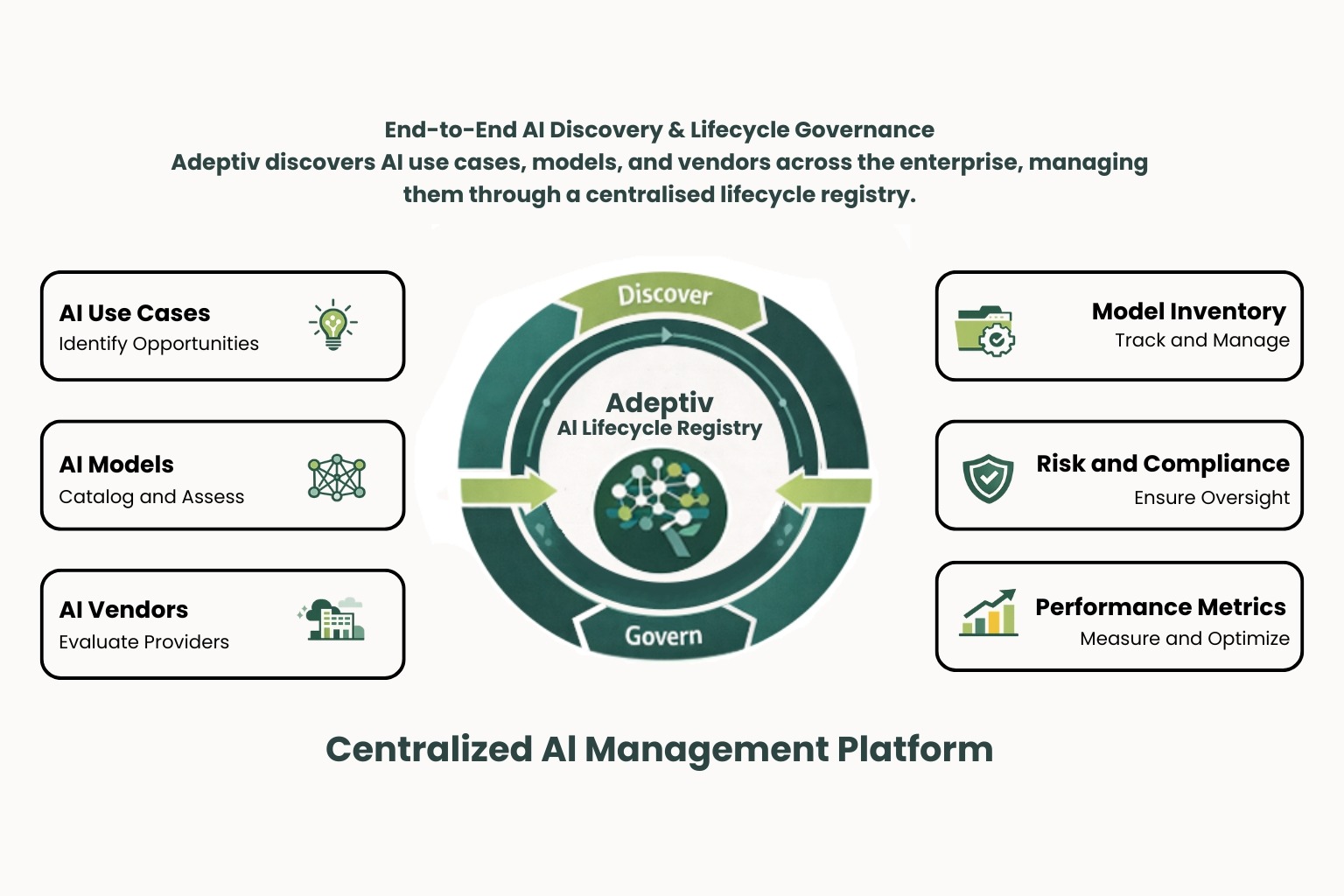
End-to-End AI Discovery & Lifecycle Governance
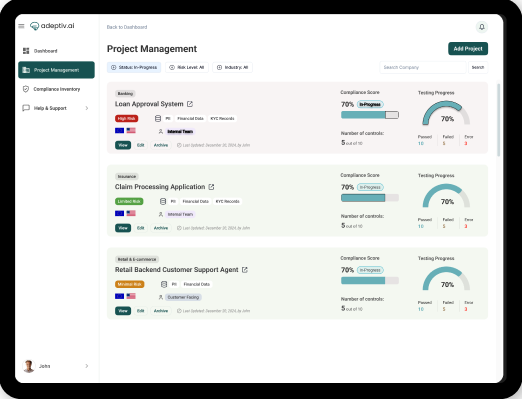
Adeptiv discovers AI use cases, models, and vendors across the enterprise, managing them through a centralized lifecycle registry.
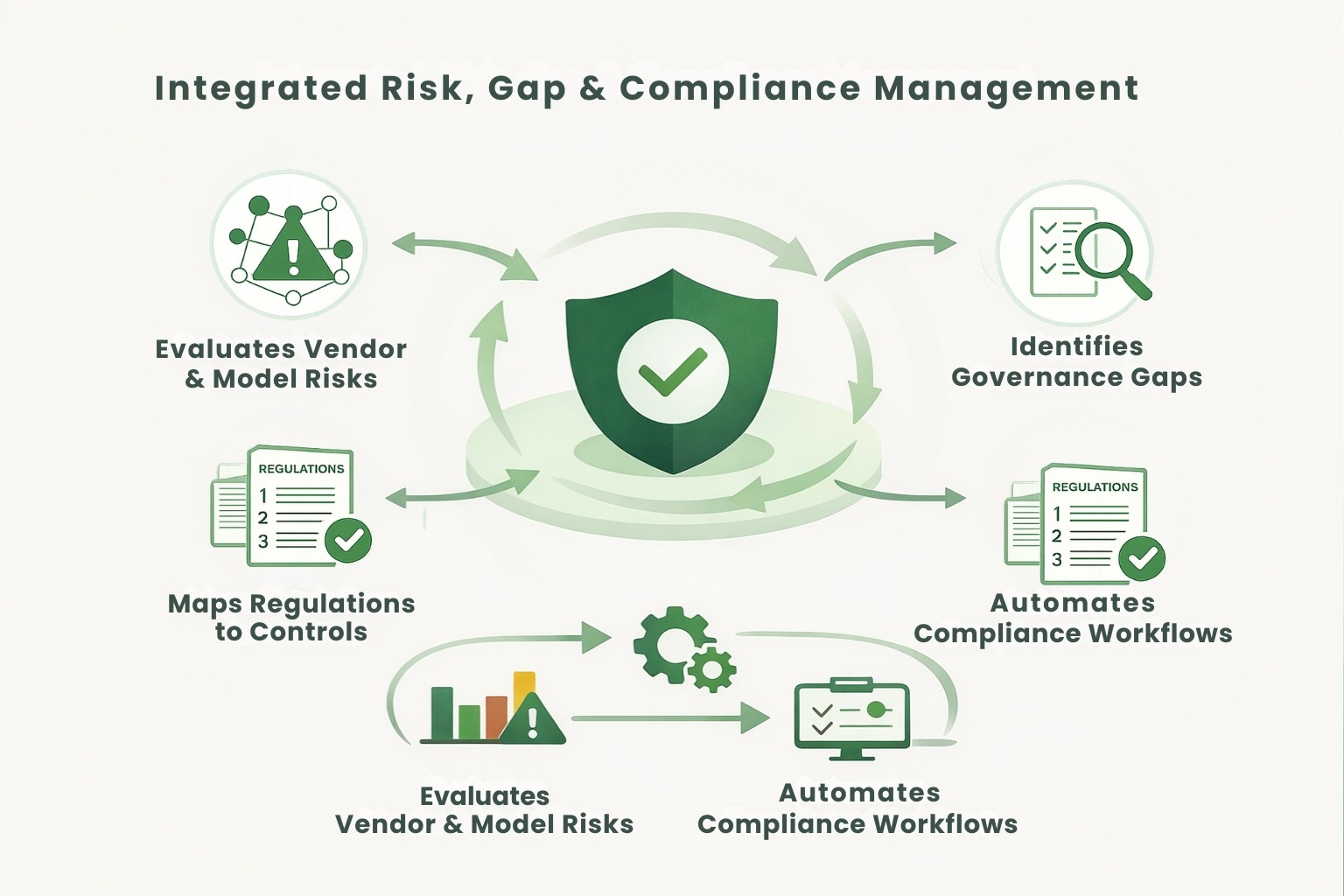
Integrated Risk, Gap & Compliance Management
The platform evaluates vendor and model risks, identifies governance gaps, maps regulations to controls, and automates compliance workflows.
Continuous Monitoring, Control & Audit Readiness
Adeptiv connects inventory data to real-time monitoring, controls, and automated reporting, enabling risk evaluation and audit-ready dashboards.
How Adeptiv AI Automates AI Compliance End-to-End
Adeptiv AI’s legal and compliance team has systematically converted 30+ global AI regulations, frameworks, and standards into 2000+ structured, implementable controls — each with defined implementation guidance, evidence requirements, and cross-framework mapping.
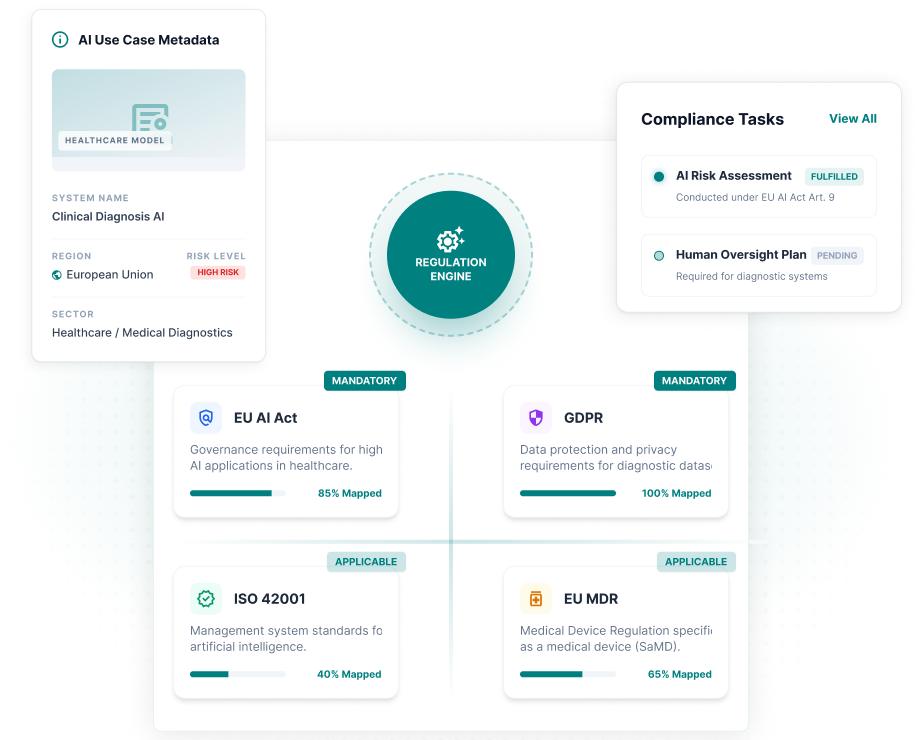
Use Case Context · Jurisdiction · Risk Tier · Sector
Intelligent Regulation Auto-Mapping
The platform automatically identifies applicable regulations and compliance obligations based on the use case's metadata — jurisdiction of deployment, sector, data types, model type, and EU AI Act risk classification.
- Context-driven applicability
- Gap analysis on-demand
- Real-time dynamic updates
2000+ Controls Library · AI-Powered · Executable
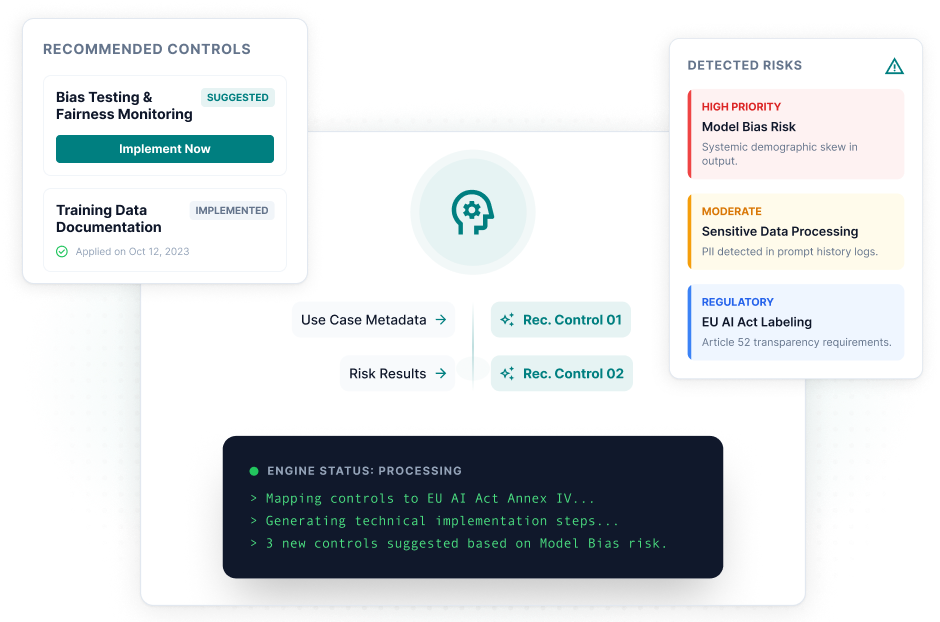
AI-Native Controls Management & Auto-Suggestion
Moving from risk and regulatory identification to actual compliance requires controls — specific, implementable actions. Adeptiv's AI-native engine auto-suggests the right controls from its 2000+ library, tailored to each use case.
- Intelligent control suggestion
- Control effectiveness scoring
- Cross-framework efficiency
Collection · Analysis · Validation · Traceability
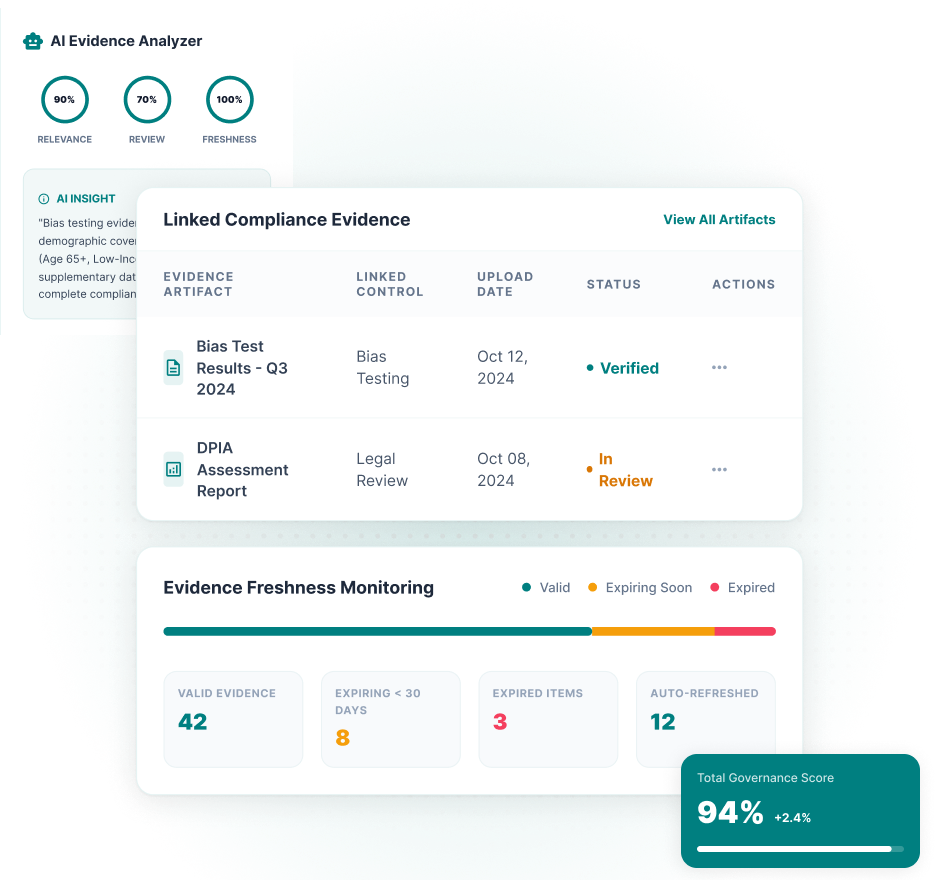
Automated Evidence Management & AI Analysis
Evidence is the currency of compliance. Adeptiv AI transforms evidence management from a manual collection exercise into an automated, continuously maintained, AI-analyzed record.
- Centralised evidence repository
- Evidence freshness tracking
- Evidence from observability
Legal · Compliance · Engineering · Audit
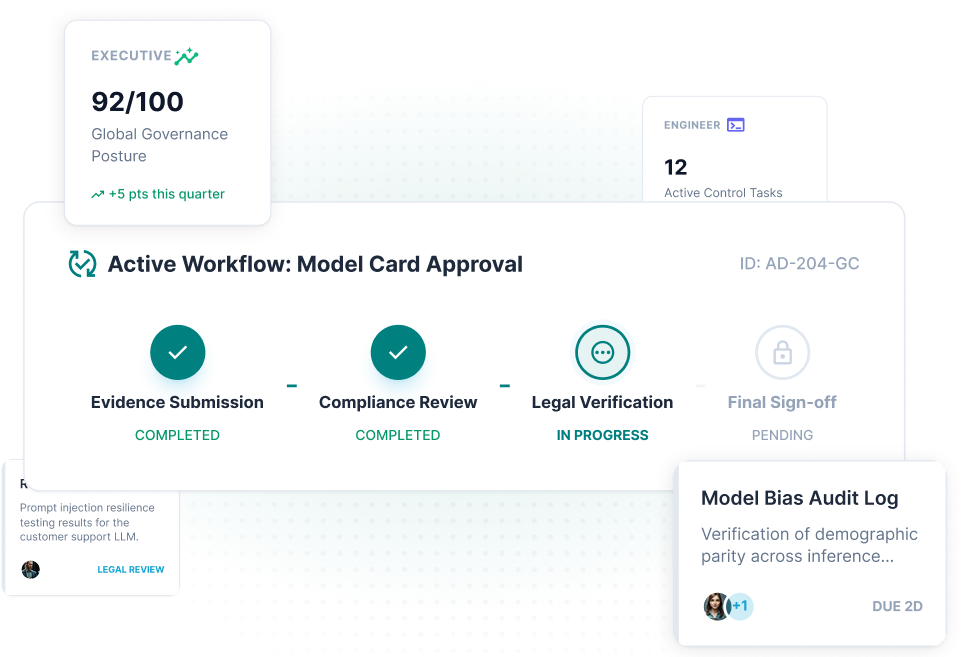
Multi-Stakeholder Collaboration Platform
AI compliance involves stakeholders with fundamentally different priorities and expertise. Adeptiv provides a shared workspace that aligns all of them around a single, authoritative compliance record.
- Role-based governance views
- Task assignment & ownership
- Stakeholder approval workflows
Instant · Framework-Specific · Evidence-Linked
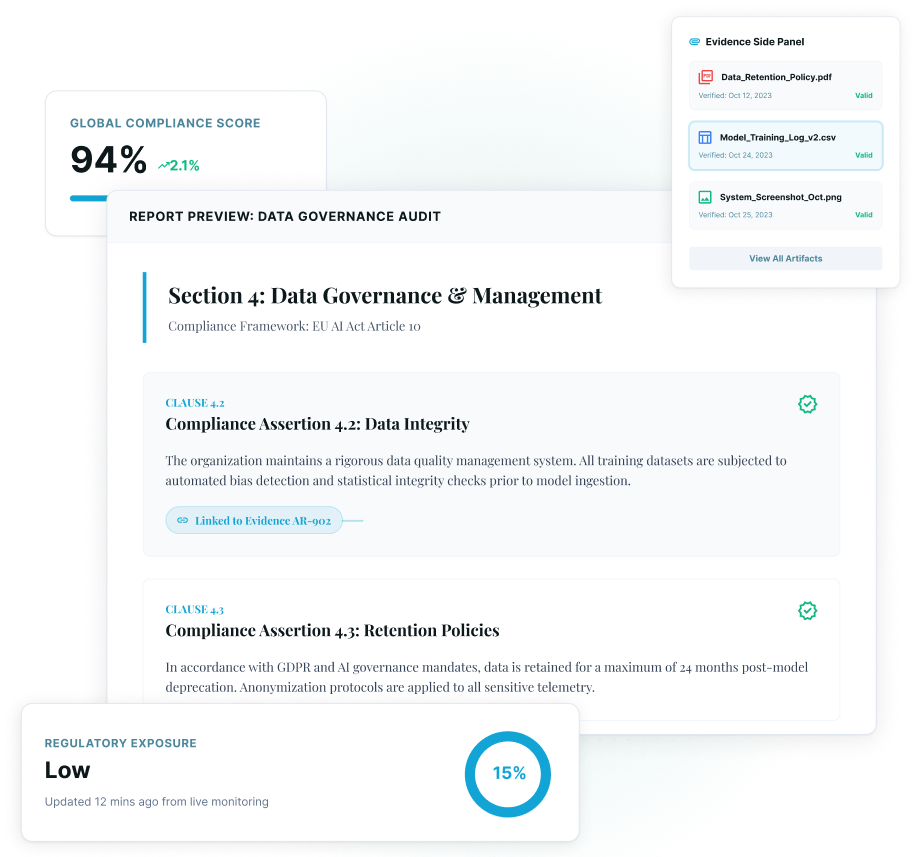
One-Click Audit-Ready Reporting
The most operationally expensive compliance activity assembling audit packages is eliminated. Adeptiv generates comprehensive, framework-specific audit reports on demand.
- Framework-specific report generation
- Executive compliance summaries
- Continuous audit readiness
From Compliance Chaos to Continuous Compliance Intelligence
Regulatory Risk Elimination
EU AI Act fines up to €35M or 7% of global turnover for high-risk AI violations. Brazil AI Act and Colorado AI Act introduce additional jurisdictional exposure.
50–70% Compliance Cost Reduction
Industry benchmarks show compliance automation platforms reduce overall compliance costs by 30–50% versus manual approaches (Comp AI, 2025).
Audit Preparation: Weeks → Hours
Traditional AI compliance audit preparation requires 3–8 weeks of manual evidence assembly, control verification, and documentation.
Competitive & Commercial Advantage
76% of organizations plan to adopt ISO 42001 as their AI governance backbone (CSA, 2025). ISO 42001 certification is emerging as a procurement requirement in enterprise B2B deals.
Turn AI regulatory complexity into a competitive advantage
AI inventory management creates a single source of truth for all AI systems, reducing shadow AI, clarifying ownership, enabling continuous risk monitoring, ensuring regulatory compliance, accelerating audits, and allowing enterprises to scale innovation safely and confidently forward.
frequently asked questions (FAQs)
What is AI Inventory Management?
- AI Inventory Management involves keeping track of all the AI systems, models, agents, data sources, and third-party tools in use throughout an organization. It’s about cataloging and maintaining an up-to-date record of everything related to AI.
Why is AI Inventory Management critical for AI governance?
- You can’t really govern, secure, or audit AI systems unless you're aware of their existence. Having a full inventory of AI tools gives you the essential visibility needed for assessing risks, ensuring compliance, maintaining accountability, and overseeing their entire lifecycle.
What types of AI systems should be included in an AI inventory?
- When it comes to putting together an AI inventory for your business, you’ll want to think about including a few key things. This should cover models you've built yourself, any third-party AI tools you’re using, SaaS applications that include AI, large language models, agents, APIs, plugins, and those AI features that are part of your business apps.
What is Shadow AI, and why is it risky?
- Shadow AI is all about those AI tools that employees or teams start using without any official approval or oversight. The problem is, these tools can lead to issues like data leaks, exposing intellectual property, violating compliance rules, and bringing regulatory risks into the mix.
How does AI Inventory Management support regulatory compliance?
- AI inventory management helps companies stay compliant with regulations like the EU AI Act, GDPR, and ISO 42001. These rules ask organizations to keep records of their AI systems, evaluate potential risks, and show how they’re monitored. Having an AI inventory in place makes it easier to track everything, assign ownership, and be ready for audits.